
BY ANDY WALGAMOTT, NORTHWEST SPORTSMAN MAGAZINE
More than 8,000 bass were electroshocked out of a 9-mile section of the Chehalis River this summer as part of a suppression and abundance study that also aims to estimate how removals of the invasive fish will help reduce predation on native Chinook.
The data also told researchers that there are now more than 1,000 rock, smallmouth and largemouth bass per river kilometer – about six-tenths of a mile – that are large enough to chow down on the young salmon swimming in the Western Washington stream.
The multiyear study performed by WDFW focuses on the Chehalis between the mouths of the Newaukum and Skookumchuck Rivers, where warm summer water temperatures present a persistent core of optimal habitat for bass, and it follows up on bass tagging and tracking there in recent years.
That initial research found baby Chinook represented 15 percent of smallmouth diets in spring and summer, and 41 percent of bronzeback stomachs contained the important salmon species. The bass captured this summer will also be dissected to determine what was in their diet.
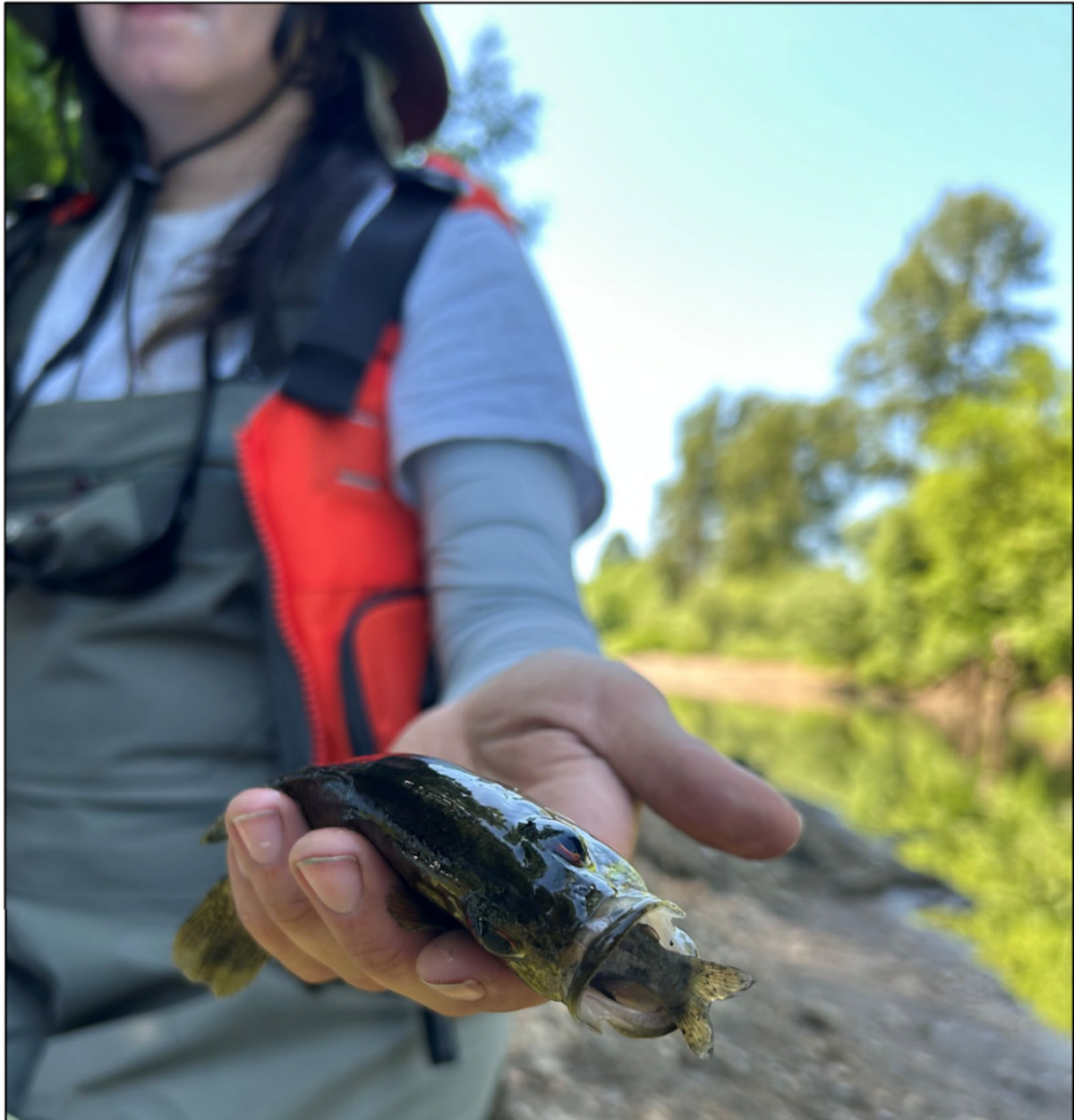
This summer’s efforts also fleshed out more about what species are swimming in the Chehalis near the towns of Centralia and Centralia. Nonnative species comprised about 65 percent of the fish assemblage and native fish roughly 35 percent, according to a 16-page presentation that WDFW’s John Winkowski gave to the Chehalis Basin Board early last month.
Breaking it down further, invasive rock bass represented nearly 40 percent of the fish, native largescale sucker just over 20 percent and nonnative smallmouth north of 15 percent.
Northern pikeminnow – a native salmon predator – along with nonnative largemouth, native peamouth, invasive bluegill and pumpkinseed, native redside shiners, nonnative American shad, and native coho, Chinook and sculpin each represented basically 4 percent down to 2 percent, and in that order.
Other species detected in small numbers included nonnative yellow perch, brown bullhead, black crappie and carp and native steelhead, three-spined stickleback, Pacific lamprey, cutthroat and Olympic mudminnow.
Of the 8,276 bass that were removed over 45 sampling days and 250 hours of electrofishing from June through September, there were 917 rock bass and 626 smallmouth deemed large enough to eat young salmon. The rest – 3,368 juvenile rock bass and 3,365 juvenile smallmouth – were less than 100 millimeters long, or about 4 inches.
Researchers report they believe they removed 7.5 percent of the estimated 12,204 100mm-plus-long rock bass and 25.6 percent of the 2,449 100mm-plus-long smallmouth in this stretch of the Chehalis.
They plan to crunch the numbers to better estimate the nonnative predators’ impact on Chinook mortality. More suppression and analysis is also scheduled for 2027 and 2028.
“Over the next several years, WDFW will continue monitoring fish populations, analyzing diet samples, and evaluating whether bass suppression can improve survival for juvenile Chinook salmon,” stated the Office of the Chehalis Basin in a November update emailed out today and where the results were first reported.
The board is coordinating work to reduce flood damage and restore salmon and other species in the watershed, the Westside’s second largest.
“The study will help managers better understand the role predation plays in salmon recovery and determine whether bass suppression can complement the habitat restoration work already underway through the Aquatic Species Restoration Program,” the board added.
The work is supported by Trout Unlimited.
“Bass are especially of concern because of their pervasiveness, high consumption of salmon and steelhead smolts, and the fact that they get far less attention than other pressures on salmon and steelhead populations like fisheries, habitat or dams,” Alexei Calambokidis, TU’s Washington policy director and member of the Washington State Invasive Species Council, told us last April. “Zeroing in on bass in the Chehalis – it’s a major unaddressed cut in a system that is already struggling especially for Chinook and steelhead.”
Smallmouth as well as walleye are also a growing concern in the Snake River where Washington, Oregon and Idaho come together, and smallies in Western Oregon’s Coquille River are the subject of electrofishing that had removed almost 40,000 as of summer 2025. And last year, USGS and the Yakama Nation assessed whether removing smallmouth from the Yakima River would improve salmonid smolt survival.