
BY ANDY WALGAMOTT, NORTHWEST SPORTSMAN MAGAZINE
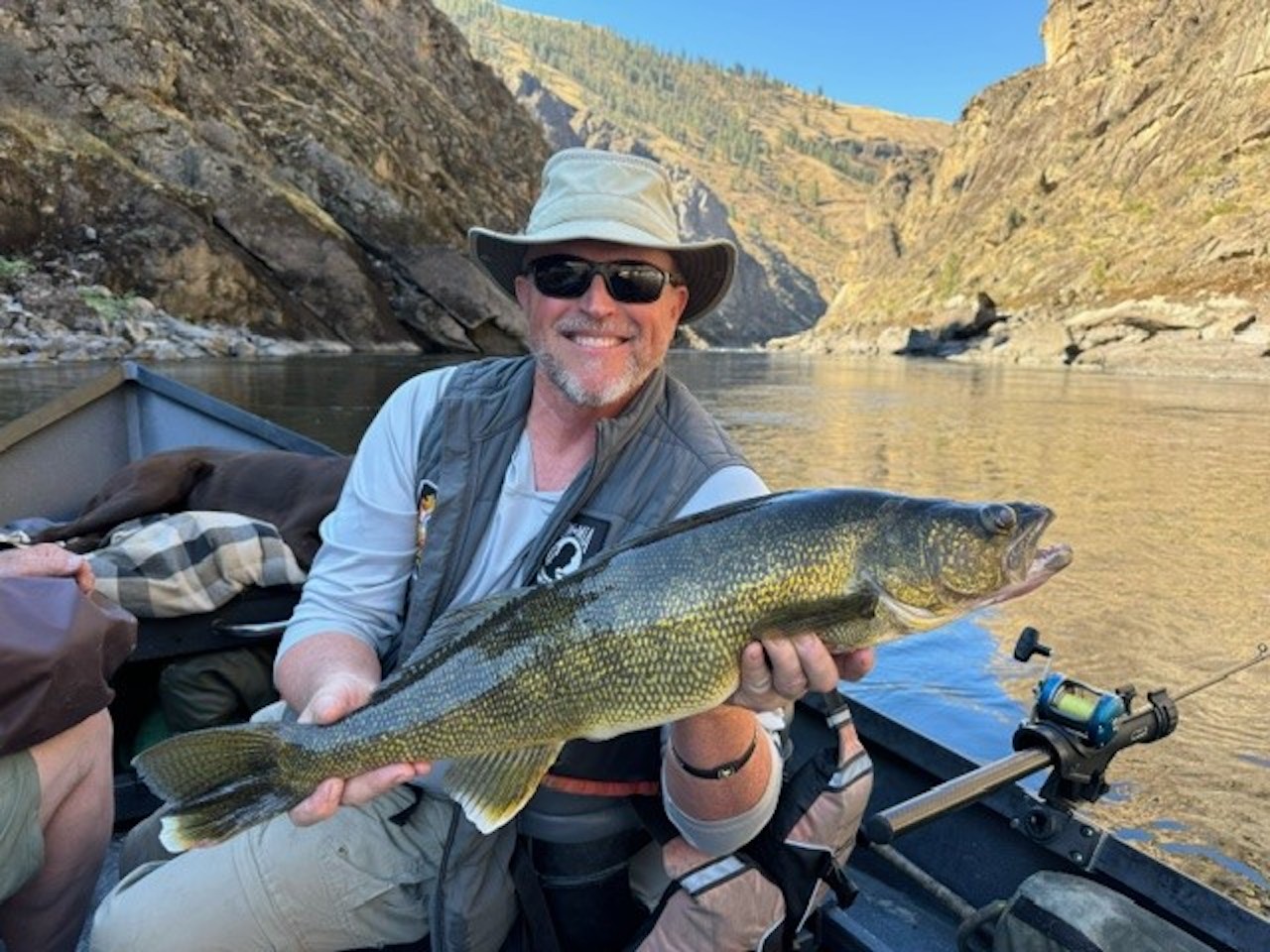
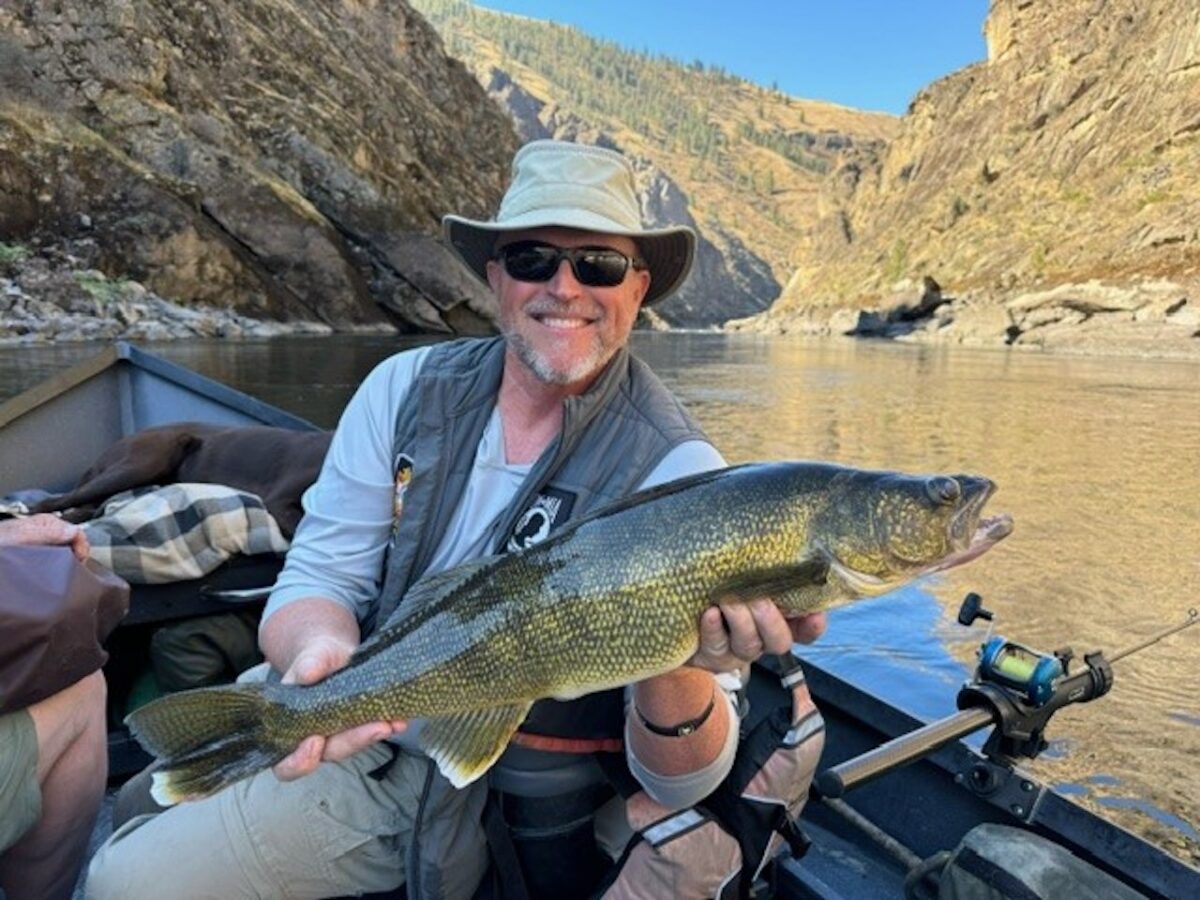
Walleye are now piscis non grata on a 140-mile stretch of Washington, Oregon and Idaho’s Snake River.
That’s the nut of a recently revealed tri-state policy statement as the nonnative species colonizes more and more of the watershed, threatening salmon and steelhead populations.
“Idaho, Oregon and Washington (three States) consider walleye in the Snake River reach between Lower Granite Dam and Hells Canyon Dam as an incompatible species with native salmonids. The presence of walleye within this reach compromises salmon and steelhead recovery. In response, the three States plan research and management actions aimed at reducing the walleye population. To help support these efforts, we encourage anglers to harvest the walleye they encounter,” reads the new policy from ODFW, IDFG and WDFW.
The policy appears to have first been made public during a 21/2-hour-long “Walleye Panel” before the Fish and Wildlife Committee of the Northwest Power and Conservation Council on October 14. It was first reported on by Northwest Public Broadcasting and then News Data.
It’s notable because all three states otherwise consider walleye to be a game fish – one that is quite popular with some anglers throughout the region. But with the policy they are essentially declaring the waters of the greater Hells Canyon region a place walleye will not be tolerated and laying the groundwork for the development of rigorous, scientific suppression programs.
The origin of the walleye policy can be traced back to October 2022 and reports of surging numbers of the fish at Lower Granite Dam on the Snake near Pullman. Idaho fish managers publicly began sounding the alarm about the increasing overlap of walleye with salmon and steelhead spawning and rearing waters.
In early 2024 it led to the formation of a joint-agency walleye work group that has since grown to over 40 people from a dozen state, tribal, federal and NGO entities, according to Idaho Fish and Game’s Marika Dobos.
Dobos was among those briefing the committee. Others included WDFW scientist Andrew Murdoch and OSU professor Jonathon Armstrong, who presented on research they published earlier this year about how a changing food web in the Snake is providing a year-round buffet for walleye, supercharging their growth.
There was also a wrap-up discussion with Idaho experts about how suppression programs have worked elsewhere and a call to action.
“We all need to work together, or this is going to eat our lunch,” exhorted Ed Schriever, who chairs the committee.
It’s a problem that didn’t seem like it would eat much lunch when it first knocked on the door – but now does.
The first walleye turned up in the Lower Granite salmon and steelhead fish trap in 2016, and for the first few years only a dozen or so followed each year.
But by 2022 walleye were not only being seen in the trap, but Northern Pikeminnow Sport-Reward Program participants at the Boyer Park station below the dam turned in 12 times as many as the year before, and IDFG reported one was caught 80 miles upstream on the Salmon River at Riggins.
Fast forward to 2025 and the number of walleye trapped at Lower Granite was six times larger than 2022, and what’s more they are showing up earlier and earlier in the year.
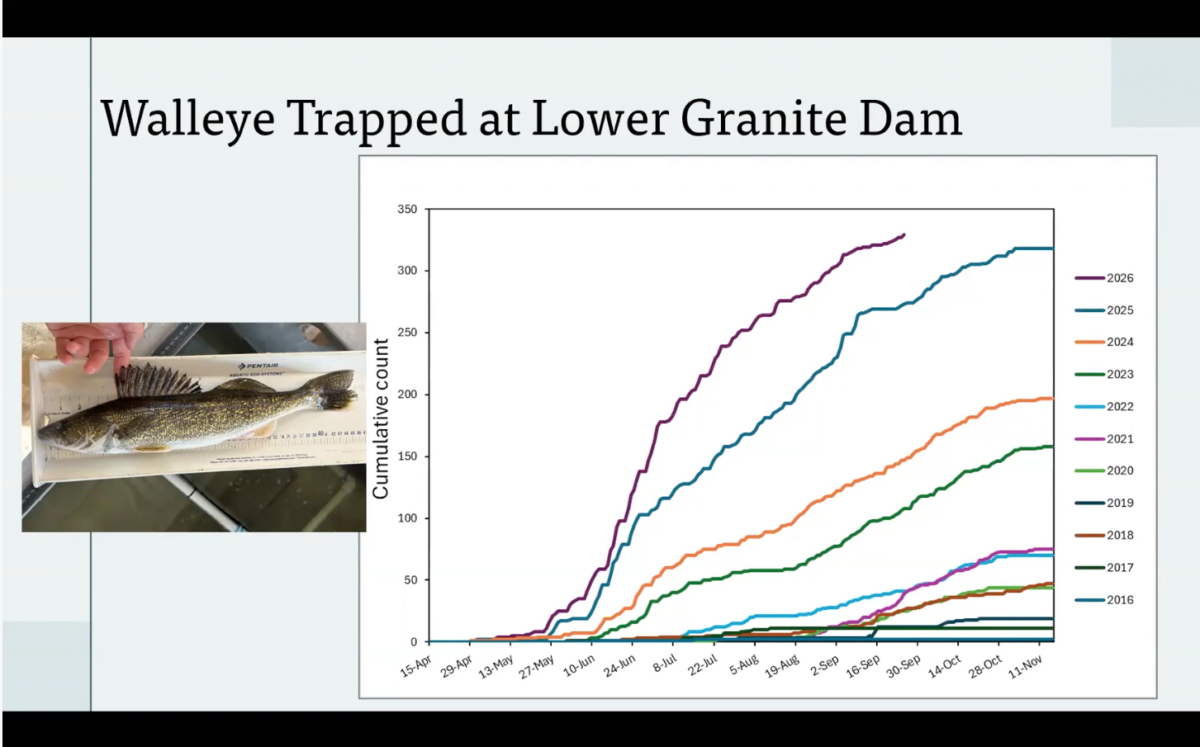
“We’re sitting at pretty close to 350 walleye (trapped) this year alone. There is no indication that is slowing down. Abundances are increasing,” Dobos told the committee.
Extrapolating from a previous study that PIT-tagged and released some walleye at the dam to help figure out how they were using the structure and locks, this year’s 350 walleye are believed to represent just 5 percent of how many are actually swimming into the fish ladder, according to Dobos.
“That’s a pretty alarming number and a pretty alarming rate that we are continuing to see increase,” she added.
That said, she noted that only a portion of the walleye that swim into the ladder successfully exit it, and that alterations to the system could also help limit their upstream movement. Walleye also seem to entrain back downstream with runoff.
But not all do. There are also barging locks at Lower Granite they can use, and walleye have now been caught all the way up to the base of Hells Canyon Dam and in the lower Grande Ronde and Clearwater Rivers.
“People are catching a lot more of them, they’re a sizable fish, and their distribution is expanding,” Dobos said.
Smallmouth bass are also increasing in the Snake, another presenter shared, and the rise of the pair of predators comes at a time that wild steelhead smolt survival in multiple monitored Idaho basins is declining.
“There are a lot of factors that can affect survival of these juveniles once they leave these tributary systems,” Dobos allowed. “However, the information that has been presented to you showing the increase in smallmouth bass and walleye is an indication that these predators are likely a big contributor to this decline in our wild steelhead.”
She said other longterm programs monitoring juvenile wild steelhead and Chinook are also seeing decreasing survival over the last 10 years.
“So there are lot of indicators that this problem is persisting, it’s getting worse, and we need to think about what sort of actions need to be taken to decrease that predation risk,” Dobos said.
To be abundantly clear, walleye and bass aren’t the only problem for young sea-going fish. PIT tag recoveries show that American white pelicans, gulls and herons readily scarf down baby salmon and steelhead, Jason Vogel, director of fisheries research for the Nez Perce Tribe noted during his presentation to the committee.
But managers’ ability to deal with birds without lethal removal permits is also limited, and flocks quickly learn to ignore hazing.
“The problem with American white pelicans, I have some data, is that we can haze them off of a certain spot, they just fly downriver and land, and they go down and they come back. And now they’re getting really smart. Our hazing efforts, you can shoot … bottle rockets at them, they don’t care anymore, so they’re not very easily moved or dissuaded,” Vogel said.
That is pushing managers towards addressing walleye.
While lamenting the loss of longterm funding for piscine predator control when the Trump Administration unilaterally backed out of the Resilient Columbia Basin Agreement, Vogel noted that there was still some money available to begin gillnetting in select areas and with certain mesh sizes to avoid salmonids. A photo he shared showed crews caught some nice-sized walleye earlier this year; the species made up the plurality of the catch in the Lyons Ferry, Central Ferry and Lower Granite Dam tailrace areas, though not at the Snake-Clearwater confluence.
Vogel also called out some “really interesting results” from a gillnet set at the mouth of the Tucannon River: 56 walleye that had also consumed PIT-tagged fish from an array of programs and hatcheries.
They’d eaten summer steelhead from WDFW’s Tucannon hatchery; spring Chinook from IDFG’s Rapid River and ODFW’s Lookingglass Hatcheries and a trap on the Grande Ronde; and sockeye from IDFG’s Springfield Hatchery for Redfish Lake.
“This was really an eye-opener for us,” said Vogel. “First off, there’s a lot of walleye down there, and second, the prey items that they had represented fish from all over the place.”
Asked by a Fish and Wildlife Committee member about how many smolts each of those PIT tags represented, Vogel said that it expanded to a range from 50 to 200 or 400 fish per tag.
It all has Nez Perce fishery managers thinking about what they can do to protect salmon and steelhead and address the emerging threat from walleye.
“We are talking about doing some walleye potential bounty for gillnets for tribal anglers and paying for walleye to be brought in from those. That’s one thing we’re thinking about doing,” said Vogel, adding that that could compliment other agencies’ actions.
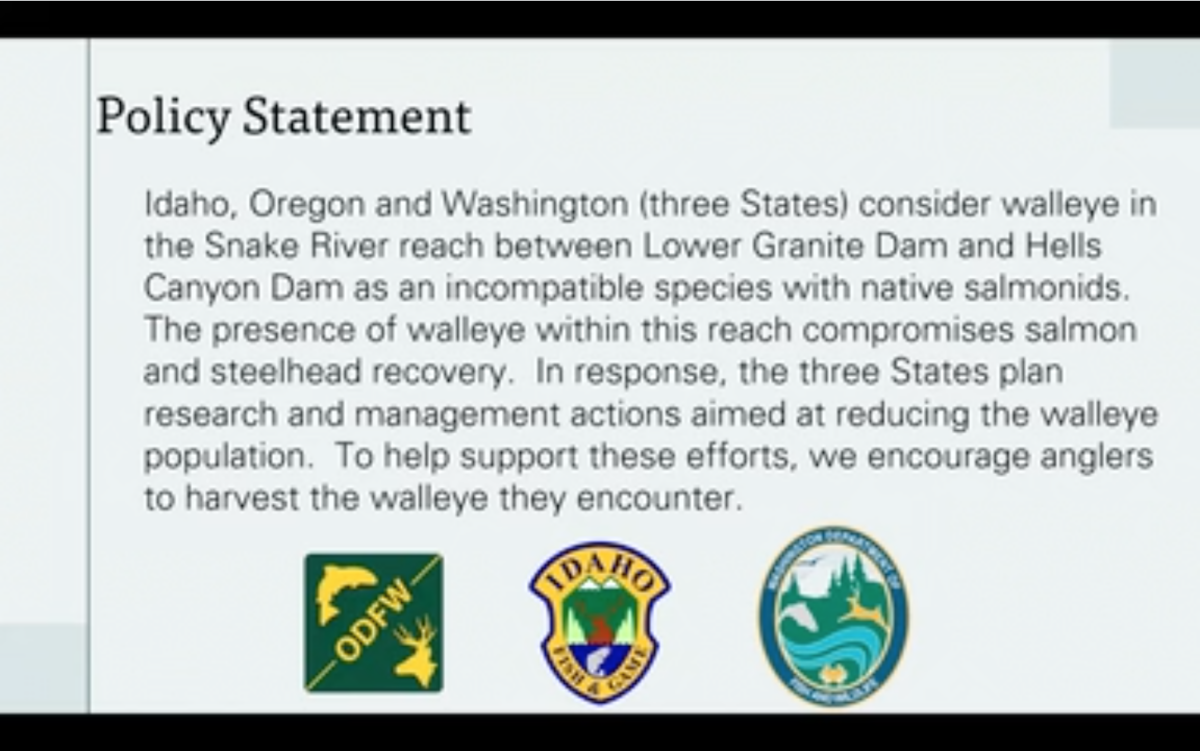
Dobos also spoke to accomplishments of the walleye work group, including the creation of the policy statement that walleye between Lower Granite and Hells Canyon Dams are “incompatible” with Chinook, A- and B-runs, coho and sockeye, among other species.
“We needed to have this support to continue doing the efforts and pursuing some of the goals that we wanted to achieve,” she explained. “And so state managers from Oregon, Idaho and Washington got together and started working through a statement that was going to be submitted to leadership staff in these three state agencies to see if we can get support … The fact that we have support at the policy level for these three states kind of gave us permission to continue on the work we started doing as a working group, at least in the lower Snake River basin.”
“Just a footnote: It was pretty challenging to get to that point. It’s a lot more challenging than you think trying to get on the same page with regards to this because of a lot of complications,” Dobos added.
Other work group achievements included PIT or floy tagging hundreds of walleye handled in the Little Goose and Lower Granite Pools by researchers to better figure out fish movements and how many are being caught by anglers.
She said of 285 floy-tagged walleye in the two pools, 29 – 10 percent – have been caught and reported so far by anglers.
“There is interest, we’re starting to get information on it, there’s some good promise we’re in the steps in the right direction,” she said.
And Dobos included a slide titled “Having the Hard Discussions,” which is where the rubber is going to meet the road on all this.
The slide asked if changes could be made to Columbia Basin predation programs, and what sort of management tools that might include – regulations; suppression; incentive.
“We often talk about these three being how do we change regulations to get anglers to harvest more fish, in this case, what level of suppression and what kind of methods need to happen to reduce this walleye population, and will an incentivized program like they have with the northern pikeminnow program work in this case for walleye? There are still a lot of unknowns, there are still a lot of hard discussions to be had, but I’m encouraged where I’m at with the working group and the progress we’ve made to this point,” she said.
The presentations by Dobos, Vogel, Murdoch and Armstrong led into a broader discussion about next steps.
“The key to an effective suppression program, if that’s the route the basin decides to head down for something like walleye, or anything else, frankly, that we perceive as a piscine predation threat, is that you have to base it in solid science. And in order to do that you kinda have to be all in on both sides of things. You have to have the robust research to be able to inform and then adaptively manage the suppression program, which also has to be all in,” advised Matt Corsi, IDFG research fishery manager.
Suppressing fish populations isn’t a new thing for the Northwest. The pikeminnow program on the Columbia and Snake is three and a half decades old, while IDFG has been working on Lake Pend Oreille to reduce lake trout. Mike Quist, a USGS scientist based at the University of Idaho, stated that it would be more complicated with walleye, which he said have a more diverse life history than Mackinaw.
It was a lot to mull for members of the Northwest Power and Conservation Council’s fish and wildlife subcommittee, including Chair Schriever.
“This is a place where the council has before and I hope can again help get a group together to have a shared understanding of what we need to know, how we need to know it,” he said. “I love the policy statement that the three states got together. I would guess the region’s tribes agree with that – they want to fish for salmon and steelhead more than they do walleye.”
At the same time, Schriever also recognized what walleye fishing has become in the Northwest and that there would be pushback from that segment. The Columbia system is a destination for anglers from the species’ native range, the Upper Midwest, and a fishery that anglers and guides can lean on when salmon and steelhead aren’t running or are shut down for yet another low return.
“I get that there are social concerns. These walleye fisheries are tremendous. There’s a lot of fishing guides that are making good money taking people walleye fishing. That’s a sad state of affairs, in my opinion. They should be making good money taking people salmon and steelhead fishing. So you’re going to have public support for walleye fishing because people are making money off of it, and they’re going to come tell you … ‘Maybe salmon are a lost cause, maybe we should just invest in walleye and just go forward.’ You find people who will support feral hog hunting. It is not in the best interest of hunting across our great states. People are always going to be able to find things that they don’t want you to do, but collectively we need to get the stomach for what we’re up against, and I think the first place is the knowledge of what we’re up against,” he said.
Schriever said it was critical to understand the relative importance of smolt predation by walleye so as to “make decisions about what do we do, when do we do it and how much do we spend on it.”
“I don’t think we can fiddle as Rome burns,” he quickly added. “With the information you all are showing us about trends in abundance and what they eat and when they eat it, we’re late to the party. Where do we go from here? I wish I had the answers.”