BY ANDY WALGAMOTT, NORTHWEST SPORTSMAN MAGAZINE
Sportsmen are pushing back against the federal government’s announcement this week that it is taking steps to totally remove Roadless Rule protections on tens of millions of acres of national forests in 10 primarily Western states including Washington and Oregon.
It comes at the same time that hunting and fishing opportunities just were increased markedly on the national wildlife refuge system and at national fish hatcheries, but if the feds thought that would quiet all hunters and anglers on this front, they were mistaken.
While you won’t see hair-on-fire headlines like this one Tuesday from an environmental coalition – “Conservationists Blast Federal Proposal to Bulldoze Forestlands” – some sportsmen are still torching a primary argument behind rescinding the Roadless Rule.
And they’re calling out how it might impact the remaining large blocks of unlogged, undeveloped big game, fish and wildlife habitat, as well as their backcountry hunting and fishing grounds, once local forest managers begin OKing new road building and clearcuts.
Yesterday, in announcing the proposed rule and month-long comment period on the supporting draft environmental impact statement, the Trump Administration’s US Forest Service Chief Tom Schultz leaned into claims that active forest management of these unroaded public lands was essential because more than 40 percent had “high or very high wildfire hazard potential” and just 5 percent of that ground had seen fuels-reduction projects the past dozen years.
“Acting now, thoughtfully and decisively, is the best way to restore the balance, reduce wildfire risk, and secure the long-term health of our forests and neighboring communities,” Schultz said in a press release.
True, some of this summer’s Northwest wildfires began burning in roadless areas – the Three Queens, Paradise and Hagen conflagrations – but other blazes only burned into them after ignition occurred well outside – Sinlahekin, Grasshopper, Rowe Creek Complex – and with plenty of roads in between.
And while roads would indeed increase access for firefighters, they might also lead to far more blazes down the road.
Well-respected Outdoor Life hunting and conservation editor Andrew McKean writes that “a peer-reviewed study of fire ecology published in January that reviewed 30 years of data concluded that wildfires are nearly four times more likely to start near roads than in roadless areas.”
No doubt lightning starts more than a few fires, but so do humans, carelessly and otherwise – some 88 percent of wildland blazes, per onX, a mapping app hunters and anglers use to figure out land boundaries, and 90 percent occur within half a mile of a road, according to the company.

The feds argue that the quarter-century-old Roadless Rule has “restricted road construction and limited the Forest Service’s ability to carry out critical active management work within inventoried roadless areas … The rescission is intended to prioritize local agency decision-making over regulatory rules that are the same across the country, regardless of specific land management issues and needs.”
However, Backcountry Hunters and Anglers said that poses a threat to “some of the country’s most productive hunting and fishing habitat and to the taxpayers and rural communities who would bear the cost.”
“This isn’t a bureaucratic footnote – it’s the wholesale elimination of protections for the backcountry habitat hunters, anglers, wildlife, and rural communities depend on,” said Ryan Callaghan, BHA president and CEO, in a press release. “The Roadless Rule works. It provides quality habitat for big game, keeps trout streams cold and clean, and keeps taxpayers from footing the bill for thousands of miles of new roads that the Forest Service can’t afford to maintain.”
According to an onX analysis, 99 percent of roadless acres in Wyoming serve as elk habitat, 96 percent of Arizona’s as mule deer habitat. Per a recent Trout Unlimited report cited by Field & Stream, bull elk hunting success in the Cowboy State is 10 times better in roadless blocks than ones thick with roads.
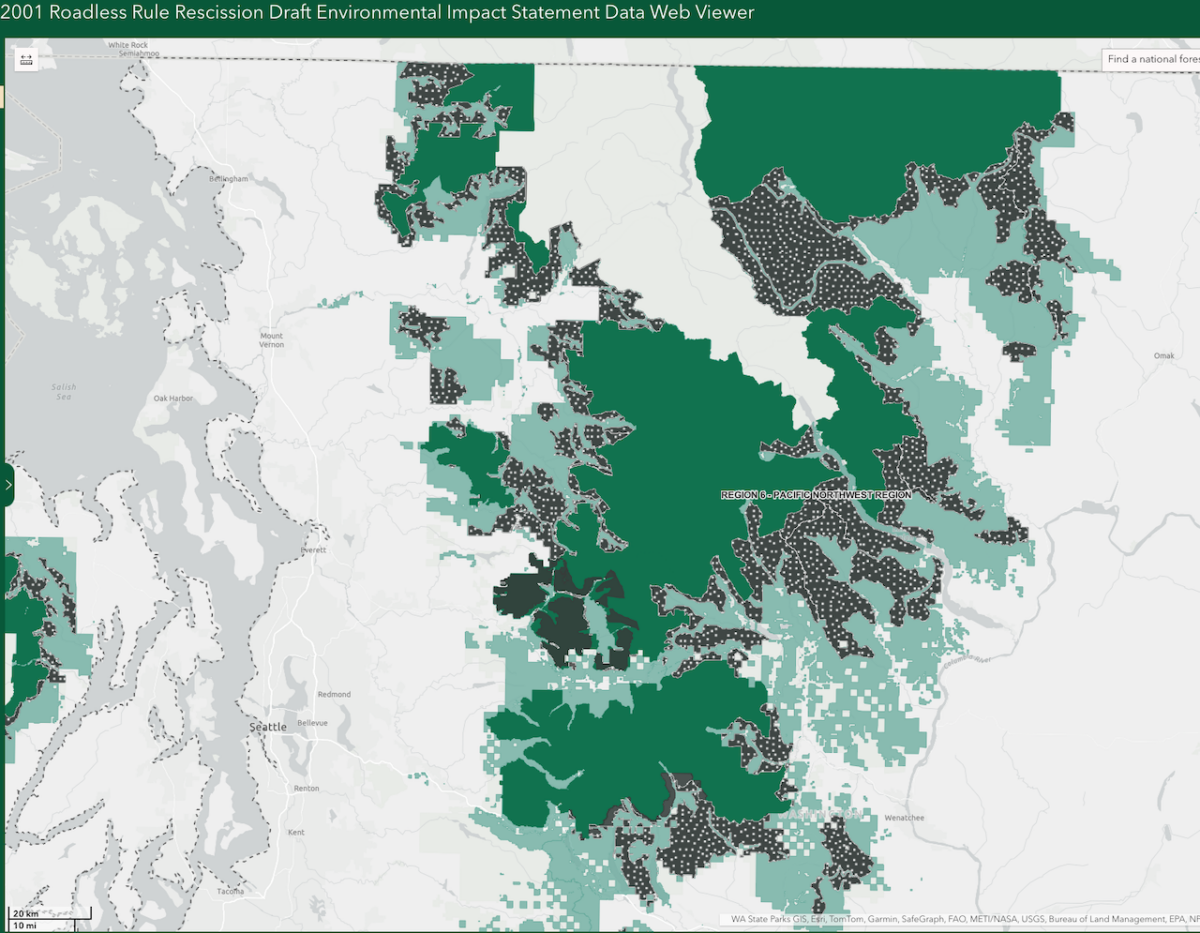
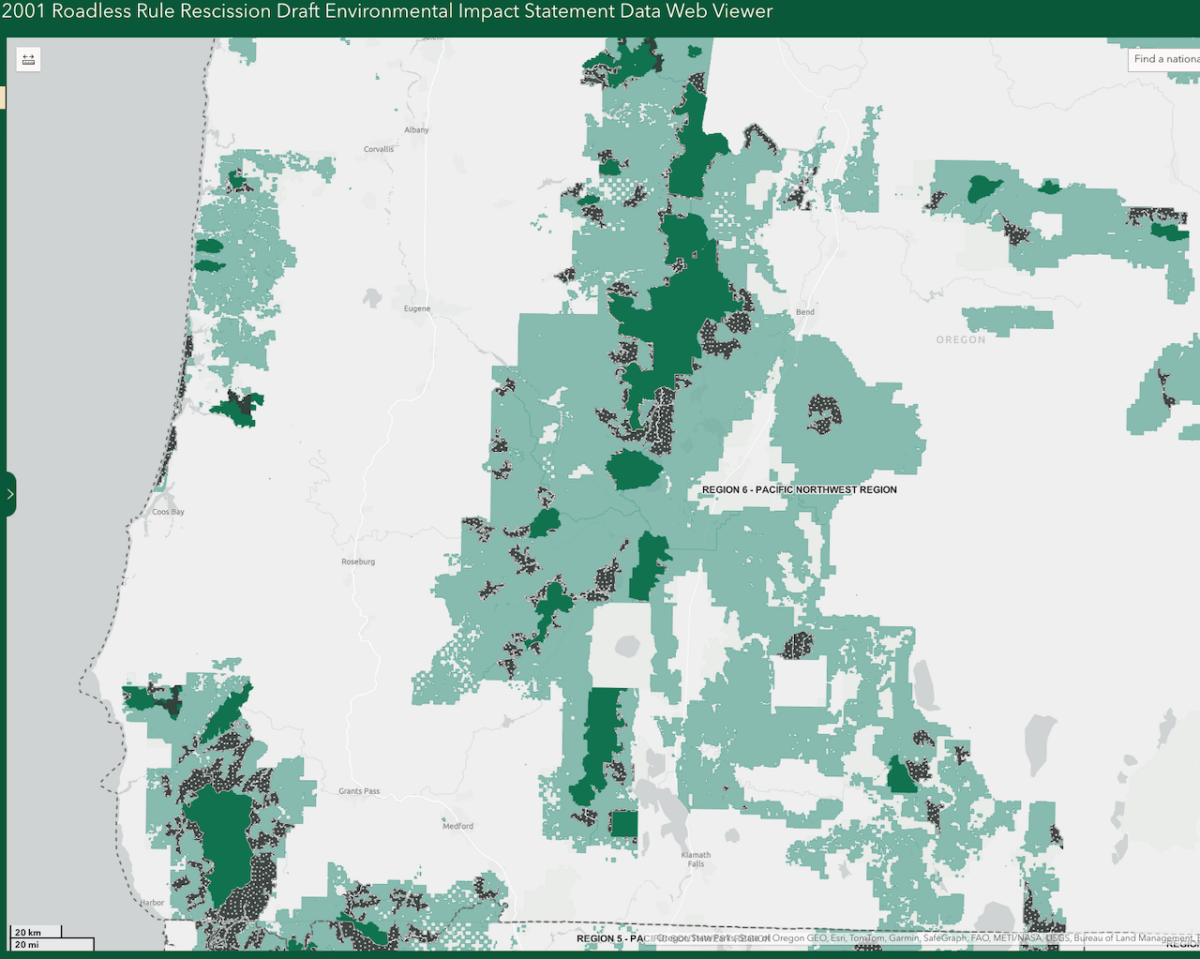
The rule change would affect 2.015 million acres in Washington and 2 million acres in Oregon, it has been reported.
A GIS map posted online by the Forest Service shows national forest lands in both states potentially affected by rescinding what’s officially known as the 2001 Roadless Area Conservation Rule.
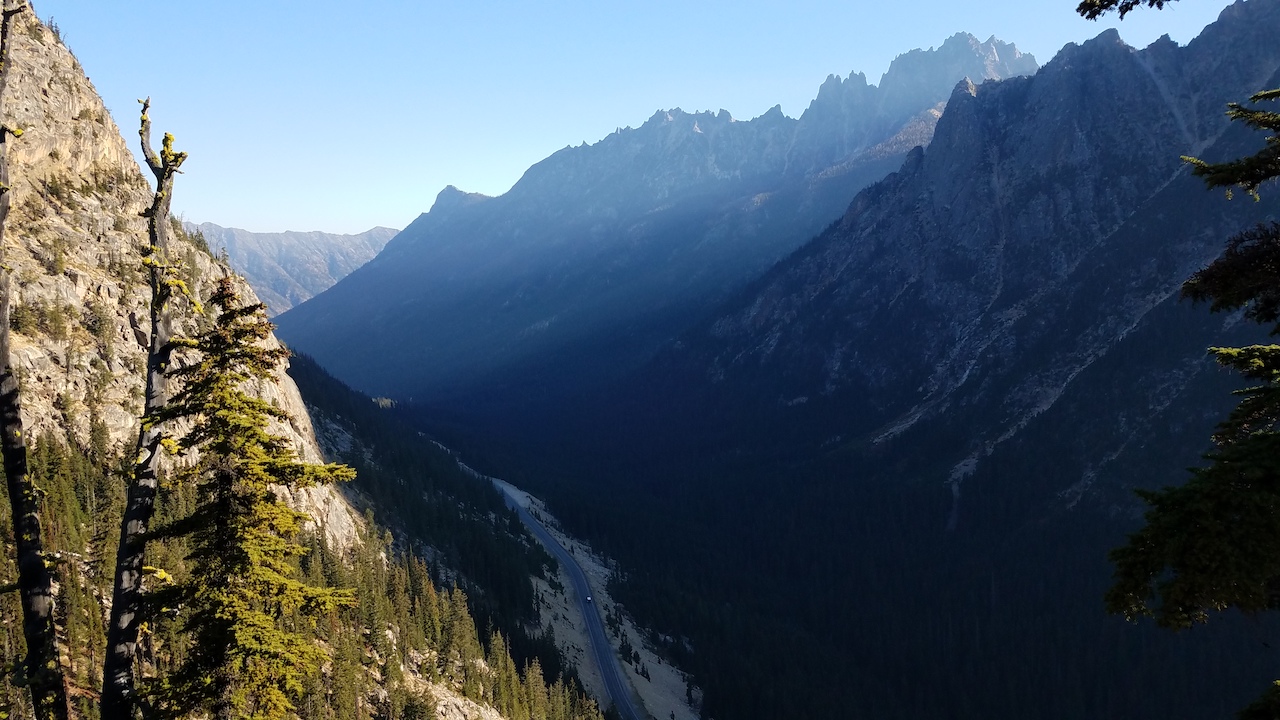
Much of it pads the borders of existing federal wildernesses, but there are also large areas above the North Cascades Highway corridor (the Liberty Bell Roadless Area), the Tiffany Mountain area (Long Swamp RA) of Okanogan County, Tyee Ridge and Mad River watershed (Entiat RA) of Chelan County, the Teanaway of Kittitas County, Kettle Range (Profanity, Bald Snow and Twin Sisters RAs), Dark Divide of Skamania County, portions of the upper Nestucca River (Hebo 1a RA) in Tillamook County and above the Snake River (Lord Flat Somers Point RA) in Wallowa County.
“These landscapes also sustain hunting, fishing, and other outdoor recreation that contributes to local economies,” pointed out David Dreher with the National Wildlife Federation. “The administration chose to divide what could have been bipartisan support to instead wholesale eliminate an important conservation safeguard. This was a missed opportunity to have cross jurisdictional consensus to improve the 2001 rule, protect habitat, and reduce wildfire risks.”
In his article, McKean spoke to the Roadless Rule’s origins:
“The Roadless Rule was instituted in 2001 as a Clinton Administration limit on construction of new roads and maintenance of existing Forest Service roads in steep, environmentally fragile, or remote areas. Because the Forest Service didn’t have the budget to build or maintain the infrastructure, the decision to designate nearly 45 million acres as roadless was celebrated as fiscally responsible. It has had the added benefit over the past 25 years of maintaining intact big-game habitat, ensuring that headwaters trout streams remain cool, and adding to America’s backcountry inventory.”
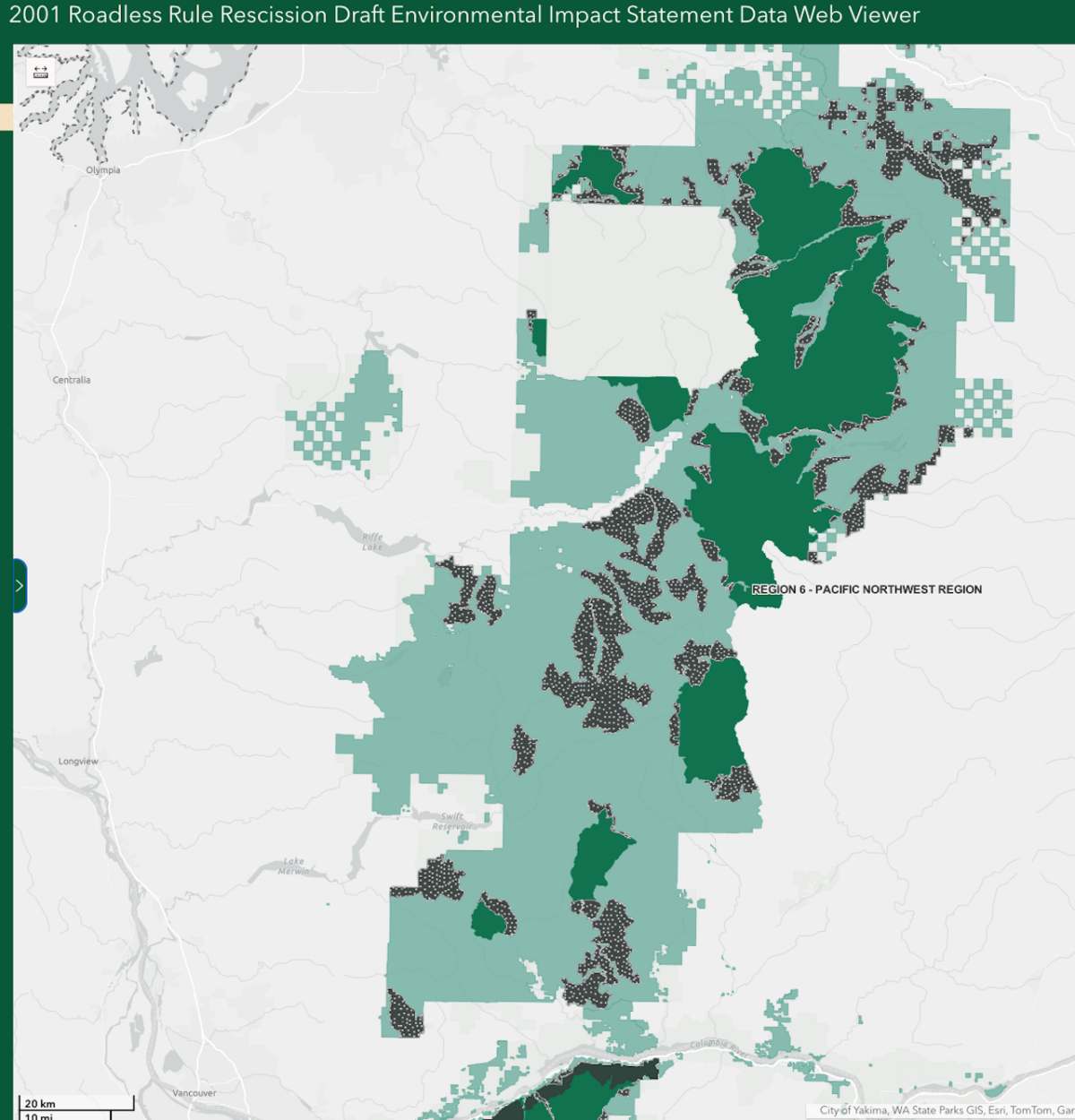
Some areas designated as roadless back in 2001 would be unaffected by the rescission because they have since been moved into federal wilderness status – Wild Sky in Snohomish County in 2008; Roaring River in Clackamas County in 2009, etc.
Because sportsmen are far from a monoculture, there will not be complete agreement one way or the other that doing away with the Roadless Rule is bad or good.
Some might argue new roads will improve access to high trout lakes and other backcountry fisheries. True, but if a reported 90,000 miles of Forest Service roads – in various states of maintenance – in Washington and Oregon already doesn’t provide enough of that, how much would? And how much more silt would development add to salmon and steelhead streams already suffering from a century-plus of mountainside erosion? Is it worth it to extract a few more spindly logs from steep ridges? Is there a market for that wood?
I don’t know the answer to those questions, but I think it would be fair to say that more active forest management would likely increase forage for big game, at least for awhile. But it’s also fair to say that roads are proven to be highly deleterious to elk, and migratory mule deer are already on a long, steady decline in the Northwest and beyond as their habitat is sliced and diced to bits. Roads might provide a short-term boon for hunting, but that would probably prove illusory after a few years, and they would also bring poachers closer to critical big game summer ranges. Is all that worth it, or should those lands be banked as habitat and refugia? Is a case-by-case basis better than a blanket?
For some sportsmen, this will amount to another major clash with their own party. Last year saw US Senator Mike Lee (R-Utah) attempt to sell off public lands, ground that is so important to fishing and hunting, and fish and wildlife, before it was turned back by hunters, anglers, hikers, campers, wildlife watchers, Republicans, Independents, Democrats, red states, purple states and blue states.
This week’s Roadless Rule announcement also provided fresh resolve to Sportsmen for Wild Olympics to push for setting aside 126,500 acres of the Olympic National Forest as wilderness and wild rivers and to push back against the rescission.
“Just like what they did to the Boundary Waters, rescinding the Roadless Rule is yet another attempt to give away our public lands to private special interests – at the expense of salmon, clean water, and future generations,” said Ashley Nichole Lewis, SWO member and a Quinault Indian Nation fishing guide. “But since their comment period last fall, sportsmen support for Wild Olympics has poured in as these threats mount. Thousands more hunters and anglers have joined our ranks and our SportsmenForWildOlympics.org/endorsements from major sportsmen organizations and brands grew by more than 35 percent. We plan to mobilize all of our new support during the upcoming comment period to fight this.”
Already in this rescission process, which began a year ago, 99 percent of some 625,000 public comments have supported keeping roadless rule protections, according to TU, but now we go again.
In pointing out the benefits of backcountry for critters and humans and calling for an approach that helps reduce fire risk, Michael O’Casey, the Teddy Roosevelt Conservation Partnership’s director of public lands, tweeted, “We encourage the Forest Service to craft a durable outcome that creates additional management flexibility to protect communities from wildfire while maintaining the conservation values of the backcountry. We view the longstanding Idaho and Colorado roadless rules as successful models that could help inform a solution.”
An action alert from BHA says that the Roadless Rule “already provides flexibility for fuels treatments and other management activities WITHOUT requiring permanent new roads” (emphasis theirs).
Input on the proposed rule and accompanying DEIS is open through midnight September 21.
For more information, see the Forest Service’s page on Roadless Areas.