BY ANDY WALGAMOTT, NORTHWEST SPORTSMAN MAGAZINE
Documents posted to a federal rule-making website provide sharper details about proposed hunting and fishing expansions on national wildlife refuges in the Northwest.
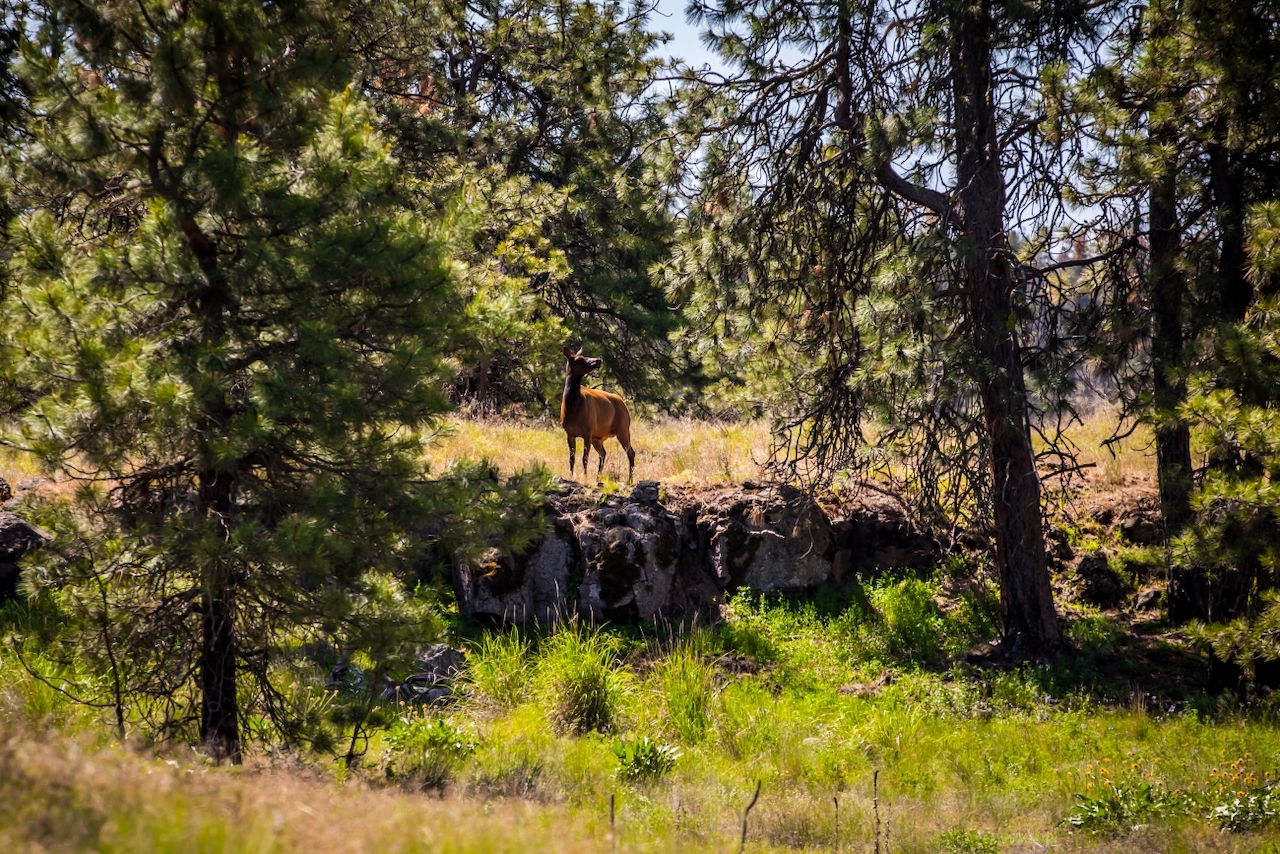
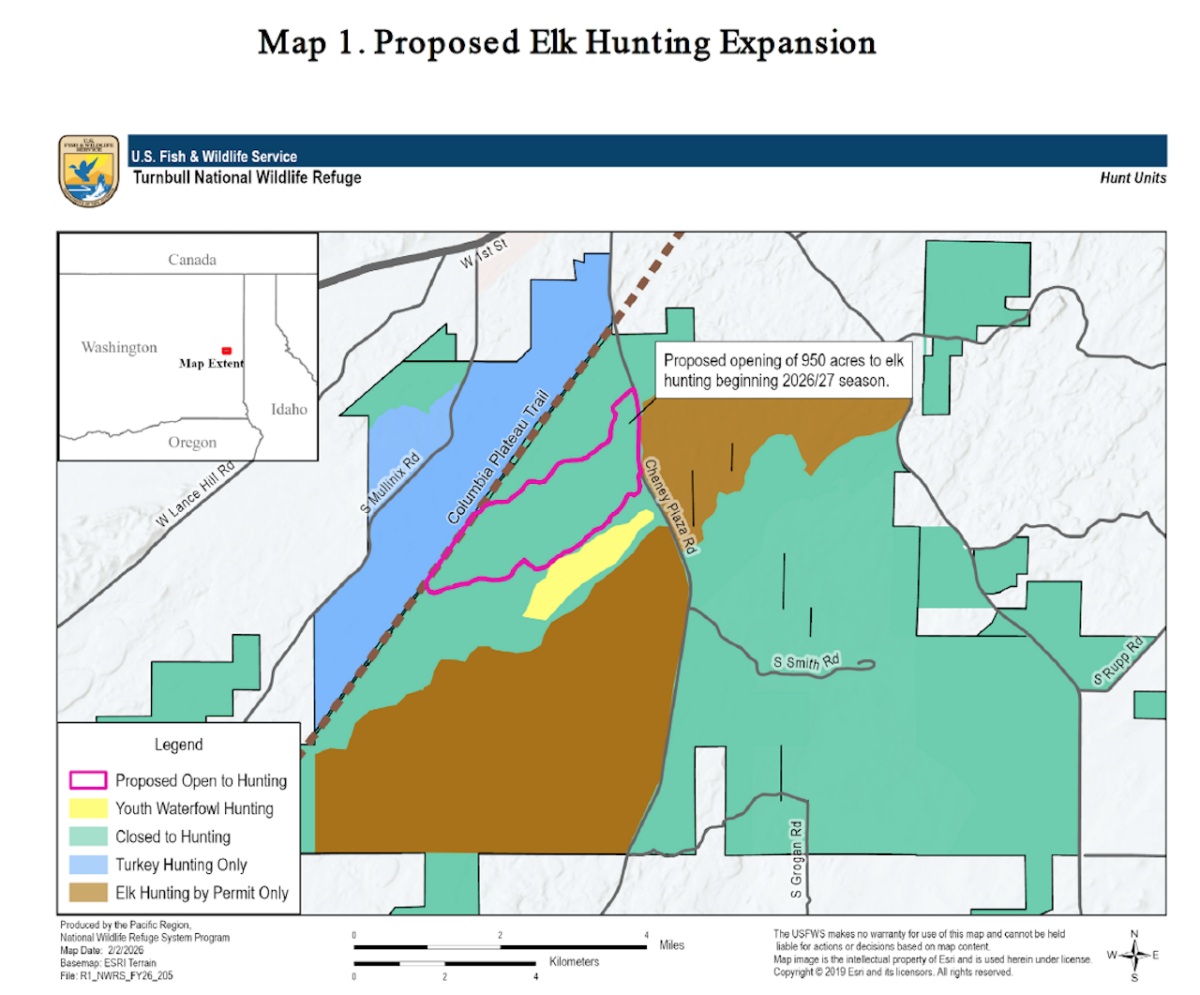
For instance, at Turnbull NWR outside Spokane, federal managers are proposing to open 950 acres for elk hunting – which would add to the 5,343 acres already open there for wapiti – in the Northwest Unit between Cheney Plaza Road and the Columbia Plateau Trail. Hunting is draw only via WDFW special permits and meant to help limit the impact of elk on refuge habitat.
And in Southern Oregon, they would allow waterfowl hunting on roughly 4 square miles of newly restored wetland at Upper Klamath NWR.
It’s the latest round in a series hunting and fishing opportunity increases over the past decades or so from the powers that be in Washington, DC, and from both sides of the presidential aisle.
This go-around from the Trump Administration also comes with a change of mindset, per se, from refuges being closed unless open to open unless closed. Andrew McKean at Outdoor Life dives into that aspect.
Many of the proposals are prefaced with references to Department of Interior Secretarial Orders to open new hunts on refuges, align with state regs, and open new acquisitions.
“Hunting has given many people a deeper appreciation of wildlife and a better understanding of the importance of conserving their habitat, ultimately contributing to the Refuge System mission. There is a long-term benefit to increasing public appreciation and visitor understanding of the importance of habitat conservation,” is a typical explanatory statement managers make in their documentations.
Across the country, 100-plus refuges, hatcheries and other federal units would be affected by the proposals, and in the hook-and-bullet world, any attempt to increase opportunity is much appreciated.
Here in the Northwest, the tweaks range from the solid and why wasn’t this done earlier? …
• the aforementioned new Turnbull elk acreage; opening newly acquired lands at Little Pend Oreille and Julia Butler Hansen to hunting; adding bunnies to the bag in large swaths of Malheur;
… to the meh and did anyone check the calendar?:
• allowing blind-bound bird hunters to take the stray snipe or dove that might fly overhead on the limited days a given refuge is open for waterfowl; opening the take of bandtail pigeons from October through January when the state actually only allows their hunting in September.
But as they say, beggars can’t be choosers, so here’s a closer look at proposals in Oregon, North Idaho and Washington:
OREGON
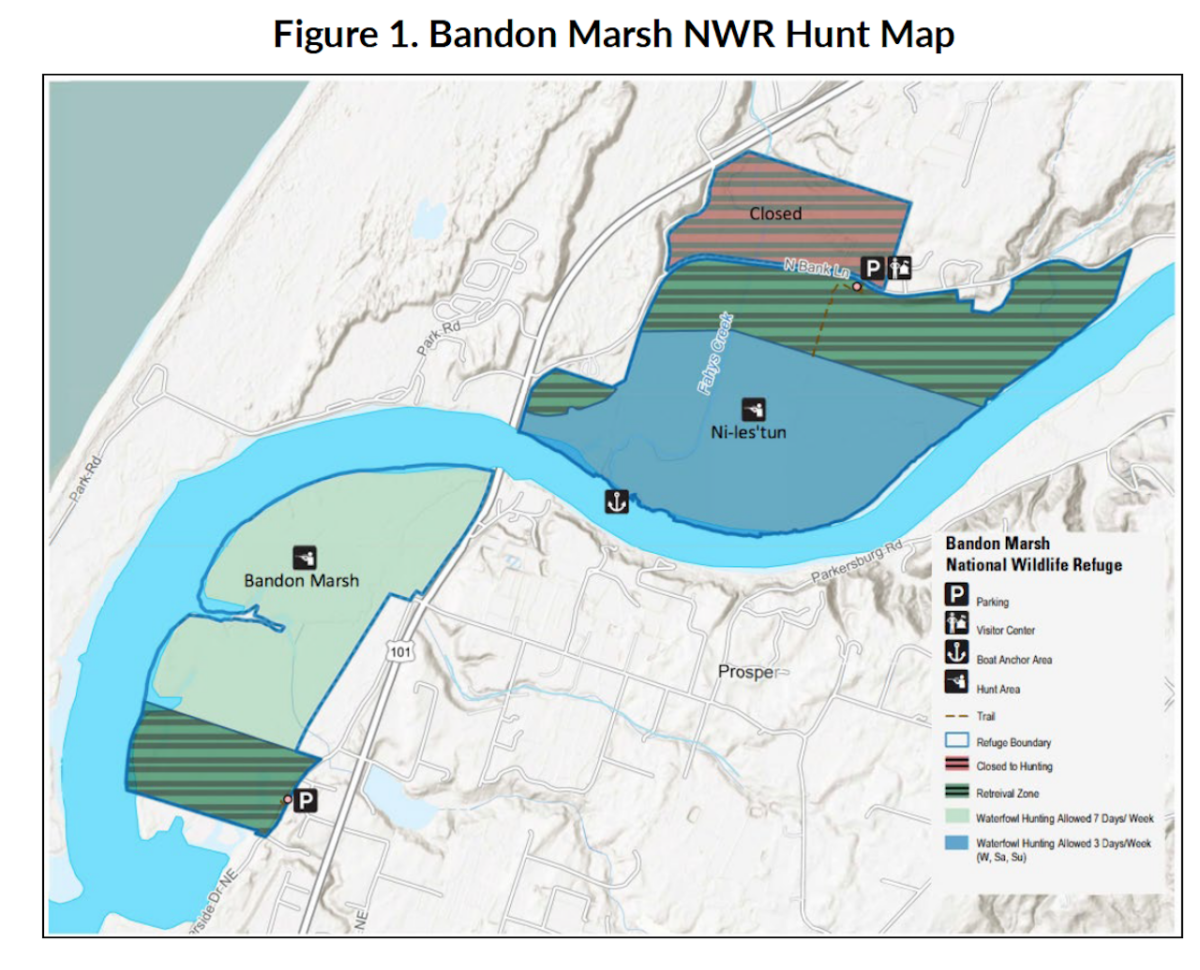
At Bandon Marsh NWR just outside Bandon, managers propose to allow snipe hunting on the 218-acre Ni-les’tun Unit, which is along the north side of the Coquille River just upstream of the Highway 101 bridge.
Waterfowl hunting is currently allowed on the unit, which is boat-in only, and by adding snipe hunting here, it would almost double the amount of land available to pursue these marsh birds at the refuge.
At Hart Mountain NWR in Southern Oregon, dove and snipe hunting would be open concurrent with other Oregon bird and big game seasons, with mourning dove and collared dove open during the regular state dove seasons.
At Julia Butler Hansen Refuge for the Columbian White-tailed Deer on the Lower Columbia near Clatskanie, 1,415 feet of shoreline along a newly acquired Crims Island parcel would be opened for migratory bird and waterfowl hunting. The stretch is on a dead-end slough above Gull Island and borders areas already open for shoreline hunting.
“The number of hunters expected to use the shoreline of the islands would be small, probably two to four parties at most per day. Waterfowl hunting already occurs on state-owned waters and tidelands surrounding the islands and along the shoreline surrounding the majority of Crims Island. Opening the shoreline of the recently acquired parcel to hunting is not expected to increase the amount of hunting or boat traffic that occurs on the island. A closure of the shoreline would be unenforceable because the refuge boundary is described as the mean high-water line, which cannot be precisely determined in many areas,” managers state.

At Lower and Upper Klamath NWR near Klamath Falls, quail would be added to the bag during state pheasant seasons at the lower refuge, while 2,599 acres of newly restore wetlands at the upper’s Barnes and Agency Lake Units would be opened for waterfowl hunting.
“The hunt area configuration was chosen to open the maximum acres, include boat-in and walk-in access points for hunters, and to provide a buffer of sanctuary acres for the adjacent private lands,” managers state about the latter proposal.
There is also a proposed new sliding scale that would determine how much of Lower Klamath (and Tule Lake in California) would be open for waterfowl hunting based on the amount of flooding.
At Malheur NWR in Southeast Oregon, rabbit and hare hunting would be opened on the 36,244-acre Buena Vista and 22,582 North Malheur Lake Units, which are otherwise open to bird and deer hunting – but only during the state upland bird season, which runs from mid-October through the end of January, and only with shotguns. Rabbits are open year-round in the rest of Oregon.
Dove hunting would also be allowed on the Buena Vista Unit, while the waterfowl, coot and snipe hunting area on the South Malheur Unit would be expanded by about 1,750 acres “to improve clarity and practical access for hunters.”
“The adjustment aligns access with the Narrows, an established and approved entry point already used for the North Malheur Lake Unit, which will reduce confusion for hunters navigating the lake and determining where waterfowl hunting is permitted,” the federal rule proposal states.
At Tualatin NWR south of Portland, snipe and dove hunting would be opened, which managers say in most years would amount to nine days for the former species and a total of five for the latter for youth hunters who draw waterfowl blinds.
Eurasian collared doves would also be opened on refuge hunt days that fall within ODFW’s mourning dove season.
At Umatilla NWR near Boardman, dove hunting would be allowed on the 4,026-acre McCormack Unit, on the Oregon portion of the refuge, while migratory and upland bird hunting would be expanded on the 4,704-acre Paterson Unit in Washington from three days a week and holidays to seven days a week during state waterfowl seasons.
At Wapato Lake NWR near Gaston outside Portland, light geese, snipe and dove would be opened for the first time with hunting of those species allowed on a 270-acre segment of the refuge in December and January.
Hunters would need to draw a blind on the three days a week the refuge is open that time of year to take advantage of the new opportunity, and each species would only be open during corresponding state seasons. Very few doves could be expected there in the first half of December, when they are open.
IDAHO
At Kootenai NWR in far North Idaho, a restriction limiting fishing to bank only on Myrtle and Deep Creeks would be removed. The move was requested by the Idaho Department of Fish and Game to align refuge access with state navigable waters codes, and boat-borne anglers would primarily likely catch rainbows, bass, panfish and perch, managers state.
WASHINGTON
At Billy Frank Jr. Nisqually NWR between Tacoma and Olympia, snipe hunting would be allowed in areas already open for waterfowl hunting – the 192-acre Nisqually River Delta Unit and the 572-acre Nisqually River Delta NW Unit.
At Columbia NWR outside the Tri-Cities, dove hunting would open for the first time on the Marsh Unit VI, Open All Unit and Farm Unit 226-227, some 12,811 acres, during Washington dove season, while pheasant, quail and partridge hunting would be allowed on the 184-acre Farm Unit.
On the Marsh and Farm Units, hunting would only be open Wednesdays, Saturdays, Sundays and federal holidays.
At Little Pend Oreille NWR southeast of Colville, migratory bird, upland bird, small game, big game and coyote and other nongame animals would be opened for hunting on 80 acres of recently acquired land on the west end of the refuge, in an area with a few surrounding houses on acreage, satellite maps show. That would bring the NWR’s huntable ground total to 38,839 acres.
Managers are also proposing to expand the overall refuge’s hunting calendar to August 1-March 31 plus WDFW’s spring turkey season, which will “expand hunting opportunities for bear by about 1 month, to include the August archery hunt; for bobcat, coyote, fox, rabbit, and hare, by 10 weeks; for forest grouse by 2 weeks; for raccoon by 3 months; and for porcupine and skunk by 4 months.”
They also have some housekeeping proposals, including limiting coyote hunting to fox season, though because of the expanded hunting calendar, opportunities for songdogs would still “increase.”
At Ridgefield NWR north of Vancouver, dove, bandtail pigeon and snipe hunting would be opened on the select days the refuge is open for waterfowl hunting (i.e., Tuesdays, Thursdays and Saturdays) during state seasons. Hunters would still need to draw a waterfowl blind to hunt the other species, and could only hunt from their assigned station.
Bandtail pigeons are typically only open for eight days in September, and none of those days overlap with the period Ridgefield is open for bird hunting.
At Turnbull NWR, along with the aforementioned elk area addition, managers are proposing to add snipe to the youth waterfowl hunt on 231 acres in the Upper Turnbull Slough Unit, the only place on the 19,000-acre refuge where migratory/waterfowl hunting is allowed. (Turkey hunting is also allowed during the fall season, thanks to a 2023 rule change.)
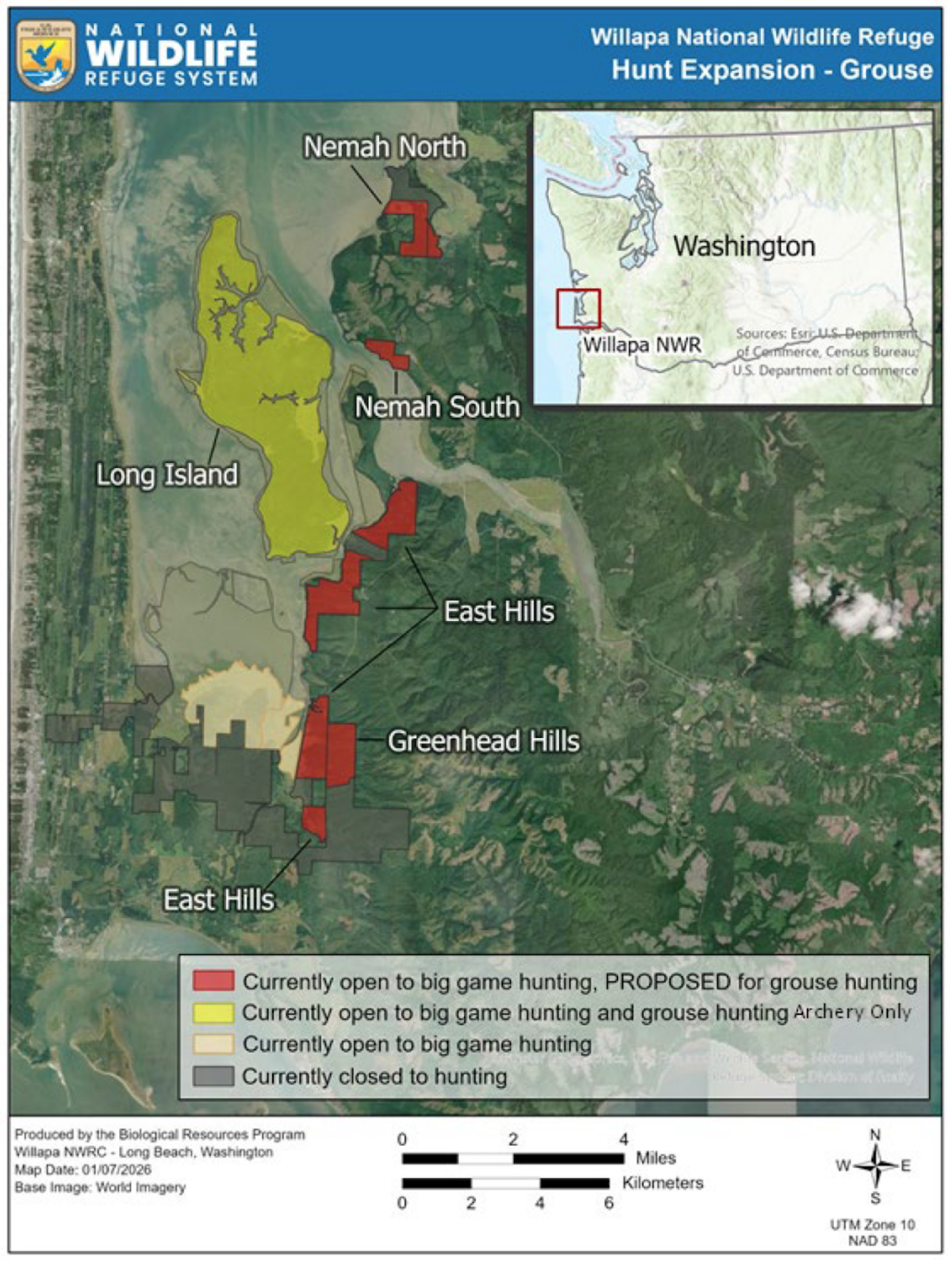
And at Willapa NWR near Long Beach, grouse hunting with firearms would be allowed during elk and blacktail seasons on three units (East Hills, Nemah South, Nemah North and Greenhead Hills) totaling 2,345 acres.
Elk and deer seasons would also switch from archery only to any weapon on the Greenhead Hills and Nemah North Units, or 708 acres. Portions of the latter unit were recently logged, satellite images show, and it looks like there’s a new logging road poking into or toward the former, which means better access.
The Long Island unit would remain open only for bowhunting of deer, elk, bear and grouse.
PUBLIC COMMENT
All of the changes described above are open for public comment through June 26 – go here for more info on how to submit your thoughts.