BY ANDY WALGAMOTT, NORTHWEST SPORTSMAN MAGAZINE
A federal judge in short order has denied a Quinault Indian Nation bid to expand their usual and accustomed fishing and shellfishing grounds to Willapa Bay and 60 miles up the Lower Columbia, though it could always be appealed.
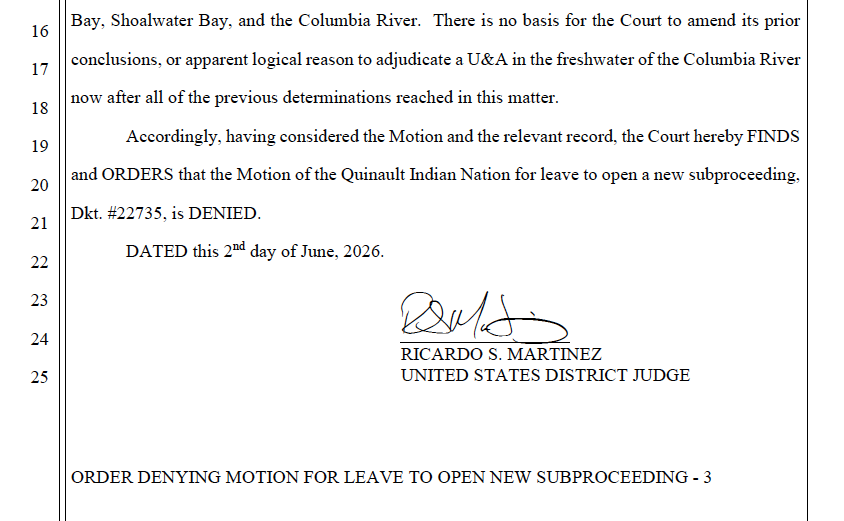
US District Court Judge Ricardo S. Martinez in Seattle said that after considering the QIN motion to open proceedings under US v. Washington, better known as the Boldt Decision, as well as the court record, he was denying the request, just a day after it had been filed.
The Quinaults had argued that the southern boundary of their treaty fisheries had not been decided by a court, but that’s not how Martinez saw it.
“The Quinault Nation’s U&A has been adjudicated with a clear southern boundary. Eight years ago, the Court set forth a marine U&A as a polygon with a southwestern point and a southeastern point and a line connecting the two—the southern boundary. Willapa Bay, Shoalwater Bay, and the mouth of the Columbia River are all more than 10 miles south of that boundary. To include them in the marine Q&A now would be to overrule the Court’s prior adjudication,” the judge wrote near the end of his three-page decision.
“The Quinault Nation fails to demonstrate that anything was left unadjudicated. To the contrary, the Motion states that the Court (back in Subproceeding 09-1) was presented with ‘evidence demonstrating that Quinault marine fishing practices were oriented southward and westward along the coast ‘between Cape Flattery and the Columbia River’ as well as ‘60 miles south of Quinault in Shoalwater Bay,’’ but nevertheless drew the line more than 10 miles north of Willapa Bay, Shoalwater Bay, and the Columbia River. There is no basis for the Court to amend its prior conclusions, or apparent logical reason to adjudicate a U&A in the freshwater of the Columbia River now after all of the previous determinations reached in this matter,” he added.
The QIN bid only surfaced publicly last Thursday with confirmation from WDFW that the nation had invited Boldt parties to a “meet and confer” in Taholah to talk about it.
After Friday’s meeting, WDFW Director Kelly Susewind reported it had been attended by more than 80 state, tribal and federal representatives and that “when and if potential litigation is filed,” it would be a long-term process sorted out in federal court.
On Monday, QIN filed their legal arguments.
On Tuesday, Judge Martinez said no dice.
It’s unlikely that this is the final word, but the Chinook Indian Nation, based in the lands of the Columbia estuary and Willapa Bay, were breathing a sigh of relief this evening.
“Today, the U.S. District Court for the Western District of Washington denied Quinault’s request to open a new subproceeding seeking treaty rights in Willapa Bay, and the lower Columbia River. In its order, the Court confirmed that Quinault’s southern treaty fishing boundary has already been determined and lies more than 10 miles north of Willapa Bay. We thank everyone who has stood with us and helped elevate our Nation’s voice,” the Chinooks posted on Facebook.
So was the Shoalwater Bay Indian Tribe, at the mouth of Willapa Bay.
“Although this may not be the final word on the matter, it is a decisive ruling from the Court at this time denying Quinault’s request to reopen their boundaries. We will continue to monitor the situation and will certainly take action if we feel it’s necessary to protect the interests of the Shoalwater Bay Indian Tribe,” they stated on social media.
And it also drew reaction from Liz Hamilton at the Northwest Sportfishing Industry Association in Oregon City.
“These proceedings by the Quinault Indian Nation were creating confusion and concern for those of us dependent on fisheries off the mouth of and into the Columbia River. Ideally, this ruling can let us return our attention to protecting and restoring the Columbia Basin stocks. We should be paying attention to ensure that the Bonneville Power Administration and the Army Corps of Engineers are running the river as best as possible for the fish. This will be vital, ’cause it’s going to be a hot summer.”
An expanded QIN U&A at the mouth of the Columbia would have inevitably involved a whole other, just as monumental court case, US v. Oregon, involving said state, five Columbia Basin tribes and others, leading to many headaches.
But as far as the Quinaults are concerned, the question is far from over.
This evening, Guy Capoeman, the nation’s president, said they knew when they filed the case it would be a long battle to prove their U&A.
“We disagree with the ruling that our southern boundary has already been established, and plan to aggressively continue to pursue our claims through the court process,” he stated.