BY ANDY WALGAMOTT, NORTHWEST SPORTSMAN MAGAZINE
Just two days after Washington state wildlife overseers turned down his “critical” request last month for wolves for a voter-mandated reintroduction effort, the former director of Colorado Parks & Wildlife sent a last-ditch plea to the Colville Tribes.
The tribes had already rescinded one offer in 2024 after learning Jeff Davis and CPW hadn’t done their due diligence consulting with tribal nations in Colorado’s southwest corner, but Davis hoped that work his state had done since then would allay the Colvilles.
That effort included a new memorandum of understanding around wolf reintroduction with one tribe, diligent work on an MOU with another tribe, compensation for wolf depredations on captive bison herds, and more training around investigations and nonlethal tactics and equipment.
“I am hopeful that you will see our good faith efforts to establish meaningful consultation, coordination and cooperation with both the (Southern Ute Indian Tribe) and (Ute Mountain Ute Tribe) to ensure that we are strengthening our relationships as we move forward together through CPW’s implementation of the state law and thus will once again support our team working with your staff to source up to 15 wolves to Colorado this upcoming season,” Davis wrote in a letter a local news station posted to Scribd.
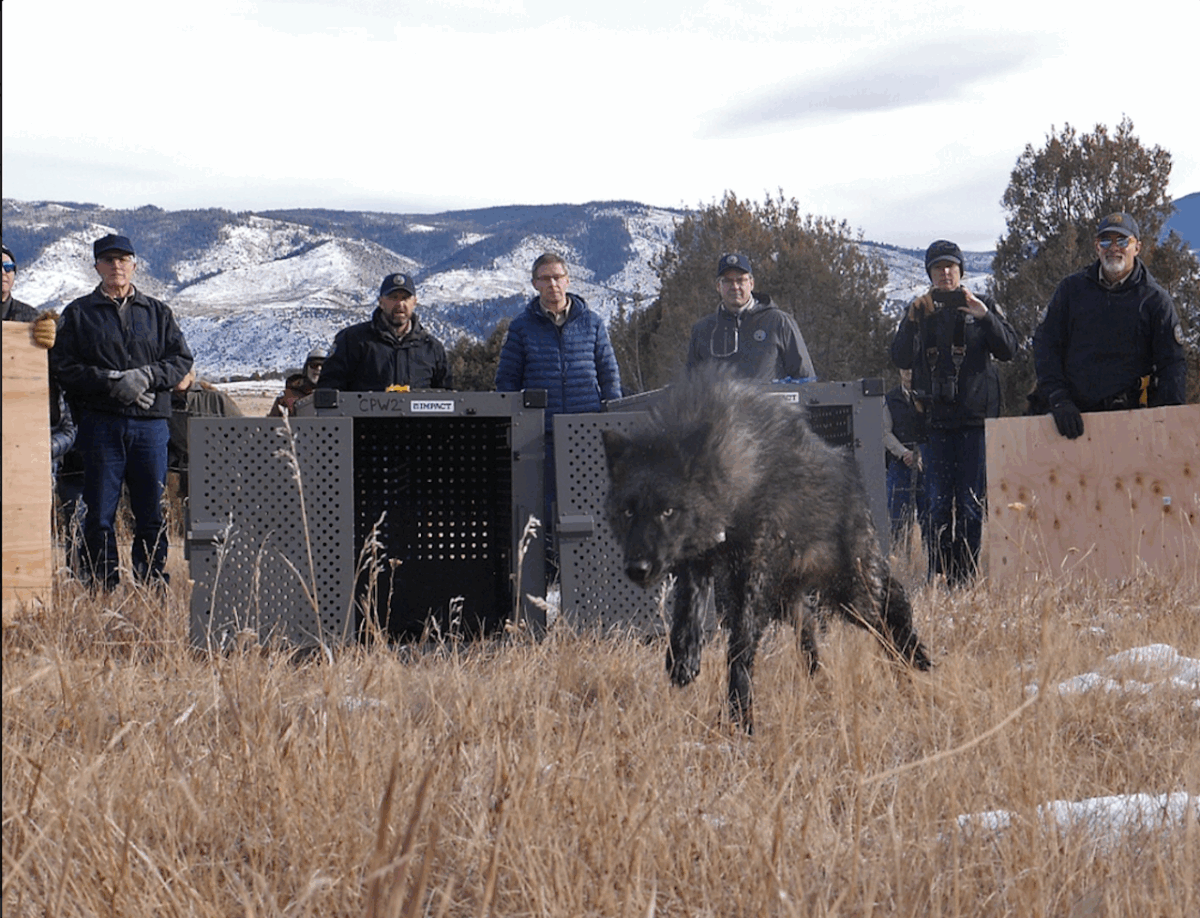
Davis, a longtime WDFW staffer and former conservation director for the agency before leaving for the Colorado job in spring 2023, had to go back to the Colvilles because:
• His old acquaintances on the Washington Fish and Wildlife Commission had just voted 8-1 not to supply any wolves this winter because of their controversial narrow decision last year to keep the species state-listed as endangered rather than downlist them to sensitive status, as WDFW had recommended, as well as state resident sentiment against it;
• Oregon had declined to supply any more after an initial 15 in early 2024;
• Idaho, Montana and Wyoming were against it;
• And in October, the US Fish and Wildlife Service had barred CPW from translocating any more from British Columbia, Canada, like last winter, and said they must instead source them from the US’s Northern Rockies wolf population instead, as called out in the fed’s 10(j) designation allowing for the establishment of the nonessential population in Colorado.
But reporting out of the Centennial State suggests Davis’s and CPW’s work with local tribes hasn’t been enough for the Colvilles.
“We’re in agreeance we would give them wolves, if the tribes were in agreeance, but it doesn’t sound like they are,” Colville Business Council Chair Jarred-Michael Erickson told KUSA. “So, there’s really nothing to discuss on our end. If the tribes aren’t on board, then we’re not on board.”
The Coloradoan appears to report on some of those other tribal issues involved – a federal matter about whether a certain ranch should be considered as tribal trust land, and where CPW should release 2026’s wolves, with Southern Utes and Ute Mountains arguing as far away from them in the state agency’s “southern oval” as possible so as to reduce potential impacts to big game and livestock.
“The lack of MOU with the Ute Mountain Ute Tribe and the unresolved federal land trust dispute gives that tribe leverage in negotiations regarding the Colville Tribes’ willingness to supply Colorado with wolves,” the Coloradoan analyzed.
Five days after Davis sent his request to the Colvilles, he resigned as CPW director so as to avoid being fired and landed a specially repurposed six-month gig at another state agency, a series of events Colorado reporters have subsequently been digging into.
If it all sounds a little hectic, let’s loop back to those furry fangers and where Colorado’s very narrow 2020 public vote to reintroduce the species is currently at.
In his letter to the Colvilles, Davis wrote:
“Given experienced mortalities from the initial 25 animals relocated to Colorado, CPW must relocate up to 15 additional wolves or risk establishing a foundational population. We may also have to consider drastic measures to protect every individual wolf we have without additional animals relocated. These measures would likely cause an impact to social tolerance and increased risks to the wolves themselves.”
Meanwhile, the costs of the reintroduction program are being questioned by state lawmakers as they prepare budget proposals for next year.
And I think that’s going to have to be all the time I have this morning to consider this fine mess created by ballot-box biology. Time to go put some coho on the smoker.