



Editor’s note: Well, that was fun! Just to be clear, this was my annual-ish April Fools Day blog.
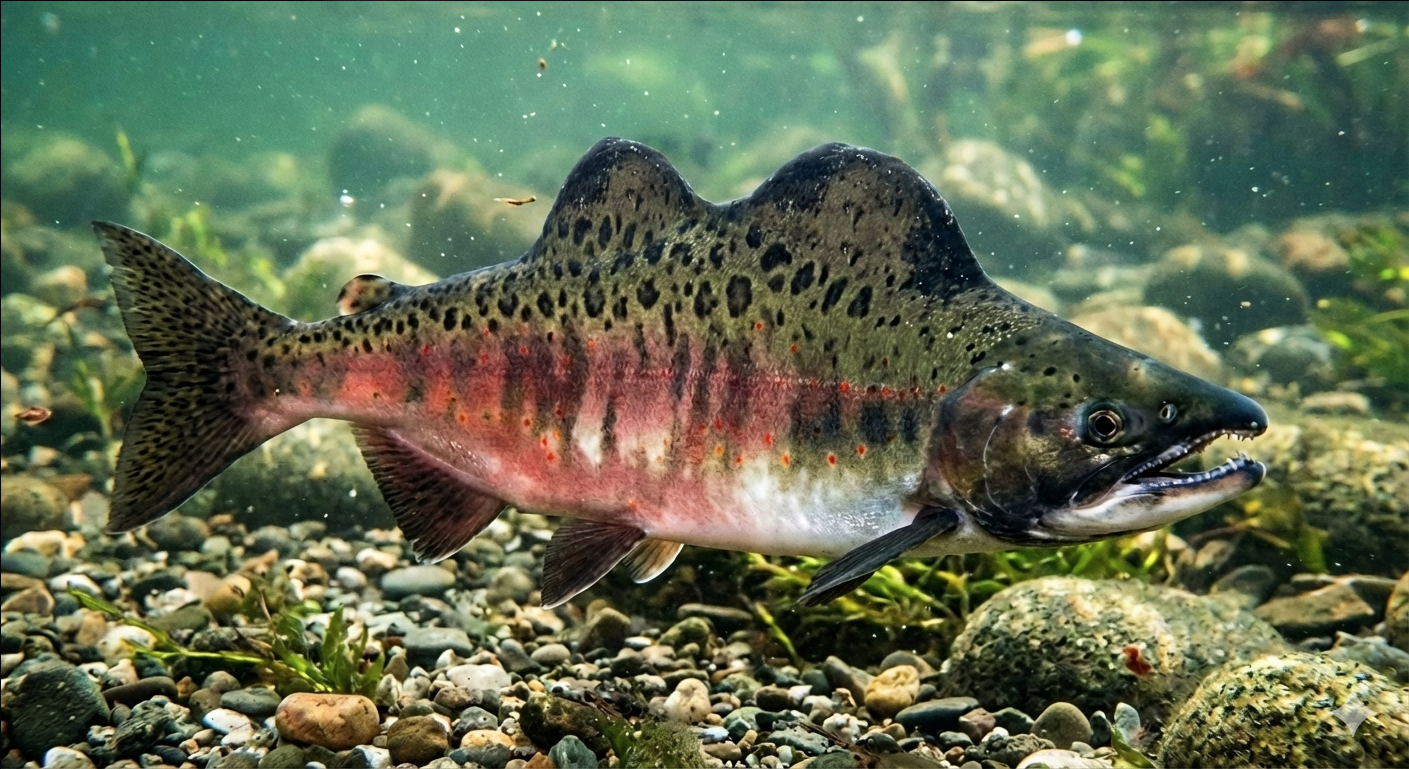
Move over sabre-toothed salmon, there’s a new freak in the water. Researchers believe that millions of years ago a double-humped salmon once swam in Northwest rivers.
They describe it as like a male pink salmon, except with a second hump, like a Bactrian camel, but are stumped about the evolutionary advantage the additional lump would have provided.
Was it for storing energy for the spawning run, battling other males of the species, showing off for females, or some other reason lost to time?
It’s believed the double-humped salmon did exist around the time of Oregon’s sabre-toothed salmon, which was renamed the spike-toothed salmon after recent evidence suggested its upper teeth actually poked out the side of its snout instead of down, like fangs.
Perhaps the double-humped salmon’s rear hump served as a decoy for the spike-toothed salmon to strike as the two species fought for spawning gravel, one researcher wondered, based on fossilized imprints in a Methow mudstone showing puncture wounds on a double-humper’s second hump.
Though they admit that evidence overall is sketchy, researchers posit that double-humped salmon returned to rivers across the Northwest, perhaps in runs in the millions upon millions, not unlike today’s single-humped pink salmon in Puget Sound.
It’s believed the species went extinct somewhere around 2 million years ago for unknown reasons, though there are also tantalizing mentions of double-humpers in the historical record, with early farmers, loggers and moonshiners all swearing they saw a few on the Nooksack, Pilchuck and other Pugetropolis streams around the turn of the 20th century.
There’s also the faded citation written by an early Washington state game warden in October 1907 that states a treble was used to snag a “curious two-hump-salmon in its rearward hump” on the Sultan River by one April Sloof.
