BY ANDY WALGAMOTT, NORTHWEST SPORTSMAN MAGAZINE
This much is certain: The Cowlitz will be open five hours next Wednesday for smelt dipping.
Whether the smelt cooperate is another question entirely.
Based on commercial test catches tentatively totaling 10,771 pounds in the mainstem Columbia this week, WDFW announced the 8 a.m. to 1 p.m. February 18 fishery between the Al Helenberg boat launch in Castle Rock and the Highway 432 bridge about a mile above the mouth.
The per-person limit is 10 pounds, about a quarter of a 5-gallon bucket, per the agency. A Washington fishing license – freshwater, combination or temporary – is required for all dippers 16 years of age and up to partake.
But just because there’s verified evidence of smelt somewhere within 68 miles of the Cowlitz does not mean the fish are actually in the tributary, or will be in five days’ time.
They infamously weren’t last March. That’s when WDFW announced four one-day openers and zero smelt were actually caught in the river.

It wasn’t the best rollout for the agency’s new – as I coined it – “Emergency Smelt Opener Notification System,” but managers are using it again this year, albeit it with some tweaks.
Here’s how it works. WDFW monitors data from commercial test fishing on the Columbia and makes a decision on Friday for the following week’s Wednesday and/or Saturday.
Basically, every Wednesday and Saturday between February 4 and March 21 are potential recreational openers, depending on commercial catches, but as last year and this season so far have showed, in the end most don’t actually open due to a lack of smelt catches or other reasons.
What’s driving next week’s opener is that this week saw average landings of 1,910 pounds of smelt on Monday, 676 pounds on Wednesday and 752 pounds yesterday, for an average of 1,077 pounds per delivery. The weights are tentative, as more fish tickets showing catches may still come in.
The idea behind this newfangled system is to give dippers more certainty and heads up about potential openers. Mechanically, it’s not unlike how WDFW manages razor clam seasons: schedule several series of tentative dates a month or so out, then greenlight individual digs following marine toxin testing a week beforehand showing that the clams are safe for consumption.
The difference, of course, is that bivalves are a whooooooooooole lot more predictable in where they can be found come an opener than an oily little migratory fish with a brain the size of a sand grain tumbling down the Cowlitz.
“There may be scenarios where the run size appears large enough for sustainable harvest, though natural factors like water conditions, timing, and unpredictable migration patterns mean smelt are not present in large numbers during days open to recreational dip-netting,” WDFW specifically warns on its handy-dandy, still somewhat new Cowlitz River smelt page.
Indeed, who knows what sort of river temperatures and water chemistry and other imperceptible signals tell smelt a given time is when to shack up.

One new feature this year on that WDFW page is a section labeled “Cowlitz River observations,” where smelt sightings and river conditions are shared. While not meant to presage openers, the information will at least give dippers who may not be dialed into the Longview-Kelso-Castle Rock SOS (signs of smelt) mafia a general idea about abundance and other good signs to weigh before burning gas money to attend an opener.
Here’s what it says this morning: “No smelt were collected during test dipping efforts, and no predators were observed. Water conditions are moderate with some color present, which is favorable, though river levels remain low. Sampling efforts will continue on Tuesday, Feb. 17.”
That might be the best intel … as of right now, anyway.
How is all this different than in the past? In recent days of yore, WDFW would provide a heads up on an opener about three days ahead of go-time; in further back days of yore, the season was just … open.
Endangered Species Act listings have a way of restricting opportunity, but to bastardize a quote from a certain dino-movie, managers will find a way to eke something out, thus the Washington and Oregon Eulachon Management Plan 2nd Edition and How We’re Doing Things Now.
For what it’s worth, ODFW is sticking with the old way around announcing openers. With a two-day notice late last March, dippers harvested 76,000 pounds from the Sandy during a seven-hour afternoon/evening fishery.
THE FOLLOWING IS A PRESS RELEASE FROM THE WASHINGTON DEPARTMENT OF FISH AND WILDLIFE
One-day smelt fishery announced for Cowlitz River on Wednesday, Feb. 18
RIDGEFIELD – The Washington Department of Fish and Wildlife (WDFW) approved a one-day recreational smelt fishery in the Cowlitz River from 8 a.m. to 1 p.m., Wednesday, Feb. 18.
The decision follows recent commercial and test fishery landings in the mainstem Columbia River that indicate the smelt run size is large enough to support limited recreational harvest of Endangered Species Act (ESA) listed Columbia River smelt, also known as eulachon.
“Based on what we’re seeing in the mainstem Columbia River, we are able to offer an early season opportunity in the Cowlitz,” said Laura Heironimus, WDFW’s smelt lead. “Fishers should be aware that smelt are still moving into the system, so availability may vary based on river conditions and timing.”
Natural factors such as water temperatures, river flows, and unpredictable migration patterns can affect smelt availability on days open for dip-netting. WDFW will post general observations on water conditions and smelt presence on the Cowlitz River smelt fishing webpage before the opener.
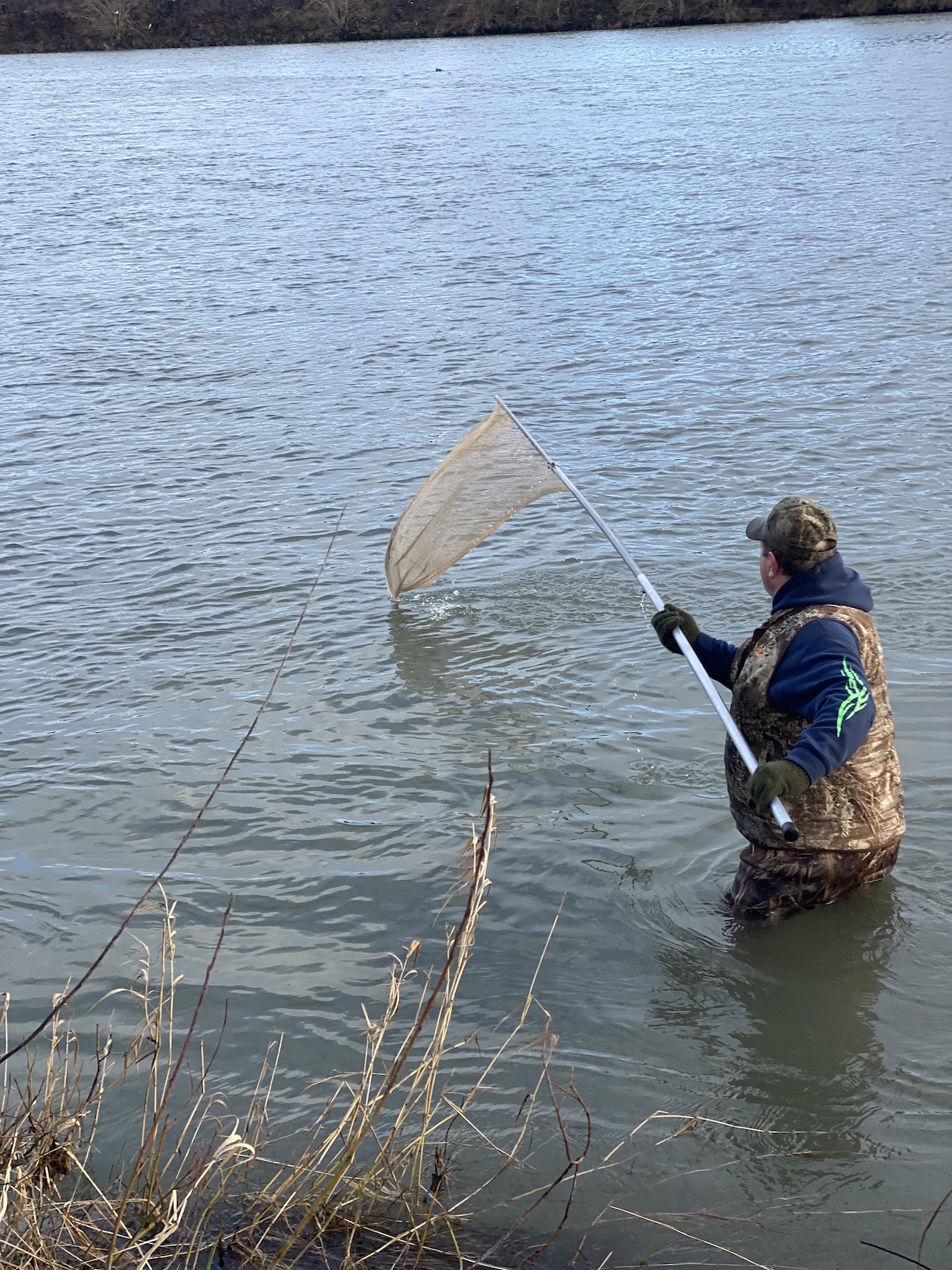
When the fishery is open, dip-netting from the shore is permitted on the river from the Highway 432 Bridge near Kelso upstream to the Al Helenberg Memorial Boat Ramp, located about 1,300 feet upstream of the Highway 411/A Street Bridge in Castle Rock. It is unlawful to harvest smelt from a vessel. A detailed map, including fishing boundaries and popular access locations, is available on the Cowlitz River smelt fishing webpage.
A valid Washington fishing license is required to dip-net for smelt. A Washington combination or freshwater license, or a temporary license, is valid. Non-residents must also possess a valid Washington fishing license. Children 15 and under do not need a fishing license. Refer to the fishing license types and fees webpage for more information.
Each dip-netter is allowed to retain a daily limit of up to 10 pounds of smelt. For reference, 10 pounds of smelt fills about a quarter of a five-gallon bucket, though anglers are advised to bring their own scale to keep track of their catch. Fishers must keep all smelt caught until they reach the daily limit. Each harvester is required to use a separate container to hold their catch, which must be in their presence or marked with their name.
WDFW Enforcement will be present to ensure public safety and enforce smelt fishing regulations, including the license requirement, 10-pound limit, and separate container requirement. Signs will be posted reminding fishers of the license requirement and regulations. WDFW staff will also be present to collect biological data from smelt harvested during the fishery. Data collected from the recreational fishery provides valuable information that helps WDFW learn more about the run, improve monitoring, and meet conservation goals.
With potentially strong river levels and flows on the Cowlitz River, dip-netters should exercise caution. WDFW recommends wearing personal flotation devices (lifejackets).
Since 2025, the Cowlitz River smelt fishery has been managed under a tentative schedule approach. Under this strategy, WDFW proposes tentative smelt dipping opportunities on Wednesdays and Saturdays from Feb. 4 through March 21. WDFW evaluates commercial landings and catch reports weekly to determine if the smelt run size is large enough to support a recreational harvest.
WDFW updated its smelt management plan in September 2023. The plan identifies current management strategies and makes recommendations for monitoring and evaluation of the population, as well as harvest criteria and communication between state and federal managers. For more detailed information, refer to the Washington and Oregon Eulachon Management Plan.
Fishery managers will continue to monitor the run size and recreational harvest to determine if future tentative dates can be approved, including the Saturday, Feb. 21 tentative date. The season closes after March 21. Weekly updates are available on WDFW’s website.
The Washington Department of Fish and Wildlife works to preserve, protect and perpetuate fish, wildlife and ecosystems while providing sustainable fish and wildlife recreational and commercial opportunities.
Request this information in an alternative format or language at wdfw.wa.gov/accessibility/requests-accommodation, 833-885-1012, TTY (711), or CivilRightsTeam@dfw.wa.gov.