BY ANDY WALGAMOTT, NORTHWEST SPORTSMAN MAGAZINE
Lower Columbia spring Chinook anglers will be biding their time on the Willamette, Lewis, Drano and elsewhere in the wake of last Saturday’s one-day reopener of the mainstem that appears to not have left enough wiggle room in the early quota for any more time on the big river until May and its runsize update.
A state manager this afternoon estimated around 1,600 total springers were harvested during “significant angler participation” Saturday, and while additional analysis still needs to be performed to suss out critical stock composition data based on coded wire tag data, between allocation balances and how many fish are in the river and how snappy they are likely to be, “no additional” fishing days are anticipated until after the US v. Oregon Technical Advisory Committee, or TAC, meets to review dam counts around the 50-percent passage point.
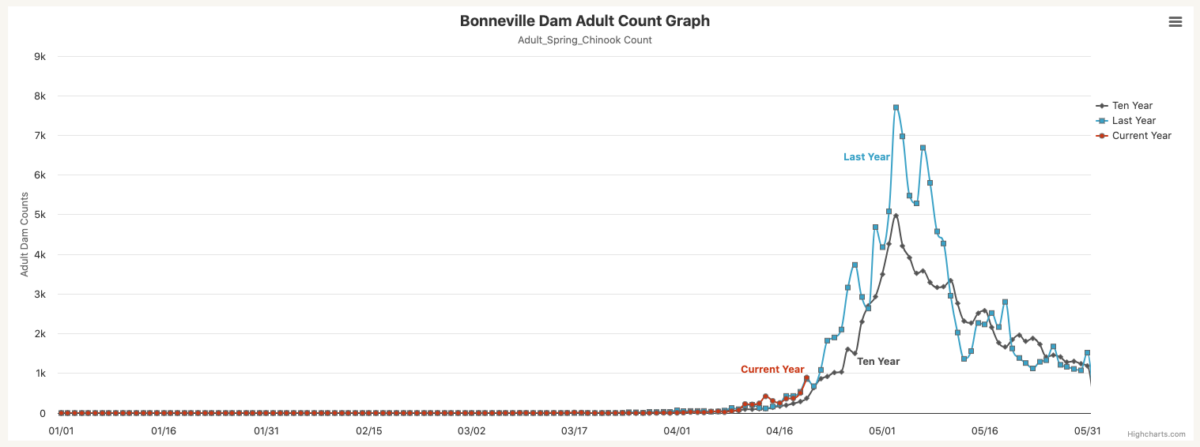
On average over the past decade, that point is May 12. This year’s run is also off to its best start since 2016, though it’s too early to say if it’s coming in bigger than forecast or just earlier than expected.
Meanwhile, preliminary estimates subject to change and posted today do show that 2,038 Chinook were kept between Saturday, April 18, and Monday, April 13 – the last day of a three-day reopener the previous weekend – bringing the total for the season on the Columbia below Bonneville Dam to 5,291 springers kept with another 565 released.
Those figures are not broken out so as to show how many of the constraining upper Columbia/Snake fish have been caught or released, but this year’s initial quota on them is 5,313 mortalities, and last week managers estimated Saturday alone would produce 1,600 of those fish and bring the quota up to 79 percent full.

Even as the dam count of 4,183 adult springers so far looks good and is running well ahead of the 10-year average and just in front of 2025’s better-than-forecasted run, state managers are pretty conservative with this fishery held over Endangered Species Act-listed salmon. Given how fast catches can add up as the run begins to peak, they weren’t interested last week in offering anything more than Saturday’s opener, and that appears to still be the case even as they slightly overestimated catch rates that day.
Reserving the remaining balance should provide a good amount of working capital come May, when the 30 percent runsize buffer guarding against an overforecast also comes off, opening up more available fish.
Those preliminary catch stats show that effort shifted somewhat last week compared to the week before, as more anglers worked the waters above Kelly Point, which is at the mouth of the Willamette River, and fewer fishermen went out below there.
Anglers above Kelly Point saw a kept catch rate of .23 spring Chinook per trip last week, up from .17 on April 6-8 and 11-12. Fishermen below there saw a rate of .15 spring Chinook per angler last week, up from .13 during the previous week.
For the season, there have been an estimated 58,916 angler trips, mostly below Kelly Point, where fishermen stand a chance of intercepting not only above-Bonneville-bound springers, but those peeling off into the SAFE fisheries and Cowlitz, Kalama, Willamette, Lewis and Sandy Rivers.
Of the kept Lower Columbia springers, 4,230 have been bonked below Kelly Point, 1,061 above. The overall kept catch rate since February 1 is .09 spring Chinook per angler trip.
At this same general post-extensions point in April 2025, the Lower Columbia catch stood at 3,389 total spring Chinook kept, including 2,596 upriver fish (2,620 kept plus release mortalities; the quota was 4,030 morts), and 376 released during approximately 42,700 angler trips.
After TAC was able to confirm on May 5 that the above-Bonneville run would meet forecast, and with sufficient catch balances available, managers held an initial 14-day, May 9-22, reopener on the Lower Columbia, which was subsequently extended 21 more days, May 23-June 12, and then three more, through June 15, when the spring Chinook management period wraps up on the Columbia below Bonneville.
Every year is different given water temperatures, flows and run strength, but the 4,183 adult kings at Bonneville through April 20, 2026, is 91 more than the count at this same time in 2025, and it’s well above all the years back through 2017, when just 919 had shown up by now.
However, it’s also well below 2016’s 6,458 and a far cry from the best year in recent memory, 2015 and its 54,183 springers through April 20.