BY ANDY WALGAMOTT, NORTHWEST SPORTSMAN MAGAZINE
An investigation into the Washington Fish and Wildlife Commission partially corroborates allegations against certain members of the citizen panel overseeing WDFW and its director.
The long-in-the-making findings substantiated in part violations of the Public Records Act, Open Public Meetings Act, commission rules of procedure, and mistreatment of agency staff and retaliation against Director Kelly Susewind, but did not substantiate improper timekeeping and compensation accusations against one commissioner who claimed to have worked on fish and wildlife business in some fashion nearly every day over a 400-plus-day stretch.
The report recommends more training and compliance reviews for commissioners and leaves the question of what punishments commissioners should face up to the powers that be.
“To the extent any formal corrective action with respect to individual commissioners is considered, it should be determined in consultation with legal counsel and with consideration of both applicable statutory authority and the full record, including the systemic conditions and mitigating factors documented herein,” the 68-page report concludes.
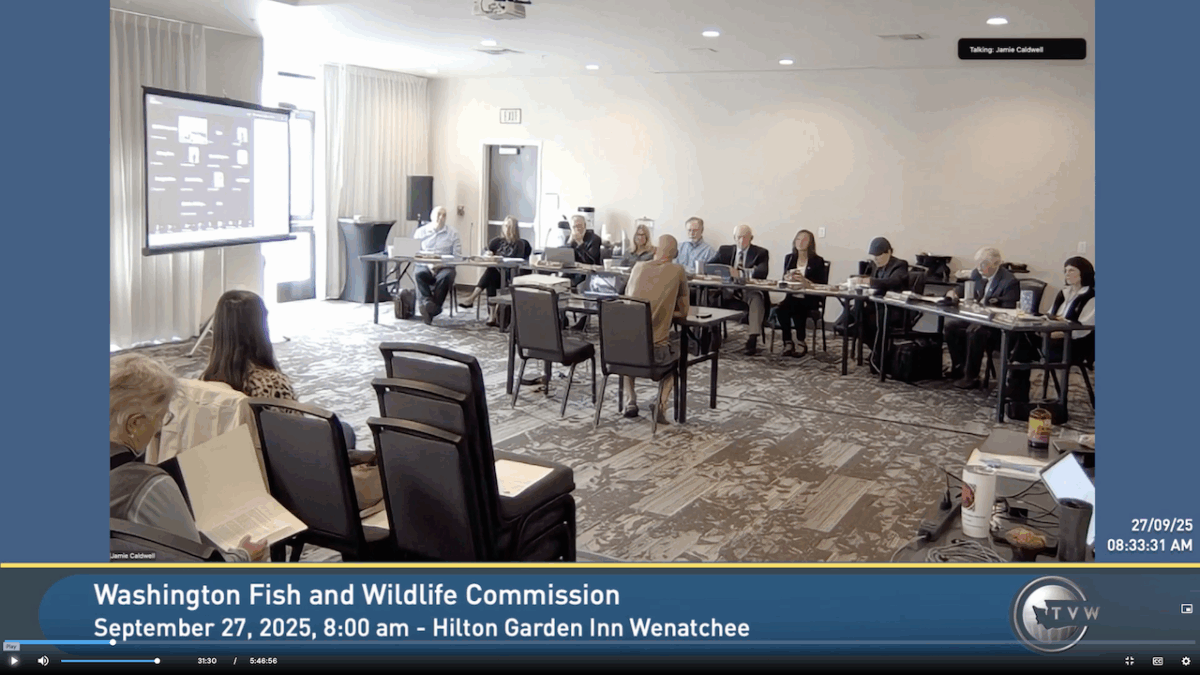
It left the Sportsman’s Alliance feeling vindicated this afternoon.
“The report reveals serious issues and even potential crimes committed by WDFW Commissioners. It’s nice to see all the evidence the Sportsmen’s Alliance brought forward more than a year ago was taken seriously, and that the wrongdoing is now substantiated and on display for the citizens of Washington,” said Brian Lynn, the organization’s Spokane-based vice president of marketing and communications. “Now it’s up to Governor Ferguson to hold these commissioners accountable.”
Their ire was primarily focused on the activities of four sitting commissioners, Lorna Smith, Melanie Rowland, John Lehmkuhl and Barbara Baker. Smith, Rowland and Lehmkuhl’s terms expire at the end of 2026, and the Sportsman’s Alliance as well as many Washington hunters, anglers and conservationists will be hoping that Ferguson continues to be more even-handed in his appointments to the commission than his predecessor Jay Inslee was.
In Inslee’s final, third term in office, he began to stack the body with more preservationist-minded members and wrench it away from its traditionally strongest supporters, hunters and anglers, among others. It created all sorts of controversy, tension, backlash, considerable public comment, employees leaving WDFW, unnecessary missteps and battles, clashes with the state’s tribes – ultimately even a federal civil rights lawsuit against Susewind and another member of his executive team (they are seeking to have it dismissed).
For its part, WDFW received the final report earlier this week and is reviewing it and “awaiting further information from the governor’s office.”
“Our focus remains on our mission and continuing our work to conserve and manage fish, wildlife, and their habitats,” stated Director Susewind.
“Now that the report is final, we expect to brief the governor in the next few days on the content,” Brionna Aho, communications director in the Governor’s Office told The Chronicle of Centralia. “After the governor reviews the report, he will determine next steps.”
The report was commissioned in June 2025 following the so-called Knoll Memo initiated by Susewind and completed recently by Chiedza Nziramasanga of Transformative Workplace Investigations.

Nziramasanga interviewed Smith, Rowland, Lehmkuhl and Baker as well as Susewind, Deputy Director Amy Windrope and Commissioners Jim Anderson and Woody Myers. Former Commissioner Tim Ragen was not interviewed, but his name is mentioned nearly 60 times
According to the report released by the Governor’s Office this afternoon, the investigation’s findings are:
Allegation 1: Violations of the Public Records Act (PRA):
“Based on the preponderance of the evidence, this allegation is substantiated in part. The evidence establishes that commissioners did not consistently comply with PRA requirements, including through use of personal devices for commission business, failure to conduct complete searches, submission of inaccurate or incomplete declarations, and in some instances resistance to production until compelled. Systemic factors, including delayed issuance of state equipment, divergent experiences with training, and high request volume, also contributed. The evidence does not establish that noncompliance was universally deliberate or the result of coordinated concealment.”
Allegation 2: Violations of the Open Public Meetings Act (OPMA)
“Based on the preponderance of the evidence, this allegation is substantiated in part. The evidence establishes that commissioners engaged in serial meetings through coordinated communications that collectively involved a majority discussing and shaping agency business outside of publicly noticed meetings, and that documentary evidence corroborates coordination on votes, policy drafting, and leadership elections conducted through private communications. The evidence does not establish that commissioners knowingly violated OPMA. The record reflects reliance on quorum-based guidance and an insufficient understanding of serial meeting prohibitions.”
Allegation 3: Violations of the WDFW Commission Rules of Procedure – Ethical Conduct and Conflicts of Interest:
“Based on the preponderance of the evidence, this allegation is substantiated in part. The evidence establishes that multiple commissioners engaged in repeated, undisclosed communications and meetings with advocacy organizations, including organizations actively litigating against the Department, in violation of the Commission’s Rules of Procedure governing disclosure and avoidance of conflicts of interest or the appearance thereof. The evidence does not establish unlawful litigation collusion or statutory conflicts of interest, but does reflect appearance concerns, institutional risk, and inconsistent compliance with the Commission’s own disclosure standards.”
Allegation 4: Staff Mistreatment and Alleged Retaliation Against the Director
“Based on the preponderance of the evidence, this allegation is substantiated in part. The evidence establishes a significant breakdown in trust between certain commissioners and Department leadership, strained staff-commissioner dynamics, and isolated instances of confrontational or inappropriate tone toward named staff members. The evidence does not establish a coordinated pattern of harassment, systemic mistreatment of staff, or formal retaliatory employment action against Director Susewind following his request for an external investigation.”
Allegation 5: Improper Timekeeping and Compensation Claims:
“Based on the preponderance of the evidence, this allegation is unsubstantiated. While Commissioner Smith claimed per diem compensation on a significantly higher number of days than her peers over an extended period, the Commission’s compensation structure permits a full day’s per diem for any day on which commission work is performed. The evidence does not establish that she falsely certified work performed, claimed compensation for days on which no commission-related activity occurred, or violated any established policy.”

Allegation 1 centers around Ragen’s agency-issued computer, which after it was returned to WDFW following his dismissal from the commission in early 2025, led to concerns about commission business being done outside of public meetings via “daisy-chaining,” that is, a work-around of quorum rules, as well as Ragen and Rowland’s resistance to producing relevant public records.
In her findings, Nziramasanga found that while requests for commissioners’ public records increased in recent years as things around the commission became increasingly contentious and some members felt they were retaliatory, they still fell under disclosure obligations.
Her report found that it took Rowland “months” to produce a simple text message related to a vote on spring black bear hunting despite a public records request having been filed “immediately” after it had been mentioned during a public meeting.
The text in question came from a former WDFW endangered species manager and after it was incorporated into a motion, it essentially had the effect of leaving the closing of the hunt open-ended instead of just for one season.
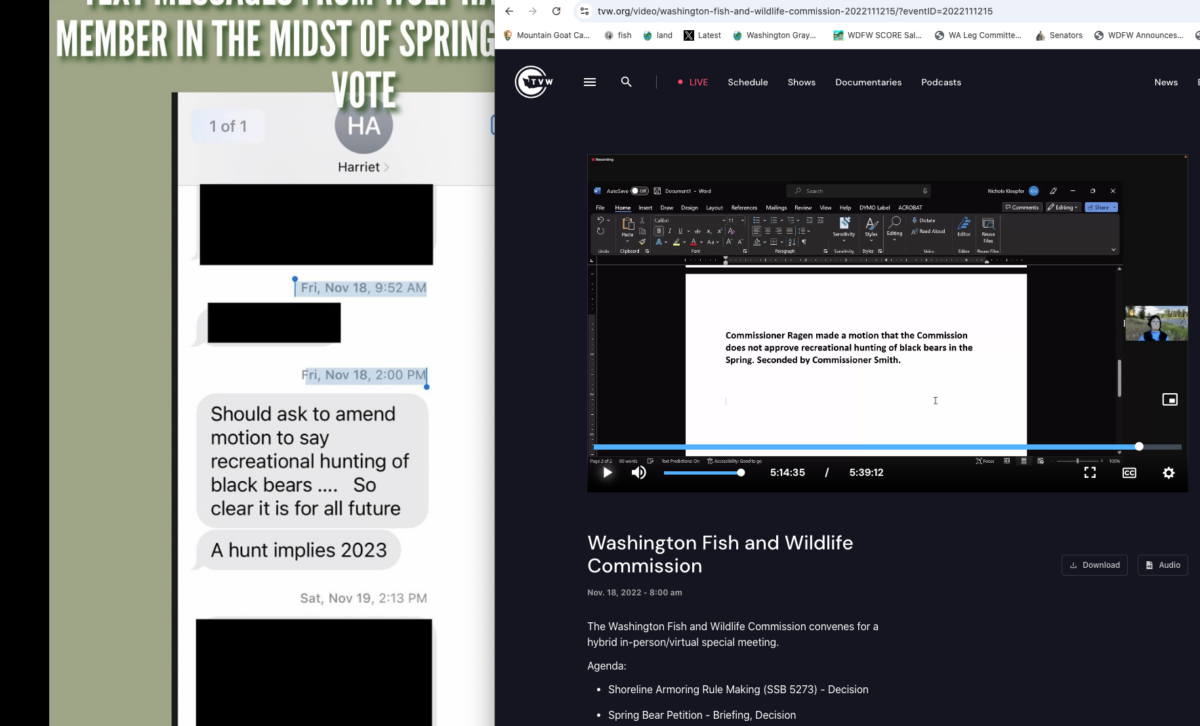
As for the Open Public Meetings Act, which governs how many commissioners can meet outside of an official gathering (in a nine-person panel, just four), there was stronger evidence of violations, including corroborating text messages recovered from Ragen’s computer.
“Multiple commissioners acknowledged frequent communications among an identified group of four regarding substantive commission matters, including the spring bear hunt, conservation policy development, the vice-chair election, and motion drafting. Commissioner Rowland confirmed that the group referred to themselves as the ‘Gang of Four.’ The communications went beyond information sharing. Commissioners discussed how to structure motions, anticipated voting outcomes, and coordinated support for leadership positions prior to public meetings — active coordination on agency business, not merely passive preparation. Commissioner Smith described four commissioners reaching agreement on the substance of the spring bear motion and then transmitting the language to Chair Baker under the Commission’s ‘no surprises’ norm, thereby extending the discussion chain to a fifth commissioner before the matter reached a public meeting,” Nziramasanga found.
She also found questionable conduct and conflicts of interest on the part of certain commissioners with outside advocacy organizations, including “regular contact” with some of WDFW’s fiercest courtroom opponents, including Washington Wildlife First, Wild Fish Conservancy and The Conservation Angler, often shortly before or after commission meetings.
Smith appeared in 40 meetings over a three-year period, Rowland in 37, Lehmkhuhl in 28.

In addition, WWF director Claire Davis sent emails to the personal addresses of Ragen, Rowland and Smith twice while her State Environmental Policy Act case over Chinook was active and sent two emails to Smith during another active litigation, though Nziramasanga also states there “is no evidence that any commissioner responded to or engaged with Davis on the substance of those communications.”
Davis along with Smith are suing Susewind and Windrope in US District Court over alleged federal civil rights violations.
Smith also acknowledged she provided input on a commissioner-vetting spreadsheet found on Ragen’s computer and that was active in recent years as WWF and others attempted to stack the commission, activities detailed on this blog as far back as an October 2022 reformist convention held on Vashon Island, for which the agenda and other information was scrubbed while it was being reported on.
Nziramasanga also looked into allegations of staff mistreatment, and she pressed Rowland on an ugly June 2022 confrontation with WDFW Wolf Policy Lead Julia Smith that left Smith feeling attacked, as well as her interactions with former agency bear biologist Stephanie Simek, who left the agency afterwards.
Rowland, a former federal ESA lawyer, acknowledged she “has a strong personality” and that her “questioning style could have been perceived as aggressive” as she sought information, and said she apologized to Smith afterwards but makes no such mention of any such apology towards Simek, who left the agency as a result and ultimately went on to head up a New England fish and wildlife agency – a loss of up-and-coming talent.
“Across interviews, witnesses described a highly polarized and adversarial institutional environment. Commissioners Smith and Rowland described feeling politically targeted and characterized the investigation as disruptive and punitive. Department leadership described serious concerns about governance norms and institutional risk. Staff were at times placed in the middle of disputes between commissioners and leadership. The cumulative effect of these dynamics was destabilizing to governance processes and demoralizing to staff, though the evidence does not support a conclusion that commissioners engaged in coordinated retaliation against the Director or institutionalized harassment of staff,” Nziramasanga found.
As for the fifth allegation, improper timekeeping, that was based on Smith’s claim to have worked nearly every day over a 14-month period, at $100 a day each. Questioned about that, Smith described herself as very engaged and that early on in her term she was told that even a partial day’s work qualified for a full day’s pay.
Ultimately, the investigator “did not identify evidence establishing that Commissioner Smith falsely certified work performed, claimed compensation for days on which no commission-related activity occurred, or violated any established compensation policy. No evidence of fraud, intentional misrepresentation, or improper personal gain was substantiated.”
Even as Nziramasanga found substantiation for four of the five allegations, she reported the evidence “stops short of establishing the most serious forms of the alleged conduct.”
Lynn, of the Sportsman’s Alliance, would disagree.
“The most serious and potentially criminal behavior was all substantiated,” Lynn said. “The only mitigating factors revolved around intent, but ignorance of the law is no defense. Either these commissioners were actively and knowingly violating the law or they were too inept to know they were. Either is grounds for removal.”
The ball is now in your court, Governor.