BY ANDY WALGAMOTT, NORTHWEST SPORTSMAN MAGAZINE
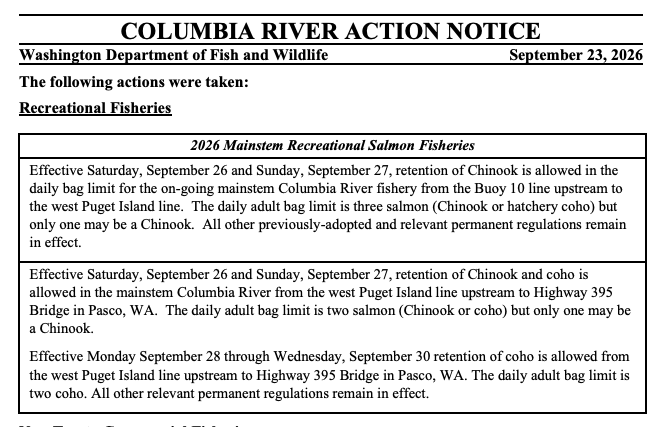
Columbia salmon managers approved a two-day fall Chinook fishery from Buoy 10 upstream to the Highway 395 Bridge in Pasco this weekend as well as expanded a rare wild coho retention opportunity on the big river during a conference call this morning.
The September 26-27 Chinook reopener comes after a runsize update to the good for upriver bright and pool upriver bright stocks earlier this week – but also as retention upstream in the vaunted Hanford Reach was limited to hatchery kings only, an unusual restriction for the last best run of wild fall Chinook in the Northwest.
“Considering current abundance expectations for URBs and completed, ongoing, and planned harvest, projected balances of URB HR and LCR ER are available for recreational fisheries. Therefore, staff recommend the following additional recreational Chinook and coho retention opportunities,” the fact sheet out ahead of the call stated.
With the reopener, the catch impact on URBs is expected to hit 13.4 percent, about 90 percent of what’s available with the run, and stay below the 15.0 percent limit for the recreational fishery.
Chinook fishing is expected to be better higher up in the system this weekend. Staffers at WDFW and ODFW model catches of 140 adult Chinook in the Buoy 10 management zone, 1,000 from west Puget Island to Warrior Rock, 2,000 from Warrior to Bonneville, and 1,800 from the dam to Pasco.
Coho – hatchery or wild – will also be open September 26-30 from west Puget Island to Pasco. The opportunity to retain unclipped silvers on the big river is rare; they will also be open October 1-15. On overall coho catch projection wasn’t made, but the fact sheet said “Unclipped coho mortalities would not likely exceed an additional 550 fish, resulting in the total for the area between WPI and Bonneville Dam being approximately 75% of the preseason expectations prior to October 1.”
You don’t always hear anglers argue against a fishery, but it happened today.
Don McBride, a Columbia River sportfishing advisor in Richland, lambasted the Chinook reopener from the mouth to his home waters, saying he was in “strong opposition” to it. He pointed out that for the first time in history Reach salmon fishermen have been required to turn back wild Chinook – a rule change that went into effect today – and that spawning escapements haven’t been hit in several years recently
The minimum escapement goal for the Hanford Reach is 31,100 adult upriver brights. Last year saw 20,181 on the gravel, described as just 27 percent of the 10-year average; 2024 saw 36,972; 2023 saw 25,170; 2022 saw 27,890; and 2021 saw 49,500, according to the DFWs’ fall fishery plans.
One of McBride’s fellow Tri-Cities anglers called reopening any Chinook to retention in the rest of the Columbia “bad optics” when Reach fishermen have to release wilds.
Even a Portland-area fisherman was leery, stating that the Pacific Fishery Management Council’s review of 2025’s returns found that the preliminary escapement for all Upper Columbia URBs was more than 1,000 fish below the goal, though data also shows that mark being hit it in all seasons back to 1996.
Still, two other sportfishing representatives supported the DFWs’ Chinook proposal, with one pointing out it would remain within impact limits.
Trevor Hutton, WDFW’s director representative on today’s call, said he was “keenly aware of the optics” on display, and he acknowledged McBride’s concerns about changing stock composition of URBs. He said he was trying to wrap his head around it, and he posited that something appears to be affecting juvenile production in the Hanford Reach.
He also clarified hatchery mark rates for Reach-bound kings, saying that half of the fall Chinook released at Priest Rapids Hatchery are clipped and 100 percent of those from Ringold Hatchery are, making for an overall two-thirds mark rate on hatchery fish. He said there is a “relatively robust” component of hatchery Chinook headed to the Reach.
Hutton added that he was “not unsympathetic” to what he was hearing from concerned fishermen and that he had his “work cut out” for him, but that that was also separate from today’s decision.
Tucker Jones, ODFW’s director representative, pointed out that Chinook catches in downstream fisheries would be on multiple stocks, not just Reach-bound brights, and that overall fisheries are being managed carefully.
“We’re not solving to 15 percent. We’re trying to take a conservative approach,” Jones said.
Hutton moved to adopt the recreational fishery recommendations and Jones concurred.
Today’s fact sheet did share some pretty grim news about the A- and B-run forecast, which continues to slide. The US v. Oregon Technical Advisory Committee downgraded the return to 59,200 at Bonneville, a drop from last week’s 61,500, which was already expected to be the “lowest steelhead count since the dam was built in 1938.”
As and Bs are summer-runs counted from July 1 on; this year’s forecast was for 133,700.
TAC now expects just 52,400 of the former stock, including 17,500 unclipped steelhead, and 6,800 of the latter, including 2,400 unclipped fish. The next lowest return since at least 1984 is 67,752 in 2021. Managers up and down the river have restricted fisheries to try and get more back. Offline, a fishermen expressed sadness that in the vast Columbia Basin, fewer than 20,000 wild steelhead would return to fabled streams such as the Methow, Deschutes, Clearwater, Grande Ronde, Salmon and Imnaha, among others.
As for fall Chinook, TAC updated the run to 612,00 adults back to the mouth of the Columbia, including 237,400 URBs (up from last week’s 226,000 but below the preseason forecast of 270,900), 101,000 pool upriver brights, or PUBs (up from last week’s 92,800 and just a hair below the preseason forecast of 102,200) and 134,000 Bonneville Pool Hatchery, or PBH tules (down from last week’s 140,700 but still above the preseason forecast of 123,800).
The fact sheet also updated fall salmon catches and angler effort from the mouth to Pasco.
Buoy 10 to west Puget Island: “Preliminary estimates through September 20 include 33,350 kept and 25,637 released Chinook, 58,622 kept and 34,267 released coho, and 62 released steelhead from approximately 122,400 angler trips.”
West Puget Island to Warrior Rock: “Preliminary estimates through September 20 include 7,182 kept and 676 released Chinook, 225 kept and 101 released coho, and 210 released steelhead from approximately 34,800 angler trips.”
Warrior Rock to Bonneville Dam: “Preliminary estimates through September 20 include 15,458 kept and 1,619 released Chinook, 1,412 kept and 473 released coho, and 93 released steelhead from approximately 47,900 angler trips.”
Bonneville to Pasco: “Preliminary estimates through September 20 include 6,075 kept and 777 released Chinook, 195 kept and 18 released coho, and four kept and 99 released steelhead from approximately 21,600 angler trips.”