BY ANDY WALGAMOTT, NORTHWEST SPORTSMAN MAGAZINE
Four months ago, the Bonneville Power Administration publicly announced to interested parties it “would continue to provide partial funding” to the Select Area Fisheries Enhancement Program in the Lower Columbia.
Yesterday, in a dramatic reversal, it was revealed BPA had completely changed its mind, putting state and county partners in a significant financial bind to the tune of $2.4 million and the production of 7-plus million hatchery spring Chinook and coho in a lurch.
That’s according to stung Oregon Department of Fish and Wildlife officials, who fired off an after-hours press release stating that it had caught them by “surprise,” “puts decades of fishery reform work at risk,” and “undermines stability for both fishery managers and commercial and recreational fishers.”
And they said that they and partners at the Washington Department of Fish and Wildlife and Clatsop County Fisheries “have no viable short-term replacement for the withdrawn BPA funds.”
It drew a withering response from Liz Hamilton, policy director of the Northwest Sportfishing Industry Association.
“This is one more nefarious effort by the BPA to step away from its fishery obligations, and this will affect both commercial SAFE fisheries and the Buoy 10 and nearby ocean fisheries,” she said in an NSIA newsletter sent out this afternoon. “One might think that their efforts to degrade the river for fish and cut hatchery production is aimed right at fisheries.”

The SAFE Program officially began in 1993 – lower river sources note its “origins” date back to the 1970s – and today, it operates on the south side of the Columbia at Youngs Bay, Tongue Point, South Channel, Blind Slough and Knappa Slough.
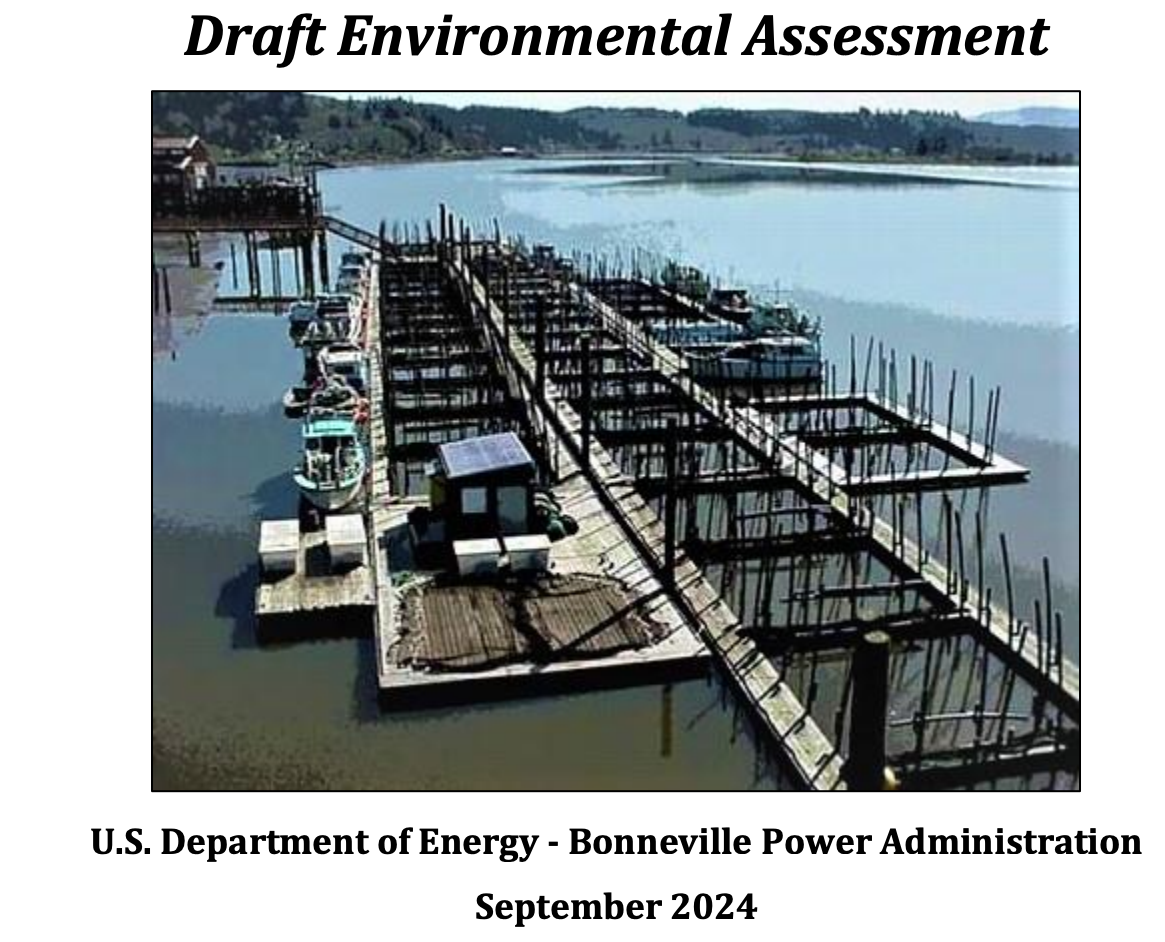
There, netpens rear young salmon spawned at nearby hatcheries, and after being released to go to sea, returning adult fish help primarily fuel off-channel commercial fisheries, though as ODFW notes, sport anglers account for more than a third of harvested SAFE fish, both in the ocean and in the lower end of the big river and select tribs. Last year, SAFE-related commercial fisheries yielded nearly $6 million in local economic impacts.
A self-contained loop, the program is “an integral component of the broader mitigation package responding to the impacts of the Federal Columbia River Power System on fish and fisheries,” helping to restore a portion of harvest lost because of the dams as well as benefitting Endangered Species Act-listed stocks, according to ODFW spokeswoman Meghan Dugan.
For instance, in spring, the commercials work Youngs Bay and the two sloughs for lucrative hatchery spring Chinook while wild ESA-listed Upper Columbia, Snake and Willamette kings are free to safely pass up the mainstem Columbia.
Dugan points out that the Northwest Power and Conservation Council – created through an act of Congress and which acts as kind of an overarching fish and wildlife mitigation investment advisor – has “repeatedly recommended” the continued funding of the program, reaffirming “that SAFE remains aligned with long‑standing regional mitigation commitments.”
BPA’s move this week came after it had just spent the last two years laying the foundation to continue help paying for the program.
In January 2024, BPA announced it was proposing to do so “to achieve maximum production levels and Chinook and coho salmon” allowed by NMFS and desired by ODFW, WDFW and CFF, took public comments, drafted an environmental assessment and released it in September 2024, took more input, answered those questions, and in February of this year found the project would have no significant impact and thus didn’t require National Environmental Policy Act review, putting a final bow on the process.
“By funding the SAFE Program, Bonneville seeks to minimize harm of weak stocks of natural-origin ESA-listed salmon and steelhead by providing harvest opportunities from Select Area Fisheries,” stated BPA’s February 27 public letter to all interested parties.
Fast forward 111 days to this Thursday, and in a three-page letter emailed to ODFW Director Debbie Colbert, BPA Fish and Wildlife Program Executive Manager Jason Sweet said it now “has decided to end its participation” in the program and that at the conclusion of federal fiscal year 2026 in three months, it would not issue a cost-sharing contract renewal with the state.
Sweet said BPA had initially supported the program’s concept of boosting harvest via hatchery runs to off-mainstem areas of the Columbia and reducing impacts on weak or listed stocks, but it “ultimately has not demonstrated an ability to deliver this theoretical benefit, and the program’s value as a hydropower mitigation tool has therefore been in question for some time.”

He also quibbled with the DFWs’ goals of addressing lost opportunities and maxxing harvest, and said that the “sole function” of the program as it currently exists is augmenting sport and commercial fisheries.
“Accordingly, and due to the absence of a demonstrable mitigation benefit for weak and ESA-listed mainstem stocks, the SAFE program does not align with the statutory purpose of BPA’s Fish and Wildlife Program – to mitigate impacts of the Federal Columbia River Power System (FCRPS) on fish and wildlife. In addition, the SAFE program’s geographic focus – off-channel areas in the lower Columbia River below Bonneville Dam means that SAFE does not align with the Northwest Power and Conservation Council’s emphasis on increases in abundance of populations above Bonneville Dam,” Sweet wrote.
He claimed that BPA has “consistently” said that program partners should wean themselves of its support and pay for operations in other way. And he indicated that NWPCC’s recommendation that SAFE funding continue didn’t obligate BPA to do so, and said it was no longer a good fit.
A BPA spokesman subsequently said its Fish and Wildlife Program provides more than $300 million annually for mitigation work in the basin.

The sudden SAFE funding pinch may leave a bigger mark on ODFW than it would have a couple years ago. As Sweet’s letter hints, WDFW’s role is not what it once was due to a September 2024 court settlement with Wild Fish Conservancy and The Conservation Angler that led to the end of the Deep River netpens, which reared hatchery coho.
BPA’s decision also came well after the end of Oregon’s and Washington’s legislative sessions, though it’s hard to say if the DFWs would have found any bridge funding there.
What gets paid for? As described in BPA paperwork, elements of the SAFE Program include operating and maintaining hatchery facilities and netpens, collecting returning adults for spawning and rearing their young, and acclimatization, transportation and release from the floating barges. All of that takes money, and according to ODFW, the federal funding runs out September 30.
ODFW says it and WDFW and CFF are working together to figure out how the federal pullout may impact the program, as well as plan to talk to state leaders and fishing communities and stakeholders. It promised to share more info as it learns more.
As it stands, this is the second dramatic federal U-turn this week affecting Northwest salmon management. Yesterday, the dismantling of crucial ocean monitoring systems – “the height of stupidity,” in one pol’s words – was halted through bipartisan pushback, a win.
Scrapping all that equipment never ever made sense, and nor does Sweet’s logic the longer you look at it.
While his letter argues there’s no mitigation benefit from SAFE for struggling salmon stocks, he is closing his eyes and ears to the overlying federal obligation to address the impacts of its hydro system on fishermen, with dams being the biggest reason our Columbia Basin stocks are fractions of what they once were. There can be no argument that that in turn results in downriver restrictions, and because of that, BPA should mitigate those impacts. Funding SAFE, just as how the federal governments funds other hatchery operations for harvest augmentation, is one way to do that.
Even worse is that pulling the funding puts unnecessary risk on federally authorized hatchery production programs that help carry a broader load.
“SAFE is a cornerstone program that provides terminal, ocean, and mainstem harvest opportunities, supports living-wage jobs in coastal communities, provides forage for critically endangered southern resident killer whales, and reduces pressure on vulnerable Columbia River stocks. Pulling funding with almost no notice undermines stability for both fishery managers and commercial and recreational fishers,” said Tucker Jones, ODFW’s Ocean Salmon & Columbia River Program manager, in that press release.