BY ANDY WALGAMOTT, NORTHWEST SPORTSMAN MAGAZINE
Another bill addressing pinniped predation of ESA-listed salmon and steelhead is now swimming around in Congress, and this one is being backed by Washington tribes, recreational fishermen and state fish and wildlife managers.
The bipartisan Northwest Endangered Salmon Predation Prevention Act of 2026, HR 9621, would amend the Marine Mammal Protection Act to include the lethal removal of harbor seals in Puget Sound and the Washington Coast by the state and tribes as well as expand authority to remove Steller and California sea lions beyond just designated haul-out sites on the Columbia.
The act would allow the culling of up to 10 percent of the potential biological removal level for the species, so just a fraction of their overall populations.

Introduced July 9 and cosponsored by Representative Michael Baumgartner (R-WA05) and Representative Emily Randall (D-WA06), it had a hearing today before a House subcommittee.
“The future of salmon populations in the Pacific Northwest rests on whether or not Congress acts to solve this problem,” said Representative Harriet Hageman (R-WY01), chair of the Subcommittee on Water, Wildlife and Fisheries, in her opening comments.
She made the issue of how the MMPA conflicts with the Endangered Species Act the centerpiece of today’s hearing, which also included three other bills.
Hageman termed an ongoing federal permit to remove sea lions in the Columbia “too rigid and covers an insufficient stretch of the river,” and said the bill would allow the National Marine Fisheries Service to “incorporate adaptive management principles … in the most appropriate manner” in regards to take removal protocols.
“Predation continues unabated across approximately 100 river miles between Bonneville Dam and Astoria, Oregon,” Hageman said.
While Representative Val Hoyle (D-OR04), the committee’s ranking member, wasn’t pleased that Oregon tribes and constituents weren’t involved in development of the bill, she said that between it and another sea lion bill, she hoped to see something that could be passed out of Congress by the end of 2026.
“This issue is too critical to get wrong or to sit on it,” Hoyle said.
Witness Dr. Timothy Petty, the National Oceanic and Atmospheric Administration Assistant Secretary of Commerce for Oceans and Atmosphere, said, “Pinniped predation is a real and significant obstacle to recovery” of salmon and steelhead and that the bill “would move that needle” on managing sea lions.
Ahead of today’s committee meeting on the Northwest Endangered Salmon Predation Prevention Act, the bill received backing this week from the Northwest Indian Fisheries Commission, Puget Sound Anglers State Board and the Washington Department of Fish and Wildlife, as well as the Columbia River Inter-Tribal Fish Commission.
In his monthly “Being Frank” column, NWIFC Chairman Ed Johnstone Jr. said that nonlethals such as acoustics and hazing don’t work because seals and sea lions have learned that the reward of salmon dinners is greater than the irritations the measures create, and he categorized the bill as a “first step toward adaptive management,” including by treaty tribes of Western Washington.

“We need to take action now, because allowing pinniped predation to continue unregulated is an existential threat to already depressed salmon stocks. We are looking at a future without salmon, which would have cascading impacts disrupting ecosystem function, resiliency and the food supply,” Johnstone said.
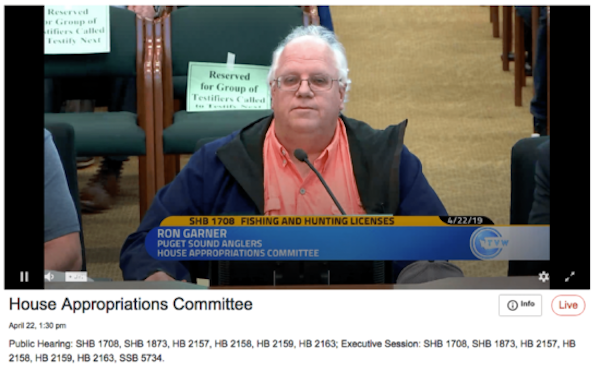
Ron Garner, state board president of Puget Sound Anglers, pointed out in a letter to Hageman and Hoyle that Congress has “invested billions of dollars” over recent decades to recover Endangered Species Act-listed salmon and steelhead in the Northwest, and that to maximize that investment all sources of fish mortality need to be addressed.
“One of the most immediate and measurable opportunities available today is reducing excessive pinniped predation on vulnerable salmon and steelhead populations,” Garner wrote.
“The Northwest Endangered Salmon Predation Prevention Act provides fisheries managers with another important science-based management tool. It complements ongoing habitat restoration, hatchery modernization, adaptive fisheries management, continued scientific oversight, humane implementation standards, annual reporting requirements, and the continued development of effective non-lethal deterrent technologies. This balanced approach recognizes that successful salmon recovery requires managing all significant factors affecting survival throughout the salmon life cycle,” he added.
NWIFC’s Johnstone pointed to a 2022 synthesis paper by the Washington State Academy of Sciences on pinniped predation on salmon and steelhead on Washington’s outer coast and inside waters that found “the preponderance of evidence supports the hypothesis that current populations of pinnipeds are a contributing factor in the decline and depression of salmon populations in Washington State waters. … Strategic and appropriately scaled adaptive management of pinniped populations are key to resolving these uncertainties but likely will require lethal removals.”
As it stands, WDFW, ODFW, IDFG and several Columbia Basin tribes are federally permitted to lethally remove a limited number of California and Steller sea lions in the Lower Columbia and Willamette. For all intents and purposes, that only occurs at Bonneville Dam and Willamette Falls. A total of 562 sea lions have been removed at both locations under various federal permits since 2008.
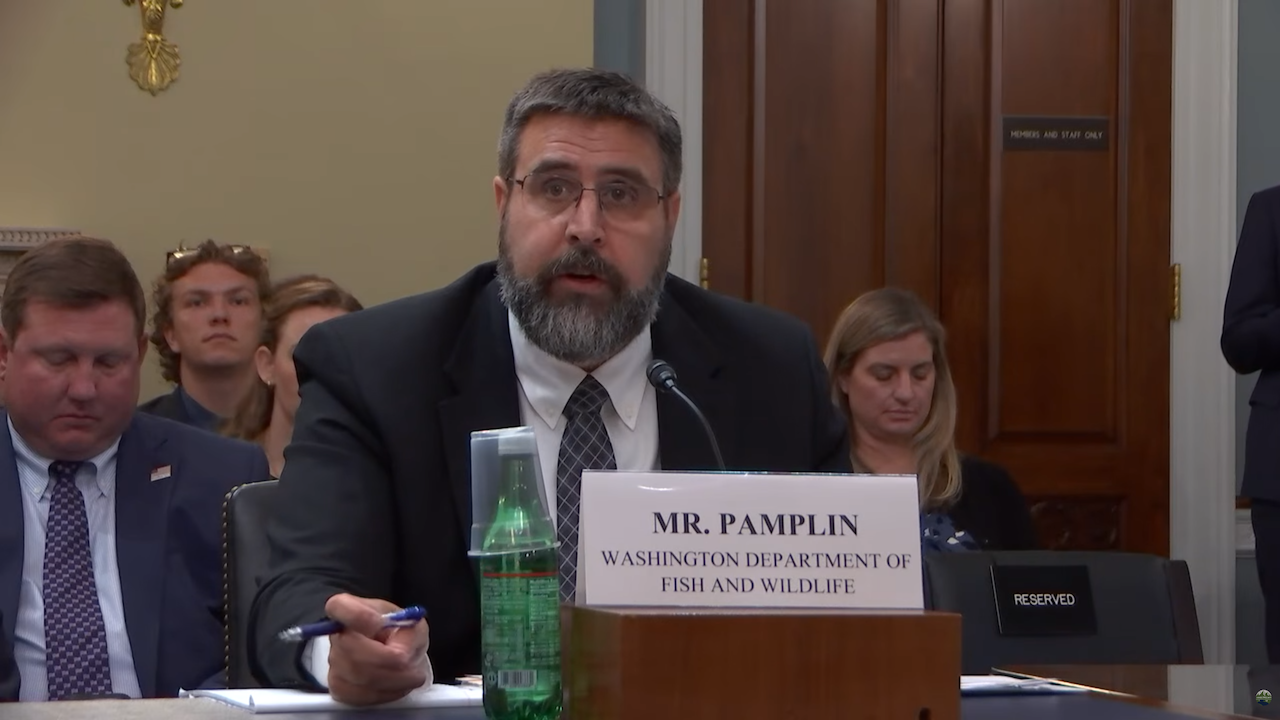
In supportive testimony submitted for today’s Congressional hearing, WDFW Director of External Affairs Nate Pamplin noted that those removals have produced demonstrable reductions in sea lion predation on salmon in the Columbia – since 2020, an estimated 39,000 fall fish and 25,000 spring Chinook have been saved – while the risk of extinction for Willamette winter steelhead has dropped from 89 percent to just 11 percent following the start of removals at the falls.
Removing sea lions elsewhere is nigh on impossible elsewhere due to an “individually identifiable” provision in the current federal permit that makes it difficult to capture, mark and observe problem pinnipeds beyond Bonneville Dam and Willamette Falls, Pamplin stated.
He said that federal research found that 20 to 44 percent of spring Chinook entering the Columbia River died “from causes unrelated to fishing activities, attributing most of this mortality to predation by pinnipeds.”
Pamplin also said that federal funding would be needed should removal authority be extended to the coast and Puget Sound.
“The lack of flexibility to conduct science-based predator management to reduce pinniped predation at hotspots hinders our ability to recover salmon. The Washington Department of Fish and Wildlife has a proven track record of working across threats to aid in species recovery, including intervening to mitigate additive effects of predation where it is determined to be a contributing factor. Whether removing birds of prey, corvids, coyotes, invasive species, or other wildlife to benefit ESA-listed species, this tool is used by the professional fish and wildlife managers at WDFW judiciously and humanely, the prey and the predator species are monitored, and it is part of a comprehensive approach to protect vulnerable life history stages while a suite of other simultaneous recovery efforts take hold,” Pamplin concluded in his written testimony.
During today’s hearing, Pamplin responded to concerns that the bill would lead to indiscriminate killing of pinnipeds. He said it would much more targeted to known locations that marine mammals were causing problems and that any federal permit would include lethal take conditions. It would not be carried out by hunters.
“I don’t see this bill as being an avenue for widespread removals,” he told Chair Hageman. “That is not something envisioned in the bill, and it’s not something we would do.”
The Columbia River Inter-Tribal Fish Commission has also weighed in in favor of the act, saying it would have a “negligible effect” on the California and Steller sea lion populations that visit the Columbia. Male sea lions enter the big river in late winter to follow the smelt and spring Chinook runs, while females and their pups stay away, so expanded removals wouldn’t impact the animals that drive the growth of both species.
“For years, tribal and state fisheries managers have shown that strategic, science-based removal of sea lions is an effective way to protect Columbia basin salmon and steelhead and prevent the habituation of this learned sea lion behavior. This legislation takes nearly 20 years of experience addressing this issue and gives it room to work beyond just the short stretch of river below Bonneville Dam. We appreciate Rep. Baumgartner and Rep. Randall’s work which will have direct and measurable benefits to fish survival, including struggling populations listed under the Endangered Species Act,” said CRITFC Executive Director Aja DeCoteau.
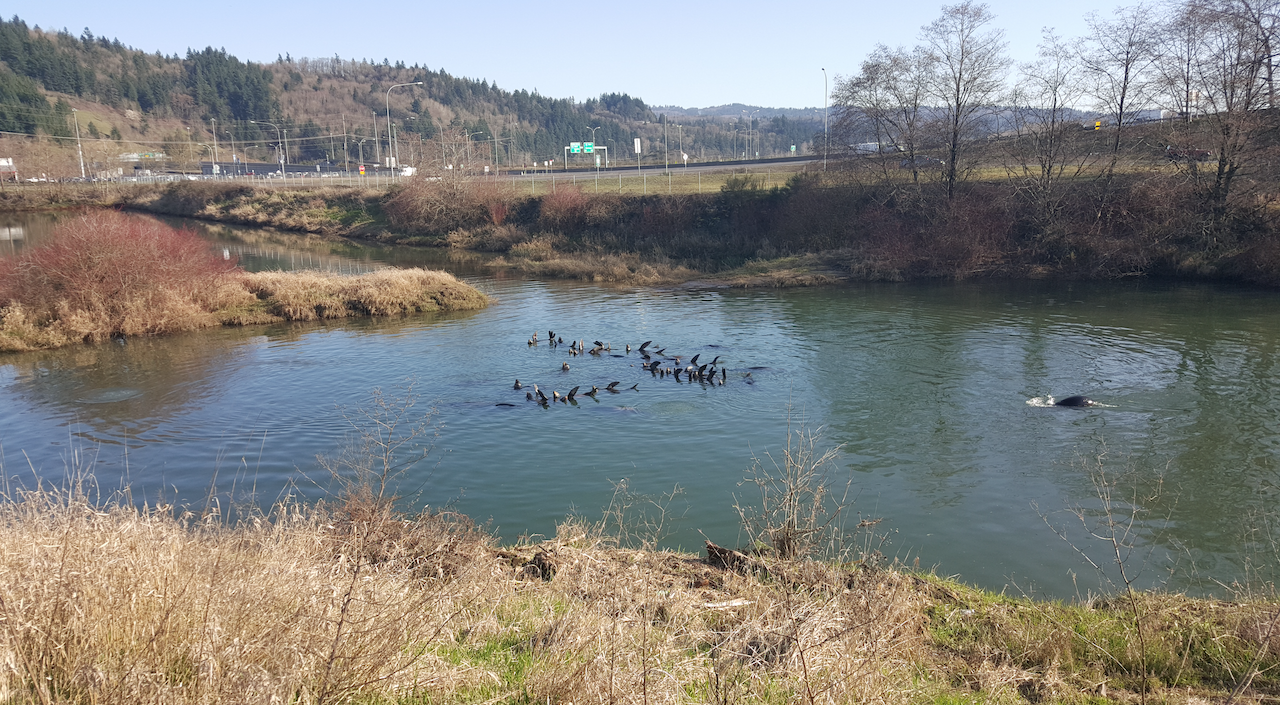
CRITFC also applauded the act’s “Columbia River Pinniped Exclusion Technology Accelerator,” which, according to language in the bill, would “stimulate innovation in the development of pinniped exclusion technology” in the Columbia and its feeder streams. Viral videos this spring showed sea lions well up tribs such as the North Fork Lewis below Merwin Dam, but predation on outgoing smolts is also a problem.
Pamplin’s testimony stated that past research in the Nisqually River delta in deep South Sound estimated harbor seals ate from 9 to nearly 33 percent of outmigrating steelhead smolts from 2016-18, while acoustic tagging data narrowed that to 11 to nearly 25 percent during the same period.
Johnstone said that harbor seal populations are at “carrying capacity”; Pamplin estimated that a “reasonable” potential biological removal level for three stocks in Washington inside waters totals just under 1,800 animals, which again is just a fraction of the overall harbor seal population.
A sea lion bill also introduced July 9 by Representative Marie Gluesenkamp Perez (D-WA03) has not yet been scheduled for a hearing. Where her bill would extend lethal removal authority to tribes using measures they deem fit, Representative Baumgartner’s bill requires take by adaptive management to be humane and carried out by states or tribes.
Gluesenkamp Perez made a brief appearance during today’s committee hearing and cast doubt on the viability of nonlethal measures to reduce pinniped predation. She is in a hotly contested reelection campaign against Washington State Senator John Braun (R-Chehalis).