



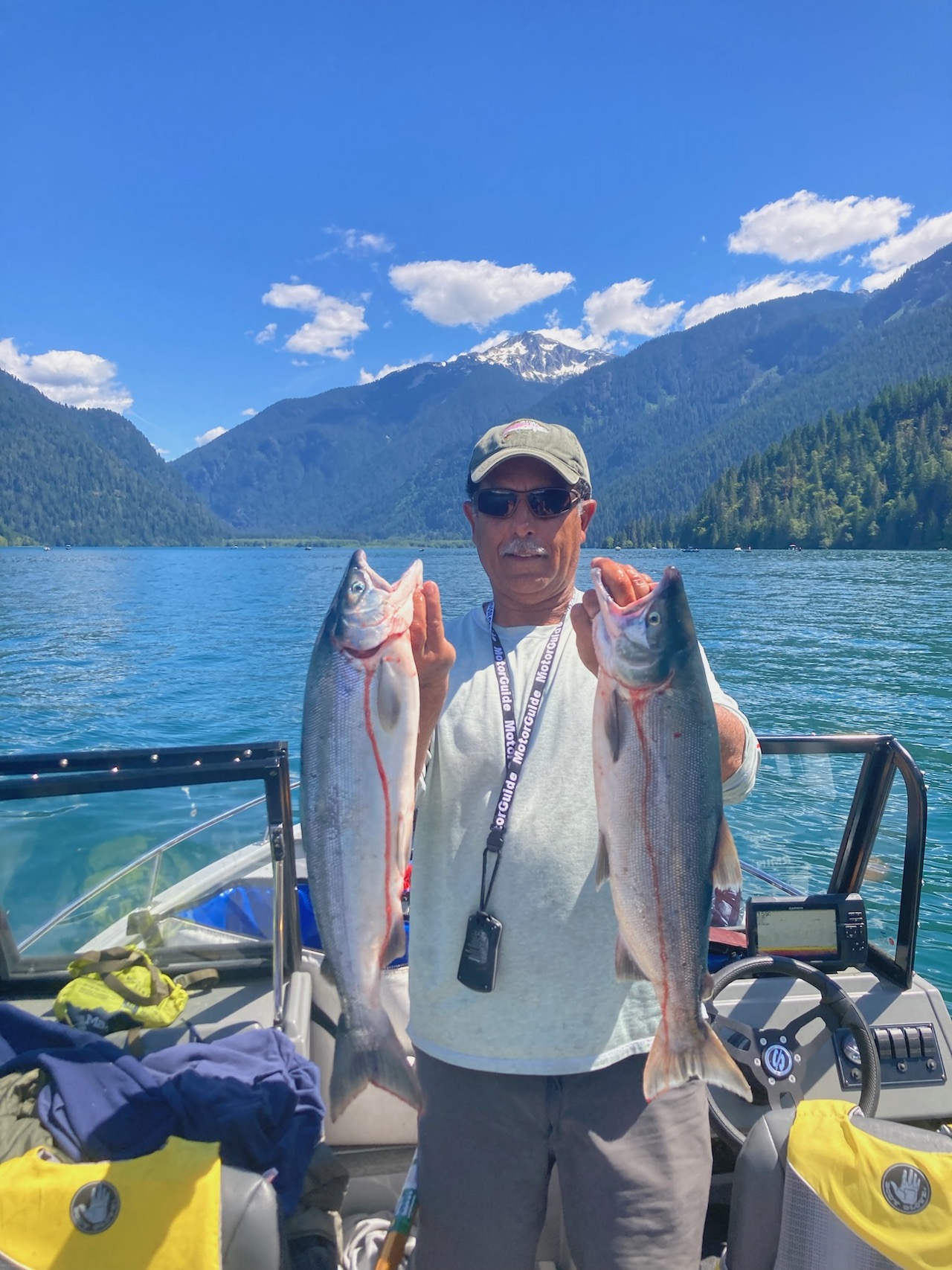
The Baker Lake sockeye prediction has been upgraded to even more North Cascadian heights.
WDFW, the Swinomish Indian Tribal Community and Upper Skagit Tribe now expect 90,000 of the tasty salmon back to the Skagit River, up from a preseason expectation of 60,214 and inseason updates of 80,000 and 85,000 in recent weeks.
“We are closing in on 80,000 actual fish accounted for between tribal harvest in the river and nearby marine areas, state recreational catch in the lower river, and traps counts,” said Chase Gunnell, WDFW North Sound region spokesman, today.
The old record return, set just two years ago, was 65,000 sockeye.
This year’s run up the Skagit to Baker Lake is a “bright spot” in a summer where other Washington sockeye stocks are faring worse or as poorly as expected,.
In its likely final update for the Columbia’s 2025 return, the U.S. v. Oregon Technical Advisory yesterday downgraded the forecast slightly to 167,500 back to the mouth of the big river, less than half of the preseason forecast of 350,200. Monday also saw state managers close sockeye retention in the Hanford Reach and Brewster Pool after their harvest allocations were met. On the flip side, Lake Wenatchee will open tomorrow, thanks to a smaller than expected but still robust run.
And, barring a miracle, it now looks like the 2025 Lake Washington run will indeed be the lowest ever. Gunnell said that 11,306 are estimated to have swam through the Ballard Locks as of Sunday and the latest inseason update tops the run out at 14,400, though it could still hit 16,700, which is 125 fish shy of 2019’s smallest return on record back to at least 1972.
The question on many anglers’ and others’ minds is, why the disparity between Westside sockeye runs?
“It’s likely the combination of much warmer waters in Lake Washington and Lake Union than in Baker Lake and Lake Shannon – warmer waters contribute to greater odds of disease and stress during both smolt outmigration and adult return migration – as well as predation from non-native fish in the Lake Washington watershed and other challenges for outmigrating smolts navigating the placid urban lakes and ship canals,” Gunnell stated.
He says that even with the Ballard Locks Adult Sockeye Transfer, or BLAST, Program and hatchery production on the Cedar, Lake Washington’s main sockeye spawning tributary, “those water and ecosystem conditions make sockeye recovery much more challenging in the urban Lake Washington watershed than the Baker/Skagit system in the North Cascades.”
That said, WDFW and tribal comanagers “remain committed” to their recovery programs, “and hope to continue scaling up those efforts to meet the need, as funding allows,” he said.
The hope is that the Washington Fish and Wildlife Commission will include predator suppression funding in their request to the state legislature for next year’s short session.

