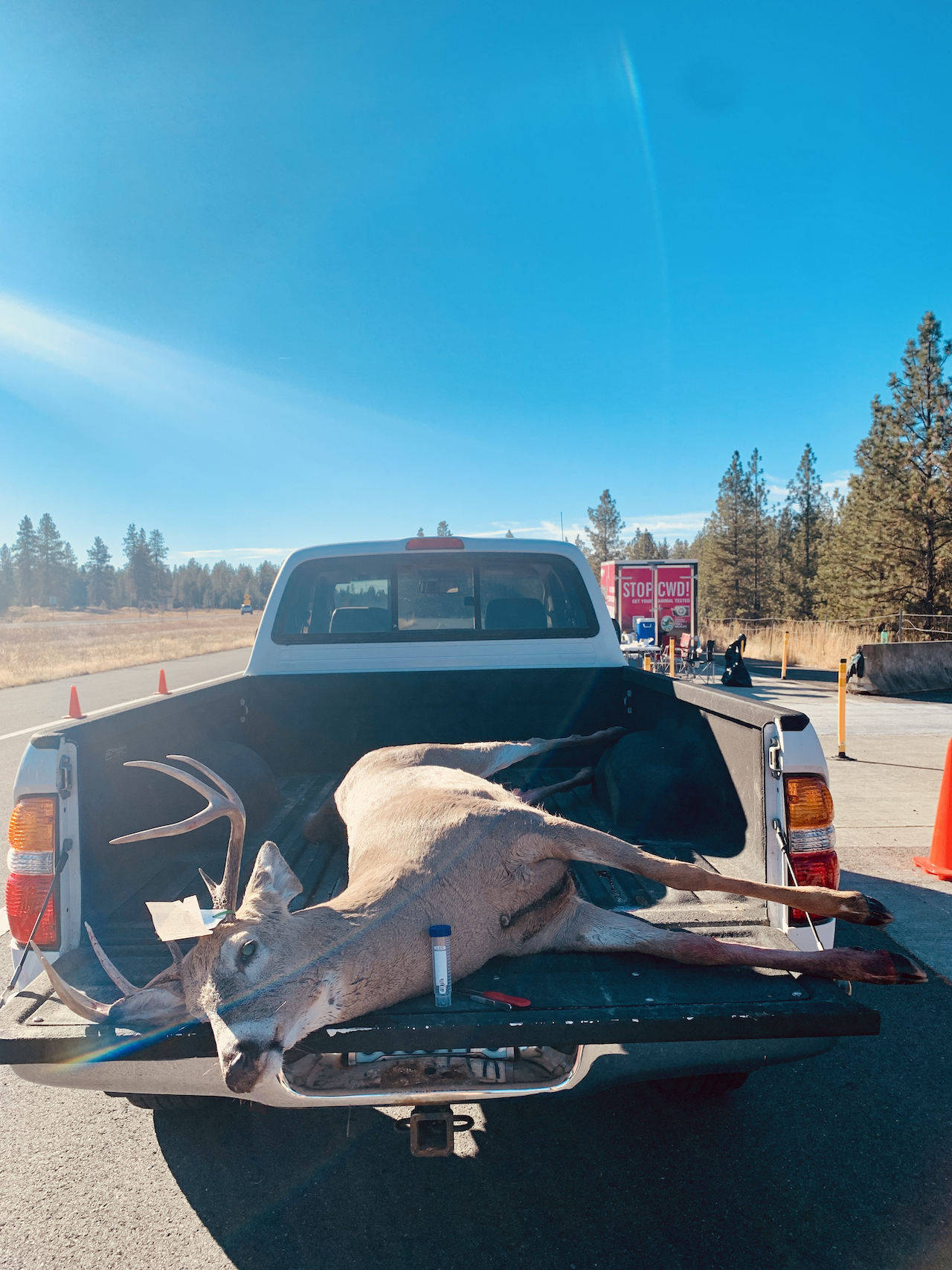
HEY! YOU! Lucky hunter with the dead far Eastern Washington deer in the bed of that pickup headed west on I-90! Nice buck, but did you know you can’t bring the whole carcass of any deer nor elk or moose out of 100-series game management units any more?

That might be what WDFW wildlife managers wish they could say in person to the few Evergreen State hunters apparently still transporting their kills whole out of the region despite rules in place barring just that.
The rules are meant to help slow the inexorable spread of chronic wasting disease, and the agency has been doing its best to get the word out on the still relatively new transportation regulations, but Region 1 spokeswoman Staci Lehman today said that most of WDFW’s other five administrative regions have had at least one instance each where a hunter came home with an entire carcass of a 100-series deer this season.
(See bottom for the full list and map of those 100-series units)
To be fair, these past two years have seen new CWD rules coming at hunters faster than a stater screaming out of Sprague in pursuit of a speeder, and there’s no sure way to get the complete, undivided attention of the hunting community these days, so some folks are always going to be caught unaware.
The always-fatal deer family disease was only first discovered in Washington in mid-2024, in a whitetail doe that died just north of Spokane. In the years beforehand after CWD was confirmed next door in Idaho, WDFW had been raising the alert among hunters and roadkill salvagers, upping sampling at game check stations, and implementing emergency testing and transportation rules as it prepared for the inevitable dread arrival.
Then earlier this year, the rules were bolstered as Director Kelly Susewind approved a suite of statewide anti-CWD measures.
Those include outlawing the baiting and feeding of deer, elk and moose across Washington – not just under treestands, but also for people dumping food in suburban backyards for Bambi – as well as a ban on the use of scents made with the urine or glands of all cervids.
And all deer, elk and moose harvested (or collected as roadkill) anywhere in 100-series game management units – essentially, all of Ferry, Stevens, Pend Oreille, Spokane, Lincoln, Whitman, Walla Walla, Columbia, Garfield and Asotin Counties – now must also be tested for CWD, per WAC 220-413-030.

That can be done by presenting the head of a buck or bull, cow or doe with at least 3 inches of attached neck, OR the extracted lymph nodes, to biologists before heading out of Region 1 and within five days of the kill.
Afterwards, WDFW says hunters can then legally move the following parts of their harvest to other parts of Washington:
• Finished taxidermy mounts;
• Meat that has been de-boned in the area it was harvested and is imported as boned-out meat.
• Any part of the skull and antlers with all soft tissue removed. Soft tissue is any tissue that is not tooth, bone, or antler (velvet must be removed);
• Hides or capes without heads attached;
• Tissue imported by researchers with preapproved permits for use by a diagnostic or research laboratory.

True, not being able to drive a carcass back to Wenatchee or Tri-Cities or Bellingham to cut up in the comfort of your own shop or back porch within easy reach of the chest freezer adds complexity to a hunting expedition, but with CWD case numbers likely to rise as more samples are processed this fall at the state lab in Pullman, WDFW is trying to get the new rules in front of all hunters’ eyes.
“We’ve spent a significant amount of time and effort getting the word out about this, including through news releases, social media posts, presentations to interested groups, media interviews, direct emails to hunters, flyers, signs, etc., but we’re still finding violations,” said WDFW’s Lehman, who is based in Spokane.
She joked darkly that she might dress up for Halloween as a zombie deer and start going door to door to help spread the word. “Trick or treat, smell my decaying meat, gimme some more brainz to eat.”
CWD is known as the zombie deer disease because it affects the brain of infected animals. Symptoms include excessive salivation, drooping head/ears, tremors, extremely low body weight, and unusual behavior, such as showing no fear of humans and lack of coordination.
It can be passed between deer via bodily fluids such as poop, pee, snot and spit, among others, and the disease can survive in the soil for years, thus the reason not to concentrate animals with bait piles and why bones should be left at the site of the kill.
I hate to sound like a damn broken record, but the idea behind all the transportation restrictions, sampling and testing is to detect CWD outbreaks early to help contain or at least slow the disease from spreading further into Washington, and sportsmen are a key part of that effort.
Nobody should be fighting this; it’s that important.
Per Montana Fish, Wildlife & Parks, should enough deer become infected, population declines are likely, with Wyoming seeing 21 percent annual declines in heavily infected mule deer herds, 10 percent in whitetails.
Lehman says there is “extensive info on transport and every other CWD-related topic under the sun” on the agency’s webpages for the disease, wdfw.wa.gov/cwd. It has sampling sites, transfer stations that take carcasses, videos on how to extract lymph nodes, and more.

So far this year no new Washington CWD cases have been confirmed, she says. All five known infected deer were discovered in 2024, mostly via hunter samples submitted during last fall’s seasons.
The disease was first found in GMU 124, Mount Spokane, in Spokane County, and then in GMU 117, 49 Degrees North, in southern Pend Oreille County.
As a reminder, 100-series GMUs are simply those units numbered from 101 to 186. The list includes:
101 Sherman, 105 Kellyhill, 108 Douglas, 111 Aladdin, 113 Selkirk, 117 49 Degrees North, 121 Huckleberry, 124 Mount Spokane, 127 Mica Peak, 130 Cheney, 133 Roosevelt, 136 Harrington, 139 Steptoe, 142 Almota, 145 Mayview, 149 Prescott, 154 Blue Creek, 157 Mill Creek Watershed, 162 Dayton, 163 Marengo, 166 Tucannon, 169 Wenaha, 172 Mountain View, 175 Lick Creek, 178 Peola, 181 Couse and 186 Grande Ronde.

The various deer, elk and moose hunting seasons continue into December in Eastern Washington. See the regulations pamphlet for specific dates.