
2026’s First Salmon Forecast Out: 147,300 Upriver Columbia Springers
Columbia salmon managers are forecasting 147,300 above-Bonneville-bound spring Chinook in 2026, similar to last season’s actual return that bested the prediction by over 30,000 fish and allowed for angling in May and June on the lower river.
If the forecast comes to pass, it would be the fourth largest run since 2016.
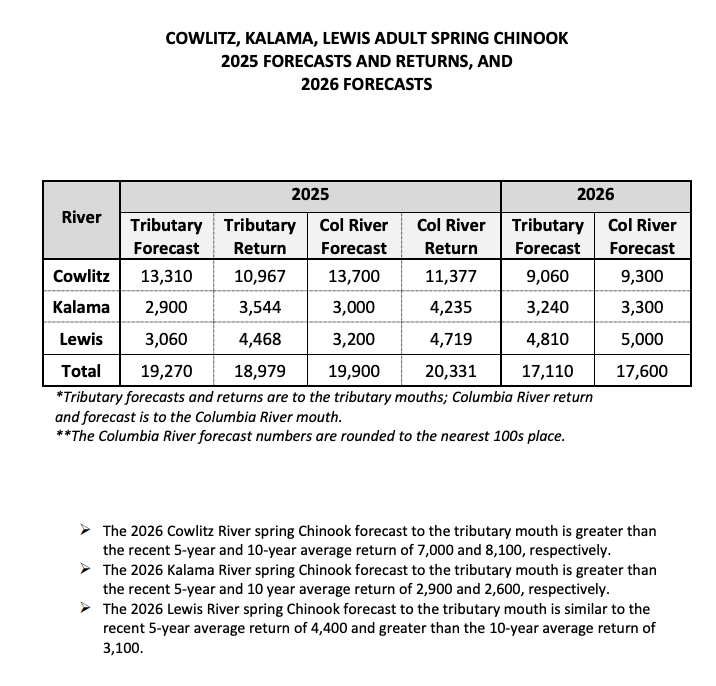
The overall springer prediction back to the mouth of the Columbia – a figure which includes Willamette, Sandy, Cowlitz, Kalama and Lewis fish – is 222,300, about the same as last year’s forecast but slightly down from the 245,379 springers that actually came back.
Today’s reveal essentially marks the public kickoff of 2026’s salmon-season-setting process, and from it managers at WDFW and ODFW later this winter will set initial fisheries on the lower end of the big river and its gorge pools based on a protective runsize buffer, the number of Snake wilds in the mix and nontribal allocations. Next year’s Snake natural-origin forecast is for 12,500, well up from last year’s forecast and just a bit below how many actually came back.
Springers are a coveted fish, providing an early-year salmon fishing opportunity and tasty filets. The Columbia’s fishery is intensively managed, with the initial round of angling on the lower river typically going into early April with catches closely monitored to determine if any more fish/days are available before the wait till the May runsize update and possible additional time on the water.
Since 1985, the highest preseason upriver forecast was 2010’s 470,000, while 1995’s 12,000 marks the low-end prediction; 2001’s 416,500 fish was the largest actual run and 1995’s 9,800 the smallest.
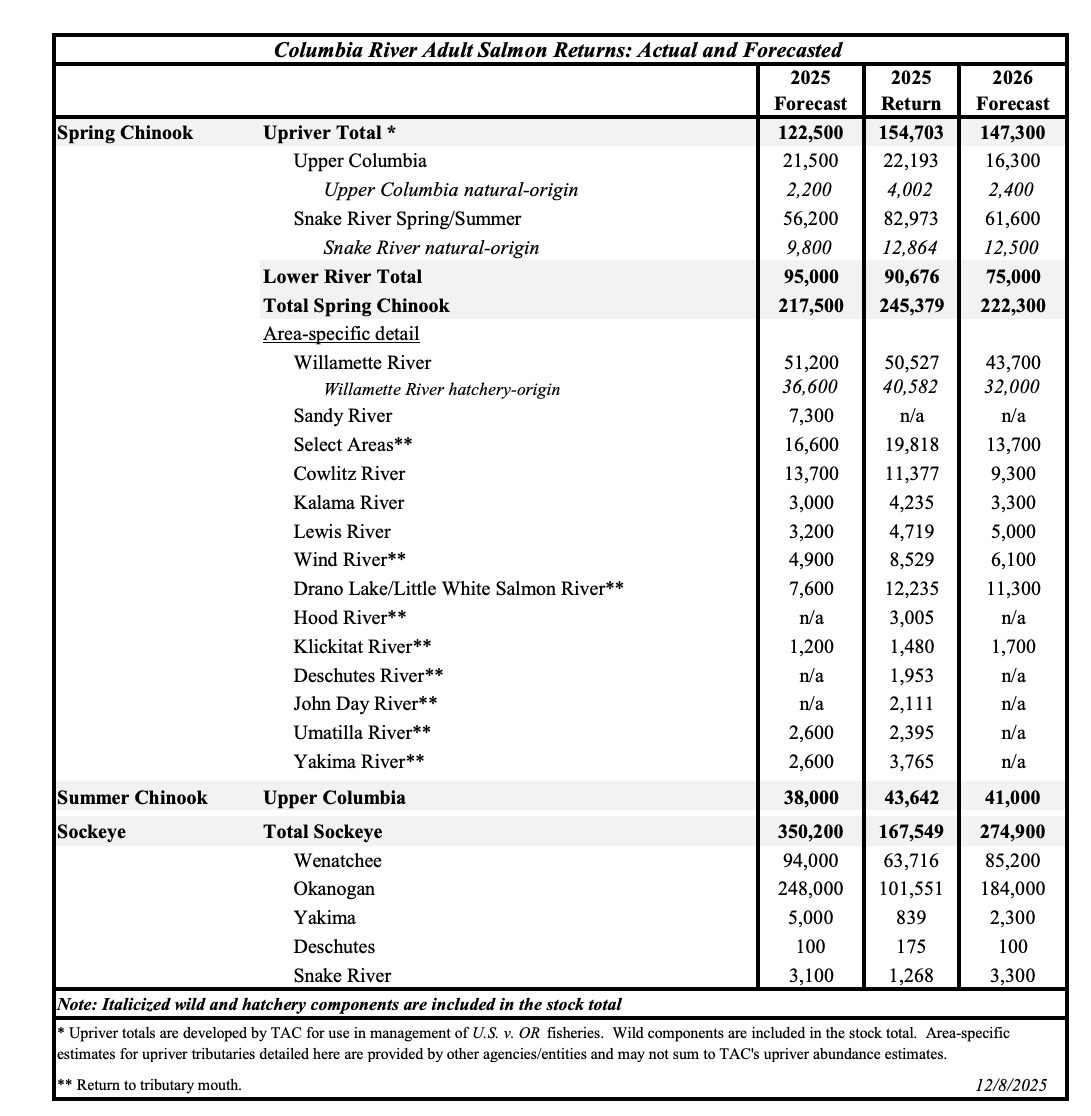
Managers also posted forecasts for Lower Columbia tributary springers, including the Willamette (43,700, down from last year’s forecast and actual return), Cowlitz (9,300 to the mouth of the Columbia, down from last year’s forecast and actual return), Kalama (3,300 to the big river’s mouth, up from last year’s forecast but slightly down from the actual return) and Lewis (5,000, up from both the forecast and actual).
Of note, the Willamette forecast is not large enough to again allow two-rod fishing; 34,000 hatchery fish is the minimum cutoff for that, but managers expect only 32,000 clipped kings.

The Wind River forecast is for 6,100 to the Washington-side gorge pool tributary (up from 2025’s forecast but below the actual return), Drano Lake’s is 11,300 (well above last year’s prediction but down a bit from the actual return) and the Klickitat’s is for 1,700 (up from both the forecast and actual).
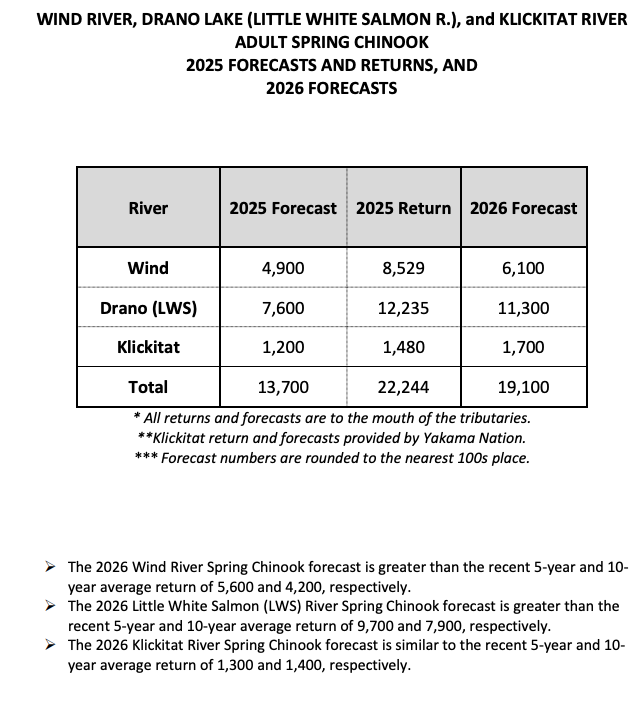
Managers also put out expectations for Upper Columbia summer Chinook (41,000, up from the forecast but below the actual return) and Columbia sockeye (274,900, on the lower side, grand scheme, but below last year’s forecast but above the actual by more than 100,000 fish).
Sockeye break out as 85,200 to Lake Wenatchee and 184,000 to the Okanogan/Okanagan (both down from 2025’s forecast but up from the actual). The Snake River forecast is for 3,300, a bit more than last year’s forecast and well above the actual return).
Next year’s fishing seasons will also see the return of the Columbia Basin Salmon and Steelhead Endorsement in Washington, required to fish for Chinook, coho, winter-runs and other fish in the watershed, and higher Oregon fishing license, combined and hatchery tag fees, the first increase since 2020.
And speaking of Oregon and salmon, its Fish and Wildlife Commission will have an informational discussion about the pros and cons of barbless hook regulations on the Columbia this Friday. The barbless requirement came out of the early 2010s’ management reforms. Bill Monroe previewed things in an Oregonian article out of last weekend.
About Author
