BY ANDY WALGAMOTT, NORTHWEST SPORTSMAN MAGAZINE
It’s waaaaay too early to get that long-handled net down, but the 2026 Columbia River smelt forecast at least holds out the potential for an opener and tentative dipping dates for the Cowlitz have been set.
Managers expect a continuation of the downward trend seen the past three winters and say the run is likely to come in below the 10-average of 8.1 million pounds.
“The 2026 return will largely consist of Age-3 and Age-4 fish from the 2022 and 2023 brood years, with some added contribution from the stronger 2021 cohort (Age-5). Marine conditions important to eulachon survival, including upwelling patterns and copepod community structure, have been mixed and trending negative since 2023,” states the DFWs’ joint staff smelt report, which was issued today.
Put that forecast into the complex parameters of the Washington and Oregon Eulachon Management Plan, and it translates out as starting the season out at the Harvest Phase 2 level – the second lowest of four in the plan – and an allowable 2 percent harvest rate for the Endangered Species Act-listed stock.
“Based on the forecast and preseason evaluation, limited commercial and recreational fisheries may be supported in the Columbia, Cowlitz, and Sandy rivers,” the report says.
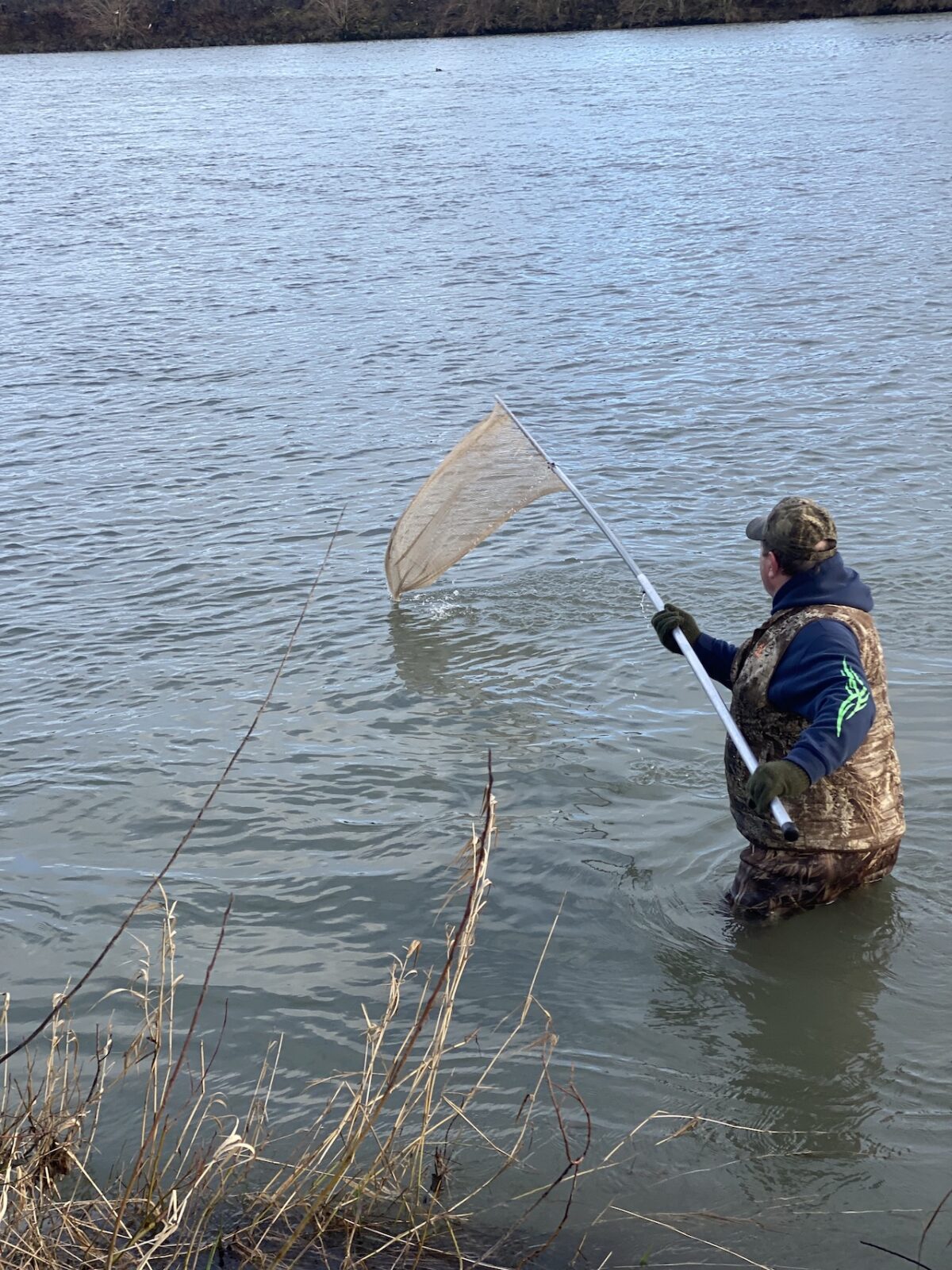
Fisheries have typically been held in Washington’s Cowlitz and/or Oregon’s Sandy after commercial test netting and other factors suggest rising abundance of smelt in the shared mainstem Columbia.
That still holds, but last winter, WDFW added a new wrinkle and announced a slate of tentative Wednesday and Saturday openers on the Cowlitz, then issued a greenlight or a no-go for a given upcoming week based on the most recent run evaluation.
Unfortunately, none of the four ultimately approved recreational dipping days in mid- and late March resulted in any smelt being harvested on the Cowlitz, with the fish staying just downstream of the mouth, at least for the first set of dates. And according to the joint report, tribal ceremonial and subsistence harvests yielded just 5,460 pounds worth, the lowest mark since 2018, when none were.
But Oregon dippers did find some on a one-day late March opener, harvesting 75,927 pounds from the Sandy.
Managers estimate 7.1 million pounds of smelt entered the Columbia last winter. That’s down from 2022’s high mark of 18.3 million pounds, but well above levels seen in 2011, 2012, 2018 and 2019, when no dipping occurred. Between tribal C&S, Sandy River and commercial test netting, a combined 133,327 pounds of smelt were harvested last season, the most since 2022 and sixth most since 2013.
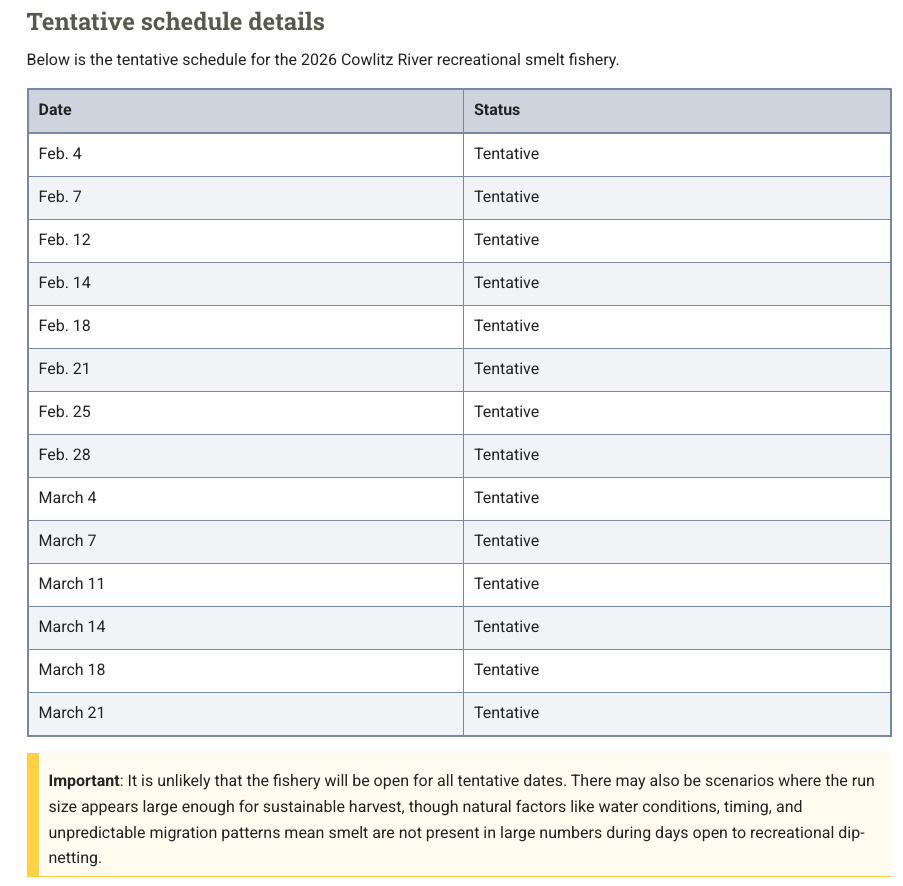
For 2026, WDFW has already posted a tentative smelt-dipping schedule with 14 days set aside in February and March, again Wednesdays and Saturdays.
According to the agency, the idea behind posting a list of possible opener days instead of sending out a emergency rule change notice is “to provide greater advance notice of potential fishing days, while balancing increasing effort with sustainable management practices. This approach also allowed for better coordination with local partners and communities, improved compliance with the fishing license requirement, and provided flexibility to adjust the schedule based on real-time data, such as commercial landings, or catch reports.”
Now, for the smelt to actually cooperate better with that schedule …
For more on Cowlitz River smelt, see WDFW’s webpage.