BY ANDY WALGAMOTT, NORTHWEST SPORTSMAN MAGAZINE
Kudos to a Bellevue high school student who figured out an effective and cheaper way to remove a coho-killing chemical from stormwater runoff and was recently awarded $75,000 for her idea.
Lakshmi Agrawal, 18, says her biodegradable cellulose nanofiber hydrosponge captures up to 80 percent of 6PPD-quinone and tire wear particles, along with heavy metals.
“Hydrosponges are an immediate solution for the $143 billion tire industry, while simultaneously protecting salmon populations and ultimately drinking water,” she said in a video about her findings.
6PPD-q is the chemical result of a tire preservative reacting with ozone at ground level. When flushed into streams, it quickly kills coho and coastal cutthroat trout. Termed “the DDT of our generation,” it was first noticed in Seattle’s Longfellow Creek, sparking research about the cause before a “smoking gun” was found in 2020. A specific mix of materials will filter it out, but the scope of the problem is vast, as illustrated by a story earlier this year about how crumb rubber used on sports fields leaches the pollutant for years and years.
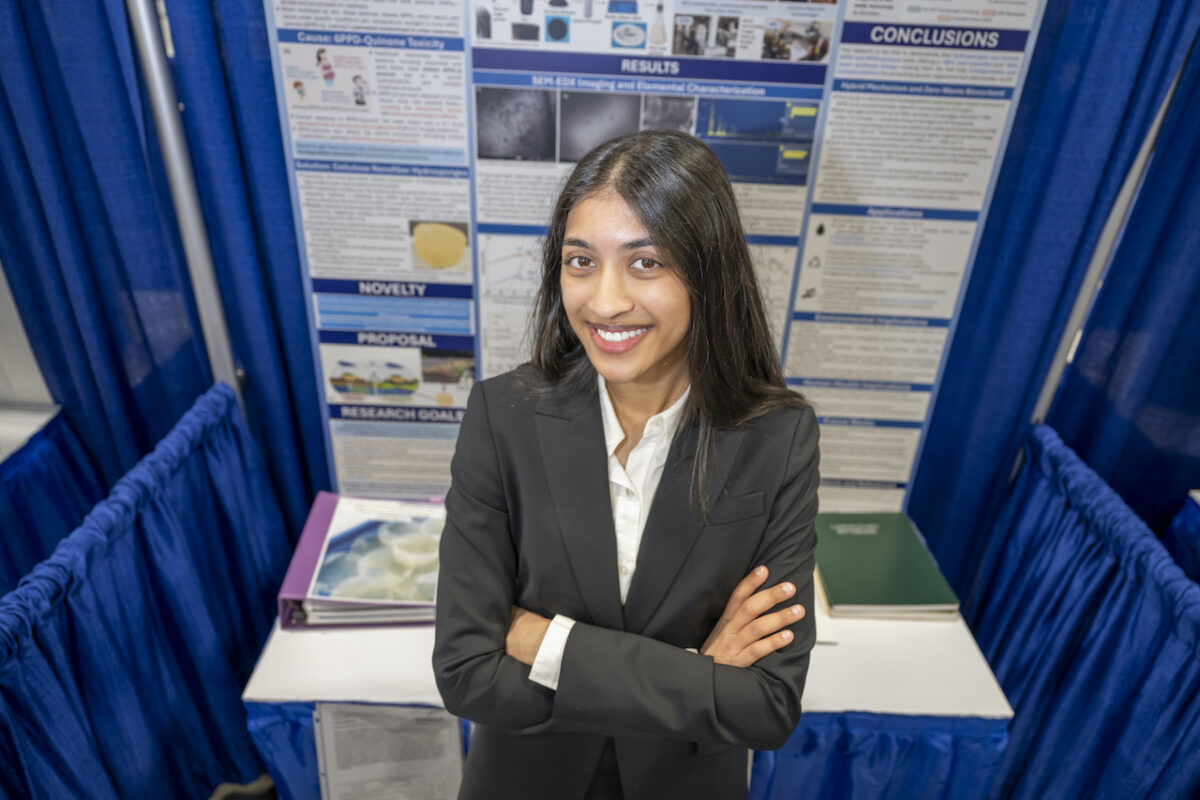
Agrawal said that after noticing increased coho mortality in her local waters, she learned about 6PPD-q as the cause and wanted to figure out a way to remove it in the near term as tire industry researchers look for long-term solutions.
She details her idea in the video, and essentially it involves modifying jute plant waste fibers in certain ways so that they trap tire wear particles and 6PPD-q.
“Compared with current alternatives, Lakshmi’s solution required 85% less energy to produce and reduced costs by about 98%. Her work may lead to a scalable way to protect aquatic ecosystems and drinking water from tire-related contaminants,” said the Society for Science in a press release announcing her winning of a Regeneron Young Scientist Award last week.
The society works to boost science literacy and holds a worldwide engineering and science competition for precollege students. This year, over three dozen students won awards ranging from $6,000 to $100,000.
“These students never fail to inspire me. They come from different backgrounds, different disciplines, and different corners of the world, and they are taking on some of our most urgent challenges with rigor, imagination, and determination. At a moment when bold thinking is needed most, they are proof of what’s possible,” said Maya Ajmera, society president and CEO.
Agrawal is a senior at Interlake High School and plans to go to MIT, according to a GeekWire story on her award.