



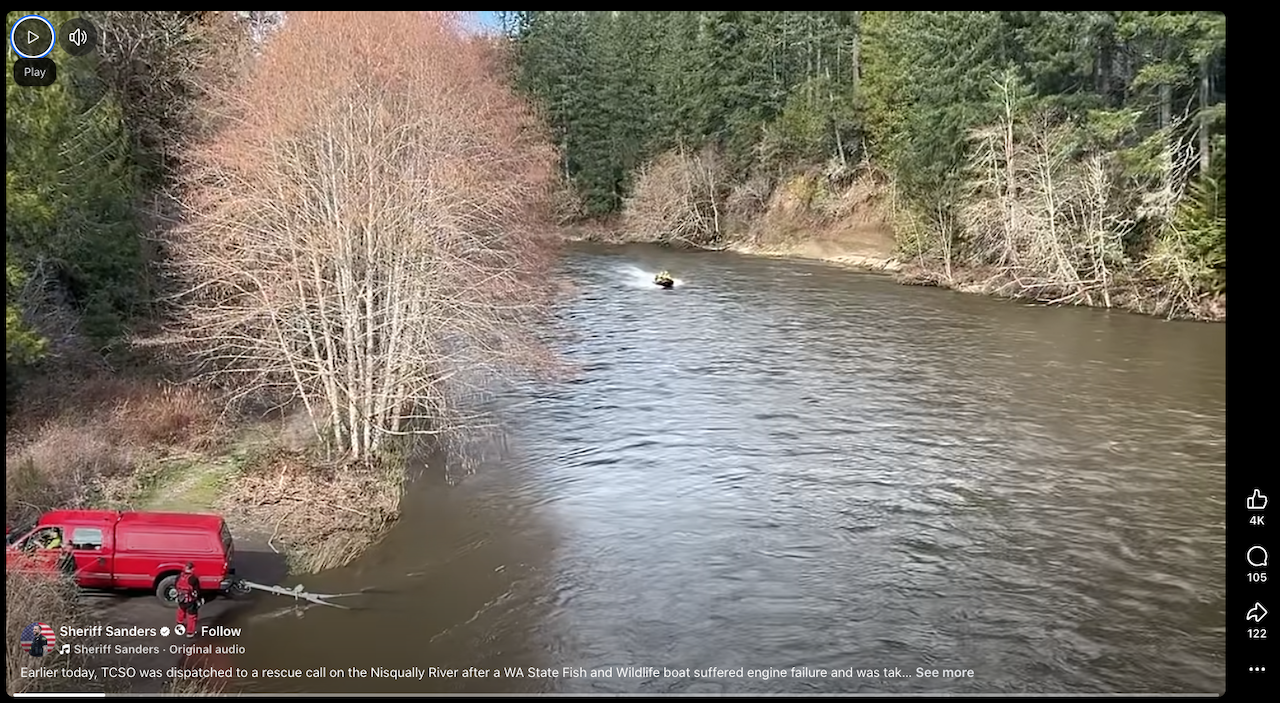
Crews had to come to the rescue Monday afternoon when a WDFW boat broke down after working on a Nisqually River smolt trap.
WDFW reports that while two crew members were able to get to the bank, the operator and boat ended up stuck on a log jam, leading to multiple rescue teams being dispatched to the river downstream of Yelm.
“The engine on the vessel had lost power while three staff were headed to shore in the boat, after removing a broken boat deflector from a fish trap used to monitor juvenile salmon migrations,” an agency statement posted yesterday reads. “The staff navigated the vessel to shore, and two WDFW staff were able to disembark. However, the boat operator was unable to disembark due to the current, and the vessel was swept downstream.”
Responders included the Thurston County Regional Dive Rescue Team, which was in the area performing training, according to Thurston County Sheriff Derek Sanders, as well as Thurston County Sheriff’s Office, Lacey and Southeast Thurston Fire Departments, Nisqually Indian Tribal Police and WDFW Police.
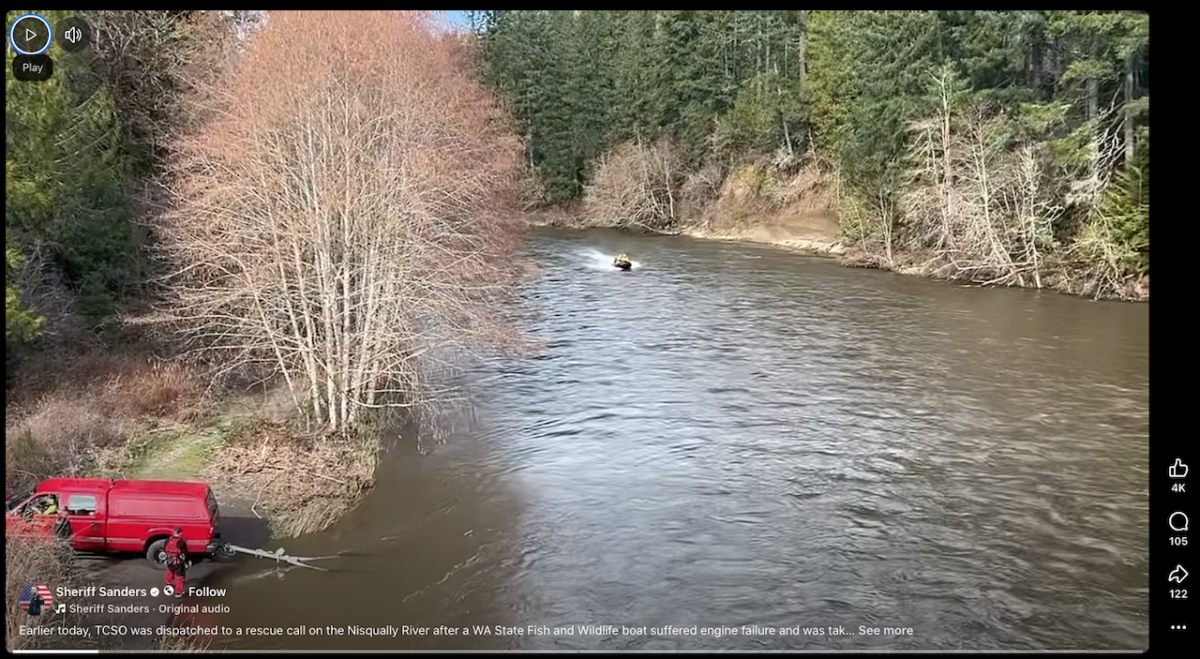
The dive team “quickly located the operator, and brought them to shore,” stated WDFW, which reported that the staffer “received a medical evaluation on scene and was released.”
The three WDFW employees in the boat “had the appropriate safety gear, including personal flotation devices.”
In early 2024, a technician hit his head on the bottom of a smolt trap on the Nisqually after his boat capsized. That led to an initial $86,400 fine from the state Department of Labor & Industries. WDFW appealed the characterization of the accident but took “corrective actions” identified by L&I on that incident and another at a Duckabush River smolt trap that led to the death of a staffer.
Smolt traps help monitor salmon and steelhead populations, many of which in Washington are federally listed, but operating and maintaining the devices comes with “significant operational challenges associated with maintaining both staff safety and fish health under dynamic environmental conditions,” per WDFW.
At the time of this latest incident, the Nisqually was running at about 4,200 cubic feet per second upstream at McKenna, down from 8,600 cfs following last week’s precipitation.
In its statement, WDFW thanked rescuers’ fast response and said it would attempt the recover the boat along with tribal police.
