BY ANDY WALGAMOTT, NORTHWEST SPORTSMAN MAGAZINE
A minimum of 270 wolves roamed Washington at the end of 2025, a 17.4 percent jump over the previous annual count. The rise marks a return to the population’s growth after just a one-year blip across 16 years of surveys.
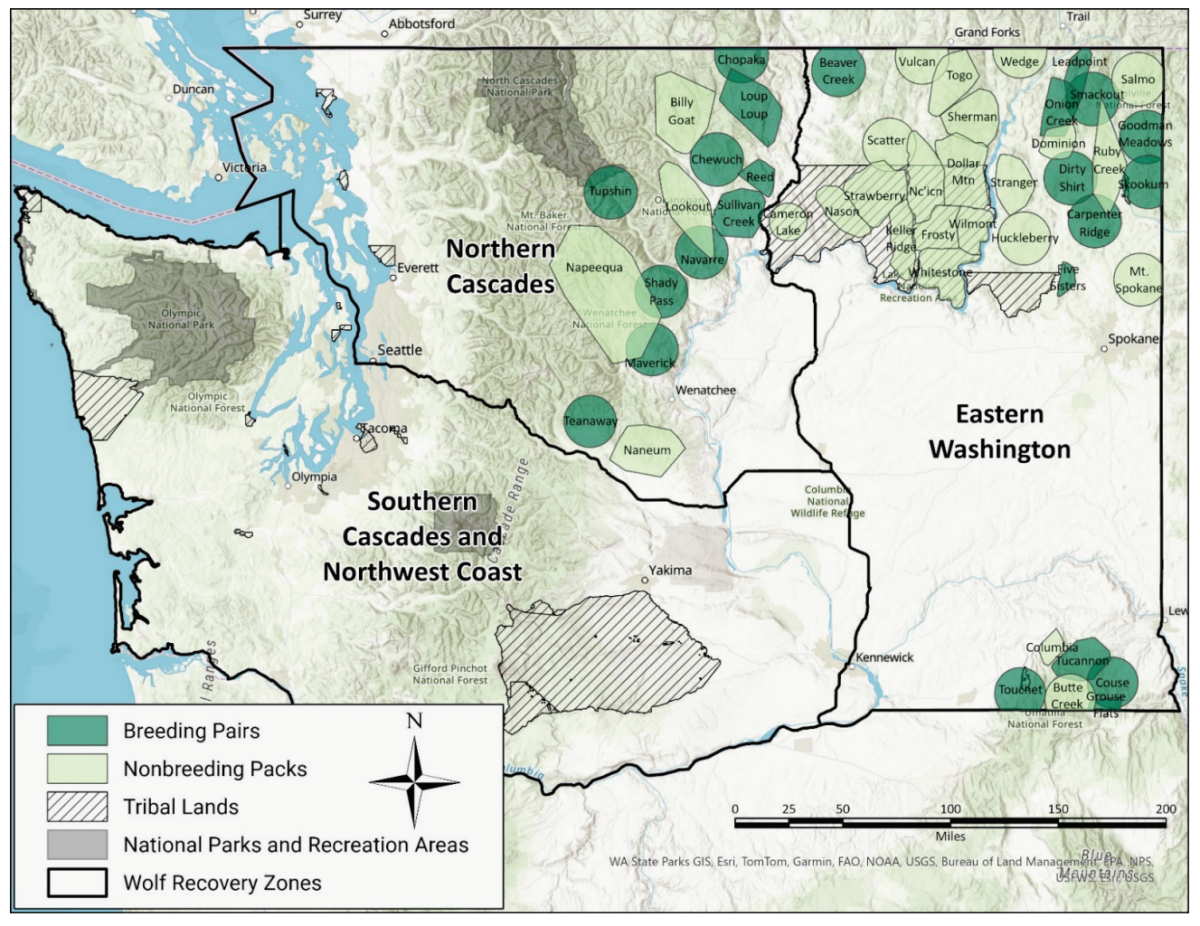
WDFW and tribal managers report there were 49 packs in the state, 23 of which were successful breeding pairs, up from 230 wolves, 43 packs and 18 successful breeding pairs last year. Figures come from the 2025 annual report.
Since 2008’s first annual survey, Washington wolf numbers have increased 21.5 percent a year, an inexorable rise that has come despite lethal removals to head off livestock depredations, as well as tribal hunting, poaching, cougars’ predilection to brain-bite wolves, and roadkills.
Oregon also today reported its population grew from a minimum of 204 to 230, a 13 percent increase, meaning that at the very least there are now 500 wolves in the two-state region. See more on Oregon at bottom.
WDFW reports that six new packs either formed or were reestablished last year, including Salmo, Smackout and Vulcan in Northeast Washington, Cameron Lake on the Colville Reservation, Billy Goat in the upper Chewuch Valley of Okanogan County and Tupshin in Chelan County at the head of Lake Chelan near North Cascades National Park.
Most of the state’s wolves remain in the North Cascades and Eastern Washington Recovery Zones, with growth largest in the former and carrying capacity being reached in the state’s northeastern and southeastern corners. Biologists note how much larger territories are in the North Cascades versus in the Blues and Selkirks, symbolic of room to spare and close quarters.
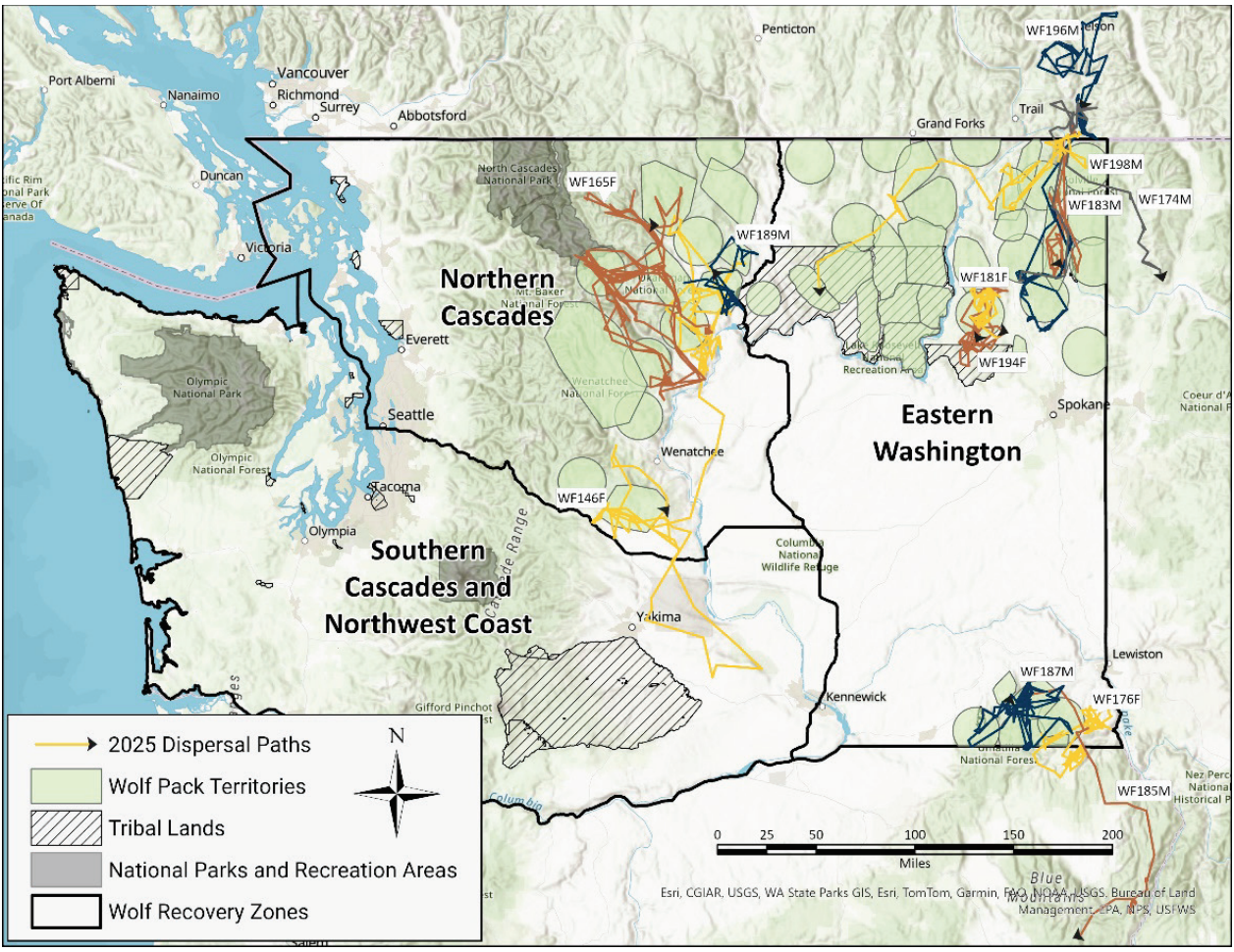
While two wolves dispersed into the South Cascades and Northwest Coast Recovery Region, none turned up in official winter 2025 surveys.
Overall, more than a dozen collared wolves headed out from their home pack in 2025, including one that went past Commissioner Molly Linville’s ranch in lower Moses Coulee down to the Rattlesnake Mountain area near the Hanford Reservation before heading back north, while another went around Lake Chelan three times. Washington animals also went to Oregon, Idaho and BC.
A total of 28 Washington wolf deaths were recorded in 2025, including 12 harvested by tribal hunters, four removed by WDFW, two caught in the act of depredating on livestock, and one that drowned during December’s flooding and turned up at Stehekin, among others. Total mortality was down from 37 in 2024.
The state’s packs were confirmed to have killed eight calves and injured eight more, while two other calves were probably injured by wolves. Ten percent of the packs depredated last year.
Over the long haul, both depredations and lethal removals have remained generally low, WDFW biologists stated, though they acknowledged that some producers may not report losses and conflicts.
“As wolf populations grow, Washington State will need to increase its investment to support ranchers and other rural residents adapt to increased wolf activity on the landscape,” said Dave Werntz of Conservation Northwest in a press release.
A total of $2 million was spent on wolf management in 2025, mostly for management and research and including $92,400 for lethal removals, $146,000 for range riders, $102,000 for cooperative agreements with ranchers for nonlethal measures, and $90,400 for livestock loss claims.

This latest survey illustrates that long-term trends are far more important than short-term ones that might be used for fundraising alarms.
“If wolf recovery is the goal, this looks like wolf recovery to me,” said Commissioner Linville.
“This is definitely progress,” said Commissioner Barbara Baker, who also acknowledged that 2011’s statewide management plan was “getting a bit long in the tooth.”
That plan says the statewide recovery goal is four successful breeding pairs in the three recovery regions plus three anywhere in the state for three straight years, or 18 in certain numbers in certain zones in a single year.
In 2024, the commission infamously failed to downlist wolves from endangered to sensitive, as recommended by WDFW staffers.
Wolf populations can sustain high levels of mortality and still grow, state biologists told Commissioner Lorna Smith this afternoon as she quizzed them about Colville Tribes wolf data and counts.
Asked by Commissioner Woody Myers about the impact of winter’s weak snowpack on captures, biologists said the lack of snow affected them in Northeast Washington much more than the Blue Mountains or Okanogan Valley.

MEANWHILE IN OREGON, ODFW reported that its 230 wolves comprise at least 30 packs, up from 25 in 2024, and 23 of which qualify as breeding pairs, up from 17 the year before.
“Wolves in the West Wolf Management Zone (WMZ) reached the conservation objective of four breeding pairs and the minimum management objective of seven breeding pairs for the second consecutive year. If seven breeding pairs are documented after the end of 2026, the West WMZ will move directly into Phase III of the Wolf Plan. The wolf population in the East WMZ continued to exceed the Wolf Plan minimum management objective of seven breeding pairs, and these wolves continue to be managed under Phase III of the Wolf Plan,” the agency’s annual report states.
ODFW reported 42 wolf deaths in 2025, 39 of which were caused by humans, including 20 for chronic livestock depredations, three under caught-in-the-take provisions, three by roadkill, two by poaching, as well as seven out of concern for human safety – a relatively unusual category.
Six of those wolves killed over safety came from the Madison Butte Pack, which ranged across Morrow County outside Heppner. According to the report – which appears to be the first place where the pack’s demise is reported – USFWS directed the removals under 50CFR 17.21(c)(3)(iv) and it was carried out by ODFW.
That particular section of the Code of Federal Regulations deals with ESA-listed species and is a take provision: “Remove specimens that constitute a demonstrable but nonimmediate threat to human safety, provided that the taking is done in a humane manner; the taking may involve killing or injuring only if it has not been reasonably possible to eliminate such threat by live-capturing and releasing the specimen unharmed in an appropriate area.”
The removal of the Madison Butte wolves followed a year of work by federal and state officials and ranchers to head off chronic livestock depredations by the pack, including 17 confirmed and three probable attacks that led to the death or injury of 25 cattle, ODFW reported.
Indeed, where Washington had a relatively quiet year on the depredation front, it spiked in Oregon in 2025. ODFW reported 106 confirmed livestock attacks, up from 69 in 2024. Seventy-seven calves, 10 cows, eight sheep, a livestock working dog and a goat were confirmed to have been killed by wolves, while 27 calves, 11 cows, two working dogs and a goat were confirmed injured.

Together, the two states’ annual reports continue to chronicle the rise of wolf populations, their costs, their wanderings, and ultimately their progress toward state recovery goals as gray wolves as a whole scientifically remain a species of Least Concern.