BY ANDY WALGAMOTT, NORTHWEST SPORTSMAN MAGAZINE
Roadways have largely been the focus of research into how a tire preservative ends up killing coho salmon, but a study out of British Columbia points to another ubiquitous and long-lasting source of the pollutant.
Many of our football, soccer and other sports fields feature crumb rubber – old tires that have been ground up – which makes the fields softer as well as easier for school districts and parks departments to maintain versus grass, but in doing so they leach what’s known as 6PPD-quinone into nearby waters or storm systems.
Following up on 2023 reports that the infill was flushing off of a North Vancouver field and dead coho were seen in a nearby stream, researchers at the University of British Columbia began investigating the linkage.
“We already knew this chemical washes off tire debris on roads and can kill salmon,” said Katie Moloney, a PhD student, in a mid-March UBC press release. “It made sense to ask whether fields using the same material might be doing something similar.”
Researchers collected samples from a dozen turf fields, 75 percent of which had crumb rubber, and looked at what chemicals were leaching out of them, as well as took samples following rainstorms from one field.

They found that water collected from one field had “6PPD-quinone concentrations exceeding levels lethal to juvenile coho salmon,” and it did so despite the surface being more than half a dozen years old.
Heavy metals were also detected in the sample.
“Every time it rains, these fields release a mix of chemicals into the drainage system,” Moloney said. “That needs to be taken seriously.”
It makes the scope of this issue even more daunting than it already was.
This seems like a lot to me, but according to UBC, the average crumb rubber field uses the ground up bits of 20,000 tires – about a quarter of a million pounds worth. One website lists granular rubber for sale for sport fields at 18 cents a pound for a 2,000-pound, or 1-ton, sack, so about $45,000 to cover a field. It’s the stuff you see fly up from the ground when a wide receiver makes a toe-dragging catch right at the sidelines, or elsewhere in the field of play.
“With fields typically lasting a decade or more, they can become long-term sources of tire-derived pollution entering stormwater pipes, and ultimately fish-bearing waterways – frequently without treatment,” said Dr. Rachel Scholes, a civil engineering assistant professor, in that press release.
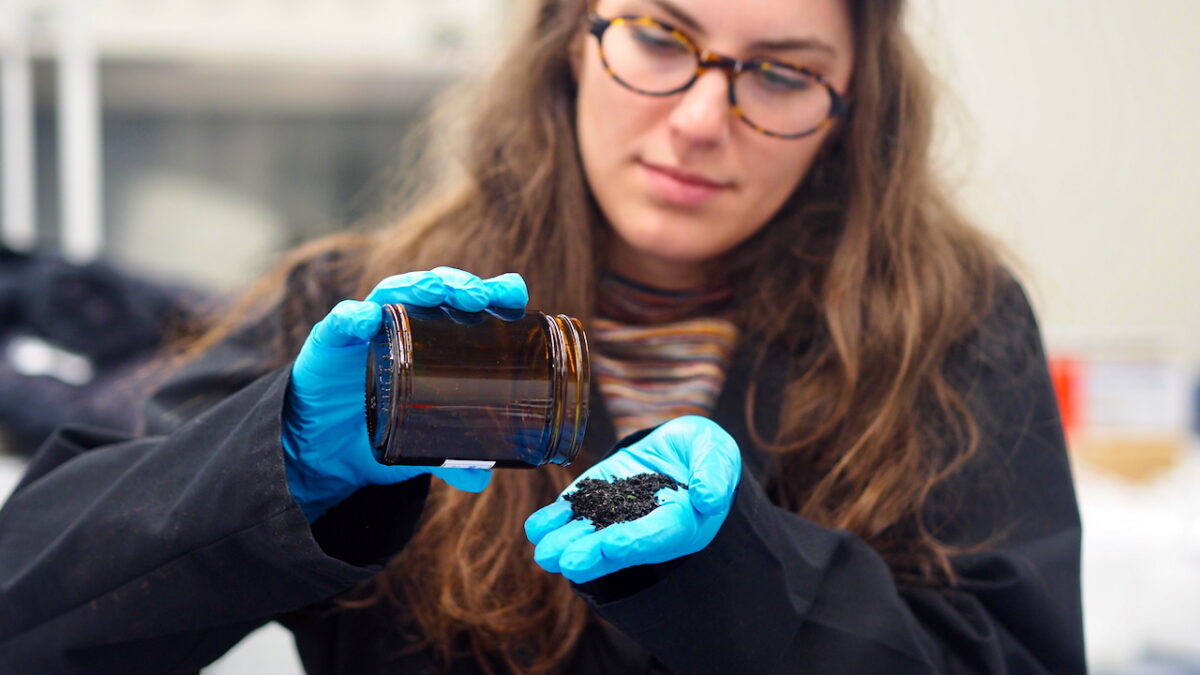
There is of course a proven way to neutralize 6PPD-q – a solution of 70 percent sand, 20 percent coconut fiber and 10 percent biochar, with a small proportion of engineered sand, iron aggregate and aluminum thrown in, completely filters it out of water, at least in laboratory settings.
I’ve been following this issue since well before my family had a rain garden installed to filter street runoff that otherwise funneled into Lake Washington’s Thornton Creek, and this new news is both good and bad to me.
It’s good that other sources of 6PPD-q are being more rigorously identified, and it’s good that we’ve figured out a way to treat it. According to UBC, play fields are typically plumbed, which makes it possible to divert runoff into settling ponds that can capture the contaminant.
The bad is, of course, the cost of all that if they’re not properly drained or don’t already have a settling pond. Then there’s the ubiquity of the fields in more densely populated areas. Between that and roadways, it again makes me wonder about rationality of saving silvers in urban streams –should that money be spent elsewhere? But shouldn’t we also address this mess we’ve made?
I don’t know. Per UBC, there are other, less polluting field options – well, besides good old grass – but they’re more expensive or are functionally limited by weather.
“Our research shows a clear need to address contaminant release from turf fields,” said Dr. Scholes in the release. “These data can help guide decisions on field design and stormwater treatment to protect aquatic ecosystems.”
Money for the study came from the BC Salmon Restoration and Innovation Fund, which is operated by Canada’s federal government and the province.