




BY ANDY WALGAMOTT, NORTHWEST SPORTSMAN MAGAZINE
Some of Washington’s toothier critters came under scrutiny during a legislative committee hearing in Olympia on Monday afternoon.
State lawmakers held a public hearing on a bill that would require WDFW to reduce predator numbers if big game herds in far Eastern Washington fell below a certain point compared to the rolling average, and they had a work session on the netting on Lake Washington that’s been targeting nonnatives that appear to be affecting salmon smolt survival.
They’re wildly different issues with very different species guilds and ecosystems, not to mention levels of likely addressability, but they chewed their way into a Senate Agriculture and Natural Resources Committee meeting.
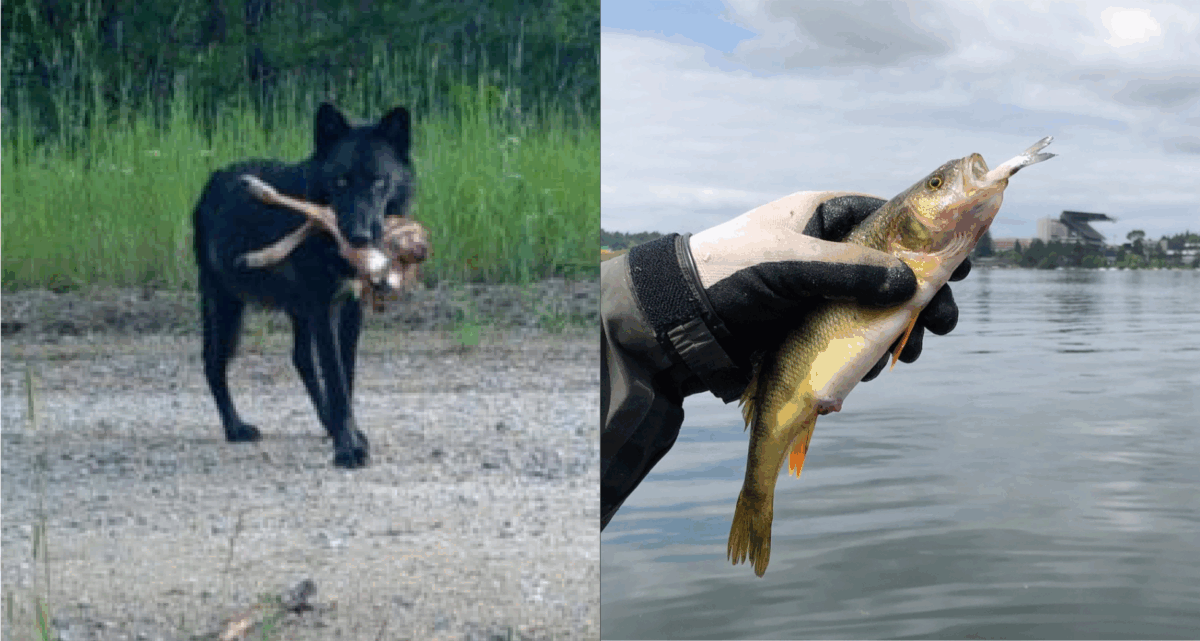
SENATOR SHELLY SHORT (R-ADDY) SAID the idea behind her Senate Bill 5960 came from sportsmen in Northeast Washington, and it would require the Washington Department of Fish and Wildlife to use a “comprehensive approach” to manage ungulate and predator populations.
“When wolf predation reduces populations of deer, elk, moose and other ungulate species by 25 percent or more in a given region, the department would be required to intervene for their protection,” Short stated in a pre-legislative session message to folks in her sprawling district in the state’s upper right corner. “This measure calls for active management of predators and prey, timely intervention and greater collaboration between state government and organized sporting groups. It would follow the lead of the feds in changing the criteria for delisting wolves as a threatened species regionally rather than statewide.”

When whitetails, mule deer, moose or other herds saw their numbers drop 25 percent below the 10-year rolling average, putting them into the “at-risk” category, Short’s bill would task WDFW with reducing predators around “sensitive” herd range areas, translocating wolves to elsewhere in the state, and/or using selective removal or nonlethal tools, as well as continue to use the measures until deer harvest hits levels seen in 2004 – a productive year statewide – and both flagtails and muley numbers are back over that rolling average.
That 25-percent drop is mentioned in, among other places, WDFW’s Wolf Management Plan and standing Game Management Plan.
Speaking in favor of her bill today, Short acknowledged the “ebb and flow” of ungulate populations, but added that there’s “frustration” that herds, “especially deer, continue to decline precipitously even as predators are not managed.” Wolf, cougar and black bear numbers are all robust in her neck of the woods; whitetails have taken heavy hits from diseases in recent years.
Marie Neumiller of the Congressional Sportsmen’s Foundation said her organization supported the bill while also asking for some amendments that would better align it with WDFW’s “existing science-based management plans.”
Kelsey Ross of the Conservation Coalition of Washington said the bill “simply codifies existing policy already.” She said the health of ungulate herds has been “sidelined in favor of carnivore-centric reform rooted in unmanagement” and that Fish and Wildlife Commission members “don’t want to do anything” about declines.
Former Commissioner Gary Douvia of Kettle Falls, however, was cut from a different cloth. “I’m very much in favor of this,” he told lawmakers today. “We need to do this to save the whitetail and mule deer population.”
Senator Short’s bill would also require WDFW to resume annual whitetail counts with the help of hunters, and to make harvest figures available annually by the end of March before the following fall’s seasons are set.
Both the Washington Cattlemen’s Association and Washington Farm Bureau signed in as “other” on the bill because of its wolf translocation element. Citing livestock depredation issues seen in the northeast and southeast corners of the state, the bureau’s Caleb Gwerder said, “We worry about that spreading.”
WDFW was also an “other” on the bill. Mick Cope, Wildlife Program director, said the agency recognized the importance of hunting in rural areas and in terms of economic impact, understood that strong game herds contributed to healthy ecosystems, and acknowledged that concerns about predators are commonplace around the state.
Cope added that while the overall goal of the bill was appreciated, directives in it weren’t feasible in terms of timeline or scale, the cost to implement it was beyond WDFW’s current budget, and some elements might need legislative approval. A fiscal note attached to the bill estimates it would cost just over $1 million to implement in 2027 and nearly $1.7 million in the bienniums afterwards.
On the other side were any number of speakers who would be familiar before the Fish and Wildlife Commission. Among them was Susan Kane Roening of the Washington Chapter of the Sierra Club, who said that wolves were being “falsely blamed” for lower ungulate numbers and that researchers say that the focus should be on improving summer range forage to boost herd numbers.
Work done by the legislatively funded Predator Prey Project in Northeast Washington found that the whitetail population – so critical to hunters – was steady to slightly declining while elk numbers were growing during the study period in the late 2010s and early 2020s.
Long term, whitetail numbers are down as a function of reduced lowland farming and habitat.
Nearly 1,200 people registered their feelings on SB 5960, with 843 saying they were pro, 352 con, and two were other.
Senator Short’s legislation has a bipartisan companion bill in the House, HB 2211. It has not yet been scheduled for a public hearing.
AS FOR THAT LAKE WASHINGTON PREDATION WORKSHOP, it came about after salmon advocates lost legislative funding last year for a project that’s been removing walleye, bass, perch and other nonnative game fish from the metro water so as to boost Chinook, coho and sockeye returns. While the King County Council stepped in with an emergency $250,000 for 2025, no money for it was included in WDFW or Governor Ferguson’s proposed 2026 supplementals, so proponents are trying to raise public awareness about the problem.
Larry Phillips, a former King County Council member and state legislator, told lawmakers that smolt predation has been a “major factor” in the sharp drop in sockeye numbers on Lake Washington, from as many as half a million annually earlier this millennium to just 18,000 in recent years.
“The result has been no tribal or sports fisheries within the Lake Washington system since 2006, which has a been a great detriment to the tribes and also to local fishermen who’ve fished that system for a long, long time. It also threatens significant investments that the state, federal government, local governments, the Tribes and others have made within Lake Washington system. Tens of millions of dollars have been spent relative to habitat restoration, and a lot of projects have been completed (or are) underway to meet that need. But we are now seeing the tremendous, significant loss relative to predation that has gone uncontrolled to date,” said Phillips.
Dr. Jason Schaffler, the Muckleshoot Tribe’s Fisheries Division director, said there were both “pathways to success” in the watershed and “pressures” creating management problems.
He said that walleye were first detected in 2005, and then in 2015 a trophy-sized fish was netted by a WDFW biologist. Some have also been caught on Lake Sammamish, but after several years without any captures, one popped up again last year.
“Lake Washington should not be a walleye fishery,” Schaffler stated.
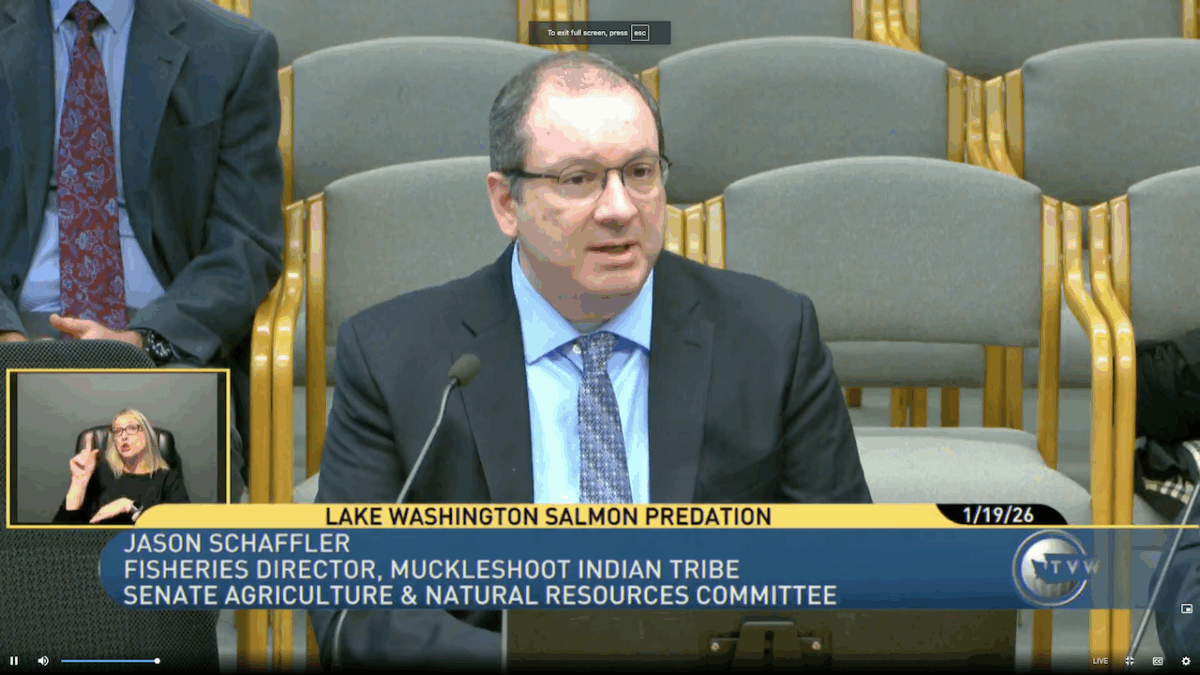
Another recently illegally introduced species, rock bass, have been coming on strong in recent years. Schaffler shared a photo of one caught at the mouth of the Cedar River that had 20 sockeye fry in its stomach.
How American shad came to Lake Washington is anybody’s guess, but Schaffler said “large numbers” now live in the lake. First seen in the late 1990s or early 2000s, unlike those in the Columbia River, these don’t appear to be sea-going, so “that means they are competing, they’re eating the same food the sockeye are eating in the lake,” he said.
Young sockeye rear in a lake eating zooplankton, etc., for about a year before heading to sea.
Schaffler also shared the particularly worrisome news that last year crews captured a nearly 3-foot-long female northern pike that had just spawned, and then a week later, and within 100 yards, they caught a male.
“There is a very good chance it got off a successful spawn,” he said. “If they do start a reproducing population in Lake Washington, we’re going to see the exact same problems we are seeing in Lake Roosevelt.”
Strong efforts on Roosevelt by WDFW and the Colville and Spokane Tribes have kept pike in check as all parties worked to protect important game fish and to keep northerns out of the so-called anadromous zone of the Upper Columbia.
Schaffler said that with money from the Bureau of Indian Affairs and state lawmakers, the Muckleshoots and WDFW had been ramping up their Lake Washington watershed removal efforts since 2015, and he shared a graph that showed between the comanagers, they had caught 25,000 fish in each of the last two years.
“What we have learned is where specific species are that are harming our salmonid resource,” he said.
Rock bass are bad news for young sockeye fry at the mouth of the Cedar, while yellow perch feast on Chinook in the Lake Washington Ship Canal, he said.
With removals, Schaffler said managers are now seeing “slight upticks” in salmon smolt survival.
“We’re having an impact, and this was with research level of removals. If we can move towards a programmatic level of removals, we think that we will be able to reduce that structure down to manageable sizes to allow salmon to recover,” he said.
While it would appear there’s no money available to continue that at the state level this budget session, lawmakers did express interest in the subject. Senator Rebecca Saldana (D-Rainier Beach) asked how residents of her district could help. Schaffler said catching and removing bass would keep them from reaching the size where they have stronger effects.
One thing that the presentation failed to show, however, was direct evidence of smallmouth predation on smolts. Undoubtedly it occurs, but where there was an image of a salmonid tail sticking out the gullet of a yellow perch and fry pumped out of rock bass stomachs, there wasn’t anything similar for smallies.
These bass are also far more popular than rock bass – quite possibly the ugliest fish there is – with anglers and tournament fishermen. A number of contests are held annually on Lake Washington, and the average-sized smallie caught last year was 2.73 pounds, down a bit from 2.84 pounds in 2024.
Saldana also asked if it was possible to do “an invasive sportsfishing event” or some other collaboration, to which the answer was yes.
Senator Kevin Wagoner (R-Sedro-Woolley) asked what there was to prevent the next invasive species from being dumped in Lake Washington. Schaffler said that bucket biologists faced “significantly larger penalties” for planting northern pike versus, say, aquarium fish.
Wrapping up, Phillips, the former lawmaker, said the new challenge to salmon recovery had been identified and his Lake Washington Predation Coalition – which includes the City of Seattle, King County DNR, WRIA 8 Salmon Recovery Council, Cedar River Council, Puget Sound Anglers, Steelhead Trout Club of Washington and Trout Unlimited – knew what to do about it.
He said a “very modest, sustained investment” on the predator control front could yield 60,000-fish sockeye runs over the coming decade.
“It’s not a big ask for funds; it’s a big ask for support … But if we do this, we can restore these runs to a fishery,” he said.
About $800,000 is needed.
SOME FOLKS SPEND A LOT OF TIME arguing that predators don’t impact game species, but at least on Lake Washington, today’s presentation showed that it appears they do. That’s a much, much different ecosystem from Northeast Washington and its big game herds, and that isn’t to say that habitat issues aren’t also part of the equation for salmon on the big Seattle lake.
But I at least appreciated that during this short legislative session, Senate Agriculture and Natural Resources Committee Chair Senator Mike Chapman (D-Port Angeles) gave both subjects a public airing. Here’s hoping conversations continue.
