BY ANDY WALGAMOTT, NORTHWEST SPORTSMAN MAGAZINE
Updated with a correction and additional comments in the 21-25th paragraphs and final paragraph.
The Oregon State Marine Board will pursue a middle path on the Siletz and begin rulemaking to limit motors to 15 horsepower and speeds to slow/no wake on a portion of the river above tidewater instead of ban all engines like a local tribe had petitioned them to do.
The board voted 4-0 on the compromise at their well-attended meeting today in Tillamook. OSMB staffers had been recommending members advance the Siletz Tribe’s bid to prohibit all motors above the Jack Morgan Park ramp, but back in January the board also directed staff to come up with a hybrid option.
“I hate to see anything that limits access to our fishing. Any limitation is a loss, but this compromise is better than losing it all, in my opinion,” said Ty Wyatt, who has fished the Siletz since 1987 and considers it his “home waters.”
The public rulemaking process that will now take place over the coming months does include a provision to bar the use of all motors upstream of Old Mill Park, located in the town of Siletz, as well as in all tributaries above Jack Morgan. OSMB no longer defines slow/no-wake as 5 mph but says it “means operating a boat at the slowest speed necessary to maintain steerage and reduces or eliminates waves that appear as white water behind the boat.”
Wyatt was one more than two dozen local guides, residents and tribal members who spoke to the board ahead of their vote – river advocates all, just coming from different perspectives.
Randy Bales, who is also a tackle maker, said he had several herniated discs in his back, and banning motors and forcing him to row his clients would put him out of commission for a week at a time.
“I’ve got three kids to support. It’s a big part of my income,” Bales said.
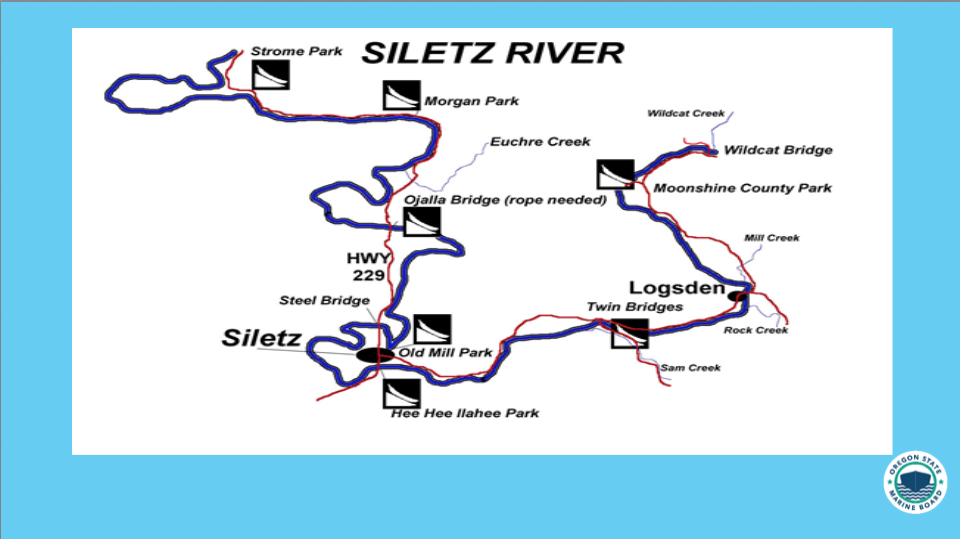
The Siletz is home to runs of fall Chinook, coho, and winter and summer steelhead. Ever since 1988, jet pumps have been banned above Jack Morgan, which is at river mile 24.5, and OSMB has been approached at least three previous times since 2000 to expand motor restrictions. Guides and anglers use their gas or electric motors to power through slow stretches of the river and/or make multiple passes through fish-holding water.
Members of the Confederated Tribes of the Siletz and/or their staffers framed today’s decision as essentially to recognize the river and its ecosystem’s rights to exist, as they themselves had to fight for after the US Government terminated them as a tribe in the 1950s.
“This river has been waiting 25 years for this board to make a decision in its favor,” said Angela Sondenaa, the tribe’s natural resources director, adding that if the river wasn’t protected, guides wouldn’t have any business.
A video the tribe posted last year showed how pressure waves from a boat powering upstream through a relatively shallow part of the river disturbed cobble, with the implication that salmon eggs were being washed away as anglers ran boats up- and downstream.
It wasn’t until late on in this process that ODFW weighed in. District fisheries biologist Chris Knutsen said the primary factors impacting salmon and steelhead were actually a lack of habitat complexity in the river itself and lost off-channel habitat, while sedimentation, water temperatures and harvest were all secondary factors.
OSMB board members had mixed reactions to ODFW’s take. Vice Chair Steve Lambert of Southern Oregon said he appreciated the feedback, which he termed “right down the middle” but in that way was also “not helpful.” He said he’d like to see biologists “take the lead on a definitive study” about boat impacts on fish populations instead of have to rely on work performed elsewhere.
Chair Laura Jackson said her panel had to make their decision in its legislatively mandated boxes of safety and conflicts, and board members heard stories of clashes between users.
The Siletz Tribe’s Alfred “Buddy” Lane suggested conflicts went unreported as tribal members walked away from them instead. “The resource has a right to exist and be spoken for,” he said.
Lane added he’d fished the river from a canoe, drift boat and the bank, and that a motor wasn’t needed and was used for “convenience and ease.”
His dad Alfred “Bud” Lane said motors produced “inherent conflict” and called them a “detriment to the river and the ecosystem.” He said there used to be lots of mussel beds in the Siletz.
By and large, fishing guides reported less conflict on the Siletz than they saw on other systems, and they also talked about motors as a safety issue – being able to chase down boats gone adrift or rescuing folks whose craft had gone under. One guide reported 81 percent of boats this past winter steelhead season were using motors, mostly gas; another said there was less conflict when anglers used motors to work a stretch than when they anchored up in a hole.
Oregon State Representative Court Boice (R-1) called in to say he was opposed to restrictions on motorized use. He said while he respected the Siletz Tribe, multiple use of the river should be kept in the “forefront.” He reminded the board that four-fifths of their budget came from user fees like motor boat registrations.
Angler Jay Yelas, who participated in an OSMB rule advisory committee, or RAC, that was convened after the tribe submitted their petition in 2025, called it “a social issue, not on-the-water conflict.”
Outside of the meeting, however, Silas Stardance, who has been guiding the river for 22 years and has lived in Lincoln County for nearly five decades, spoke to a “concerning trend” he’s seen during winter steelhead season when boaters use their motors to power upstream from take-outs to hit water before downstream-running boats reach them, achieving better success and creating something of a self-fulfilling prophecy where those who miss out on the bite are forced to get a motor to compete with the rest of the fleet.
“This practice often leads to conflicts when boats traveling in opposite directions encounter each other,” he explained. “The increased boat traffic also hinders landowners’ ability to fish their property effectively. Previously, individuals could wait their turn, but the erratic movements of boats now disrupt the fishing experience.”
Some motors end up being less clean-burning two-strokes that send a blue haze over the river, he said.
Stardance also said the Siletz Community “does not feel welcome on the river, which I perceive as a significant issue.”
“This lack of inclusivity constitutes a conflict. It is disheartening to witness individuals being pushed away from the river, especially considering the substantial investments made by the Confederated Tribes of the Siletz in habitat restoration to enhance fishing opportunities,” he added in arguing it’s time for motor restrictions on the Siletz align with those on popular North Coast rivers, where the fishing is both “productive and welcoming.”
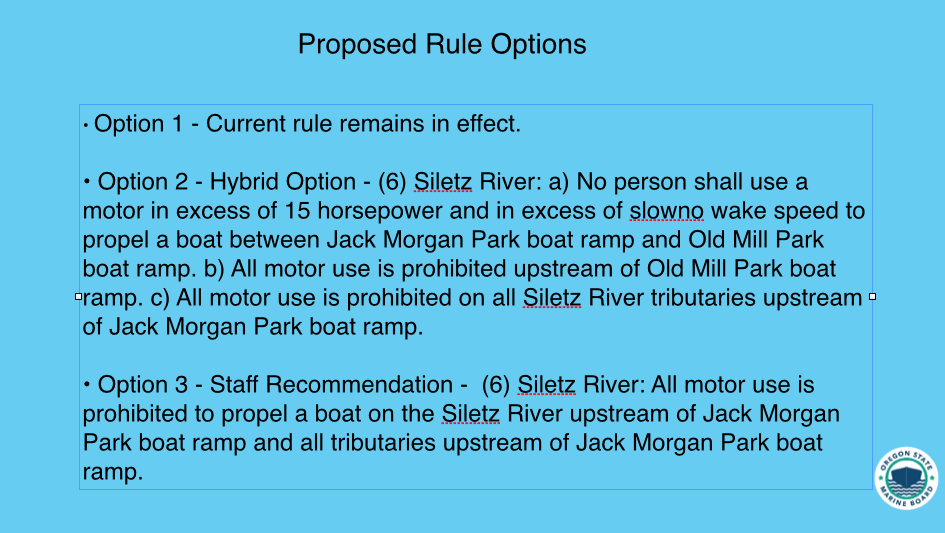
When it came time to decide on the three rulemaking proposals before them, Lambert seemed unsure that there was enough conflict to prompt a full motor ban above Jack Morgan. He said the board “should be cautious about taking big steps,” and he recognized ODFW’s judgment that boats weren’t causing negative impacts. He termed their opinion “a heavy weight” on the issue and said the compromise proposal was a “good starting place” for the rulemaking process.
Jackson said that the amount of the Siletz River that would be closed to motorized use under the petition “is a little concerning to me.”
Fiona Wylde, a newer member of the board, recognized the passion on display as well as the fact that many would be affected by the board’s decision. She said she was “surprised” by ODFW’s takes.
And board member Dax Messett, a river guide himself, said he didn’t support rules that took away access, and said the process will now allow the board to receive more information and testimony “so we can take into account all sides.”
OSMB is down to four commissioners after the tragic passing of recently appointed Jeffrey Cunningham in a skiing accident.
According to OSMB Director Larry Warren, the proposed language approved by the board will now be filed with the Oregon Secretary of State’s office. A new public comment period will then open, with a public hearing likely in late spring. The board will also hold a work session/public hearing somewhere in the Newport area and invite representative groups to flesh out their arguments, as well as hear from the general public. Then, a final rule could come as early as the board’s quarterly meeting in Madras.
After today’s vote, angler Ty Wyatt was quick to credit those who attended the meeting.
“I want to say that being involved matters,” he said. “Twenty-six people testified today and made a difference” about a river that hosts thousands of fishermen annually.
The Siletz Tribe’s Sondenaa termed the decision “a positive outcome” though expressed disappointment “the most protective” option wasn’t chosen, per a KLCC story.
Editor’s notes: Comments from guide Silas Stardance and the Siletz Tribe have been incorporated into this updated, corrected article. The initial version incorrectly reported that the hybrid option adopted by the Oregon State Marine Board yesterday had just popped up. That was based on a bad reading of meeting material. In fact, back in January, the board asked staff to develop one.