By MD Johnson
An overabundance of big predators. Too many sea lions. Short seasons. No seasons. European green crabs. Avian influenza. Everywhere hunters and anglers look, it’s bad news. Or is it?
There’s no denying the fact this century’s outdoors arena is wrought with the less-than-positive. Invasive species are very much a concern. So, too, are matters such as bird flu, increasingly poor sturgeon recruitment, steelhead stocks, and the “myth” of climate change. That’s sarcasm in case you missed it.
But there are positives for those who hunt and fish. The Columbia has earned herself the reputation as being one of the premier walleye and smallmouth waters in the nation. Three pintails in the daily bag during the 2025-26 season. More white geese. Excellent razor clam harvest opportunities on most Washington South Coast and Oregon North Coast beaches. And wild turkeys.
With very few exceptions, wild turkey populations throughout the Northwest have expanded, both numerically as well as geographically, some to the point of having become problematic, e.g., wintering flocks with hundreds of birds roosting in Farmer Jones’ barnyard and pooping on Farmer Jones’ valuable livestock fodder. For the turkey hunter, this increase is good news; for Farmer Jones, not so much.
From the far northeast corner of Washington and its Pend Oreille Valley to Southern Oregon and its Rogue Valley and almost everywhere in between, the gobble of the wild turkey, unheard throughout the Northwest until the latter part of the 20th century, now summons spring mornings and quickens the heartbeat of the young and not-so-young alike.
And as we here at Northwest Sportsman do this time each year, we ask those “in the know” to look deep into their omniscient crystalline orb and give a glimpse of what turkey hunting fanatics might hope to find once the block on the calendar reads April 15, 2026.

WASHINGTON
I introduced you to Richard Mann about this time in ’25, focusing primarily on his background as a turkey hunter and, perhaps more so, on his role as current president of the Washington State Chapter of the National Wild Turkey Federation. Now in his second year at the helm, Mann continues to further the federation’s message of information, education and conservation, not only as they apply to the wild turkey but all wild things in Washington.
A busy man, as he prepared to make the trip back to Nashville for the NWTF’s annual convention last month, Mann made a few minutes to talk with me about the upcoming season’s prospects.
MD Johnson Let’s start, sir, with Washington and Westside easterns, the “ghost” as they’re often called. Are easterns doing all right west of the Cascades?
Richard Mann My experience with (easterns here) goes way back. They’re small populations. They’re not usually close to the road, so they’re not easily accessible. And a lot of them are on private timberlands now that require a permit, and that really cuts back on the ability of the average hunter to find them and then get access.
MDJ Overall and by all accounts, is the eastern population stable? No huge ups and downs?
RM I would say it’s stable based on what I’m hearing and talking with the biologists at NWTF. Remember, this is a ground-nesting bird in Western Washington that has to deal with wet springs and limited habitat. I don’t see these populations ever taking a giant bump. We do have birds showing up in “new” places. It’s a mix of birds. Not every bird in Western Washington is going to be a (pure) eastern subspecies anymore, and haven’t been for years.
Some of this is migration. We’ve seen birds in Snoqualmie Pass, North Bend and Cle Elum areas. And there have been sightings on the Chinook Pass side of birds that look an awful lot like Merriam’s and not like Easterns.
MDJ East of the Cascades, are Merriam’s turkeys doing well?
RM Merriam’s are doing well, and I see their populations expanding outside our traditional Northeastern Washington areas. My personal experiences in 2025, both spring and fall, is that there are plenty of birds. We’ve had two mild winters in that country, and that bodes well for turkey populations. Spring (2025) hunting was a little tougher, it seemed, with some birds taking well over an hour to work, but persistence pays off. There should be a ton of toms out there this spring.
MDJ Rio Grandes on the Eastside – they, too, are doing well?
RM I don’t hunt in Southeast Washington a whole lot anymore, but access in the Blue Mountains is still an issue. A lot of those birds down there are on private property, and they always have been, so it’s a matter of doing your homework early and getting permission ahead of time. The (Department of Fish and Wildlife) has a lot of Hunt By Written Permission opportunities down there (see privatelands.wdfw.wa.gov), but now would be the time to be researching those instead of waiting another month. But I was down in the Blues a couple years back doing a mentoring camp for WDFW employees, and we saw plenty of birds.
MDJ Crystal ball time, Richard. Thoughts on the 2026 spring season in the Evergreen State?
RM I’ll predict a good season on par with or slightly better than 2025. Again, we’ve had two mild winters now, so we should have a few more 2-year-olds, i.e., mature gobblers, out there. The birds just didn’t have to struggle a lot this past winter. For the person who’s willing to hunt, invest the time, and walk in a little ways … well, the birds are there. It just depends on the willingness of the individual to get out and do a little more work. It should be a good season.

OREGON
From across the Columbia and her digs in Salem at the Oregon Department of Fish and Wildlife’s headquarters, Mikal Cline serves as the agency’s upland game bird coordinator. Like Mann’s, Cline’s views on the Beaver State’s wild turkey population is quite positive, as is her prediction via the magical orb for the ’26 spring season.
MDJ Across the board, Mikal, how are turkeys faring across the whole of Oregon?
Mikal Cline The big conversation for us right now is the climate and weather, and how those affect the birds and their behavior. You know, we’ve had such a nonwinter (this year), and we think about how that nonwinter has the potential to affect our birds. An early spring can mean early breeding effort, which means early nesting. And as a hunter, the earlier you can get out this season may well be to your benefit. My crystal ball shows excellent overwinter survival; it’s hard to imagine anything out there (right now) causing any degree of turkey mortality. We’re not seeing avian influenza in our turkey flocks. We haven’t seen any die-offs.
MDJ Is there, Mikal, anything that might be considered not-so-good news in terms of Oregon’s turkeys?
MC If this nonwinter translates into drought, that (could mean) wildfires, which in turn could impact both our rangelands and our forestlands. Not that all fire is bad; I don’t want to say that, but what we don’t need is a mega-wildfire that burns really hot and eliminates huge tracts of habitat. I don’t see drought affecting our spring hunt at all, but we are concerned about drought for this summer. Drought, obviously, can mean a scarcity of water, which can concentrate birds at water sources and make them more susceptible to harvest, predation and disease transference.
MDJ The outlook for the ’26 spring season, Mikal? It’s been exceptional the past two years. Do you see this positive trend continuing in terms of turkey hunting opportunities?
MC I think it’s going to be good, man! I’m trying to think here. Is there a place that’s growing? An untapped area that folks may want to try? I will say that it seems like the Ochoco has been filling up with hunters. It’s no longer a secret. So I’d encourage folks to try some new spots, like the Fossil Unit. We’re also seeing flocks building in the Burns area, as well as in Lake County. So there are some new opportunities that might be fun for folks to explore.
We haven’t been moving a whole lot of birds around lately, what with avian influenza, but there’s always the tried-and-true Rogue and Umpqua Valleys. And the Willamette Valley, which is primarily private but the ODFW does have some Hunt By Reservation (myodfw.com/articles/hunt-reservation-program) offerings in the Willamette.
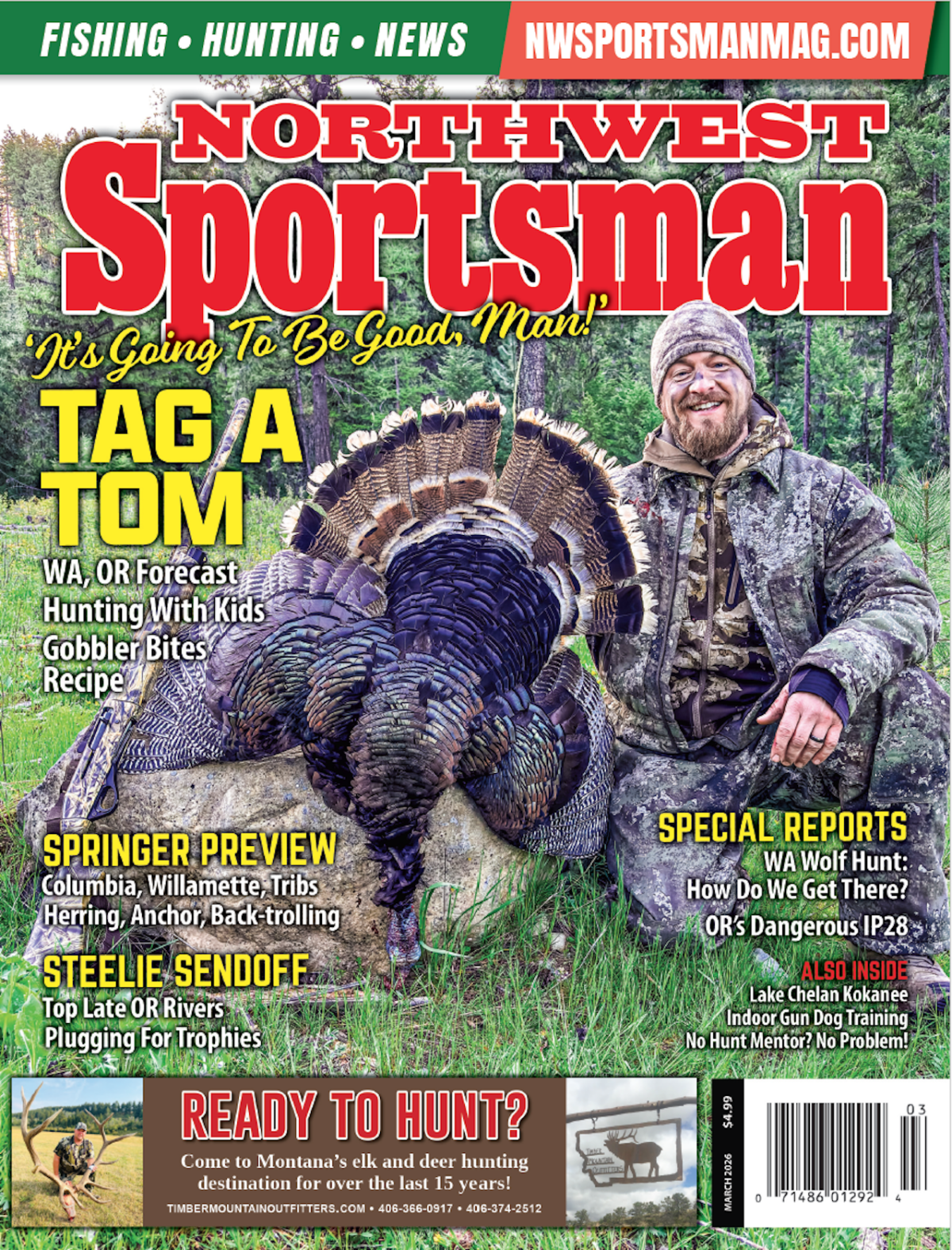
I’LL END ON this note. In a recent conversation with a friend of mine, Michael Callian, who currently serves as what I’ll define as the marketing/media guru for Dave Smith Decoys based out of Lebanon, Oregon, we gradually shifted the talk from a waterfowl season wrap-up to what to expect this spring in terms of turkeys.
Callian, as fanatical a turkey hunter as he is a waterfowler, jumped all over my comment, I having mentioned I’m partial to the last two weeks of the spring season; that is, the final 14 days of May. The California poppies are blooming. Most tags have been filled or hunters have been magically transformed into anglers. Me, I told Callian, I like to wait; however, it’s what he said in response that should be the mantra of every turkey hunter in the Pacific Northwest.
“Yeah, but here’s the thing, MD,” Callian said without hesitation. “It’s always good. I mean from start to finish, you’ll be able to find a bird somewhere that’s fired up. And there’s a good chance he’s not with hens.”
It’s March now. Time to dust off that vest and gear. Check the decoys. Take a sunny afternoon and pattern that gobbler getter. Maybe run a lick or two on that favorite call, just to make sure you haven’t lost your touch in the offseason. Get it done now because April 15 ain’t that far off. And dem’s your Outdoors MD’s orders.
Editor’s note: For more spring turkey hunting articles, including tactics, gear and recipes, see the March and April 2026 issues of Northwest Sportsman Magazine, where this article originally appeared.