



THE FOLLOWING IS A NATIONAL MARINE FISHERIES SERVICE FEATURE STORY
Every summer, salmon and steelhead returning to the Yakima River swim hundreds of miles from the Pacific Ocean toward their spawning grounds in central Washington. But as they turn toward the Yakima River in Richland, Washington, they often hit a wall of heat they cannot penetrate.
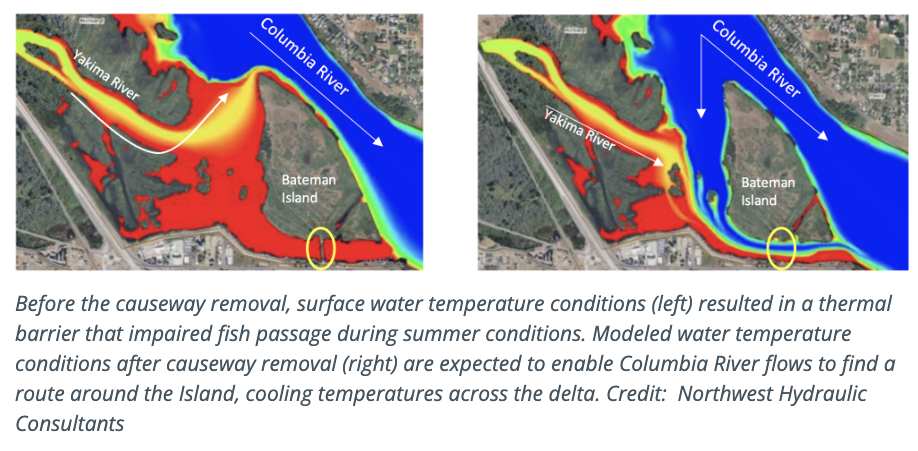
It’s not a physical barrier, but it might as well be. Summer temperatures at the mouth of the river can reach lethal levels for salmon. Fish may wait for weeks or months for cooler conditions before continuing upstream, but they are often too exhausted to reach their spawning grounds.
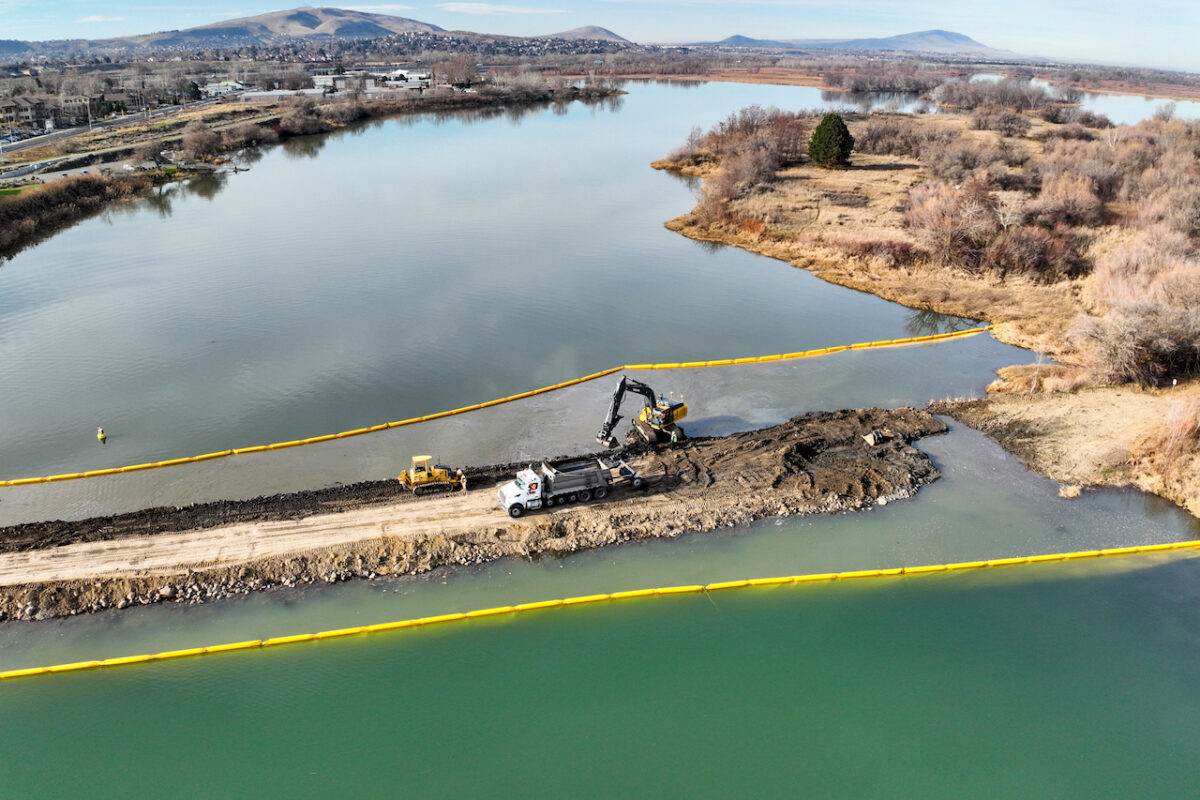
In 1939, an earthen berm was constructed across part of the Yakima River Delta to Bateman Island to allow cattle to graze there. This causeway slowed the river’s flow around the island, allowing the water to heat up and create deadly conditions for both adult and juvenile salmon and steelhead.
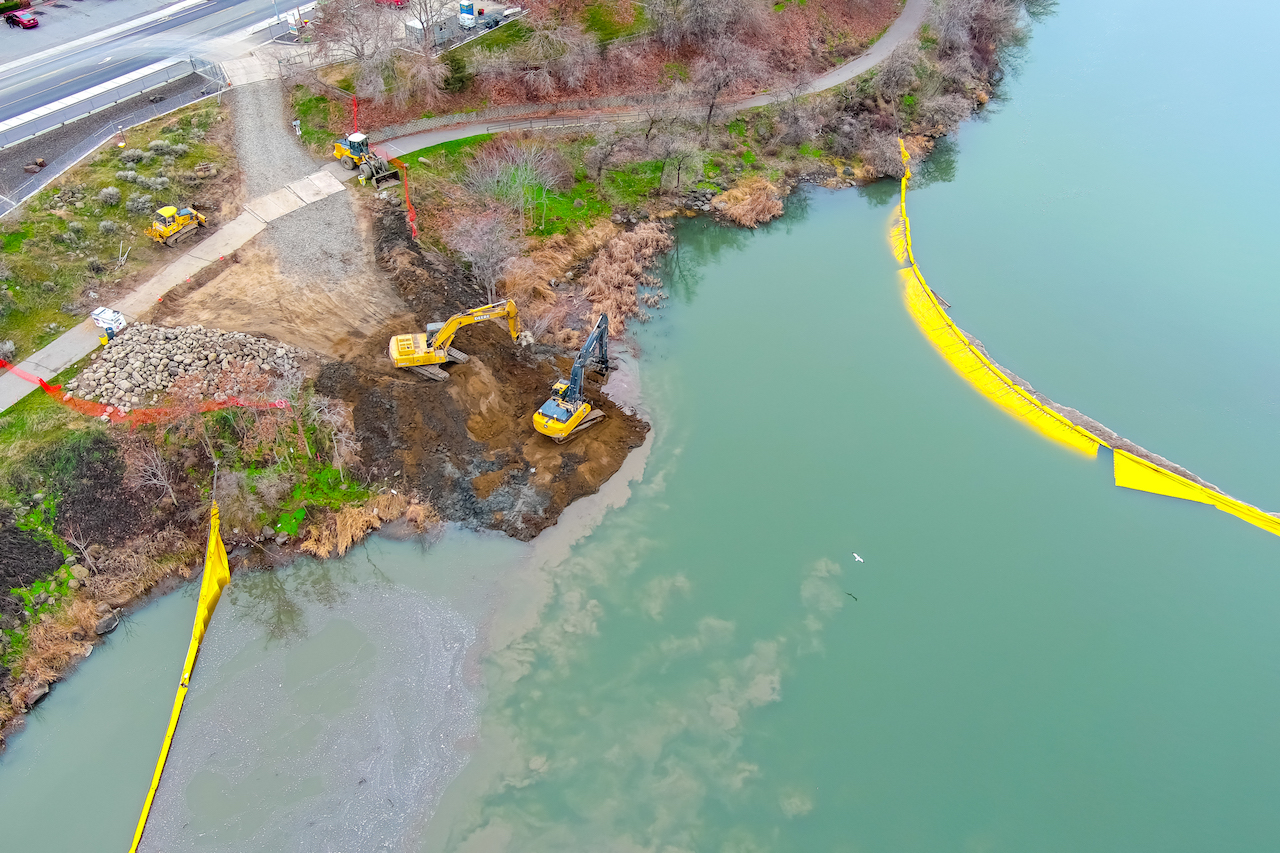
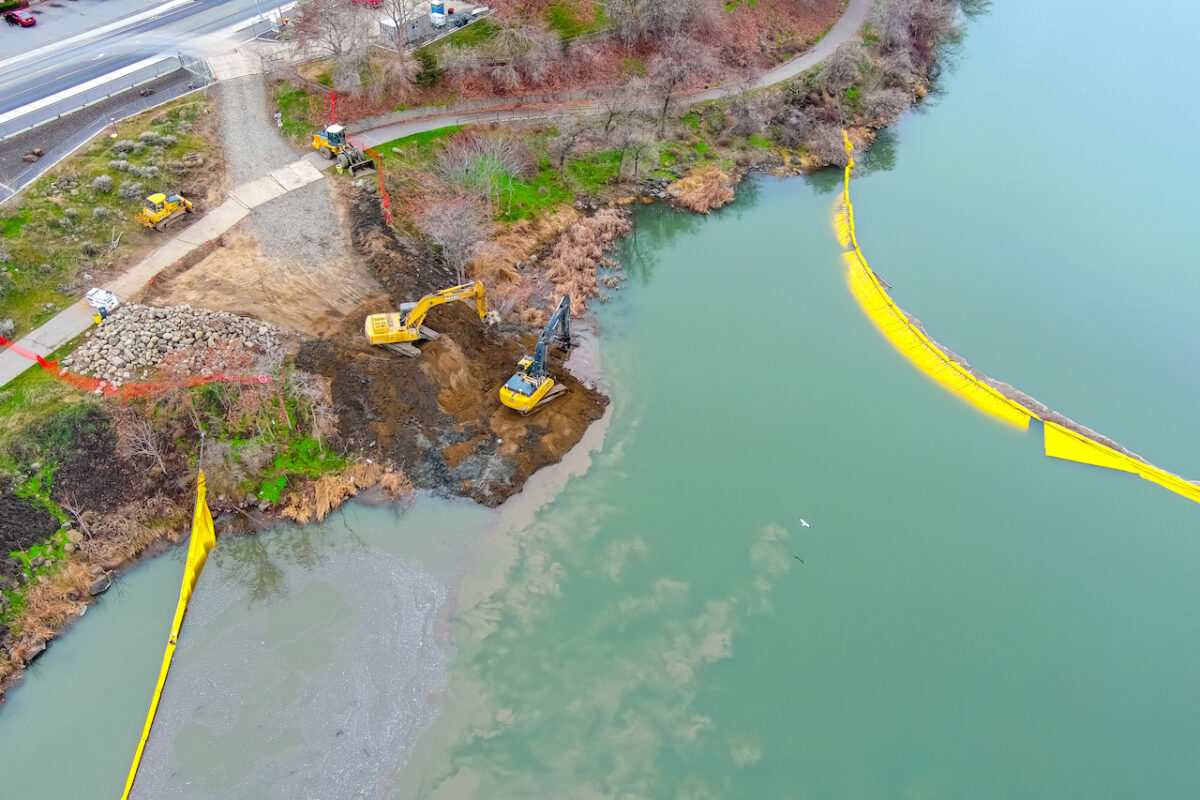
This February, construction crews finally removed the causeway, allowing the river to follow its natural course for the first time in nearly a century.
NOAA Fisheries’ Office of Habitat Conservation awarded funding to the Yakama Nation for the removal project. Reconnecting the channel around Bateman Island to the Columbia River will:
- Improve access to more than 1,500 miles of tributary spawning and rearing habitat and 214 miles of mainstem spawning habitat in the Yakima River
- Support the Yakama Nation’s fishing rights and protection of sacred sites
- Increase the number of weeks salmon can safely migrate up the river each summer
- Reduce predation of migrating juvenile salmon and steelhead by nearly 30 percent
- Reduce the impact of toxic algal blooms, invasive plants, and mosquito populations
“This work gives adult salmon and steelhead a much better chance of reaching spawning habitat,” said Adrianne Grimm, NOAA Marine Habitat Resource Specialist. “It will also help juvenile fish survive outmigration to the ocean. This project is a great example of how NOAA works with tribes and partners to tackle complex restoration challenges.”
Steep Salmon and Steelhead Declines in the Yakima Basin
For millennia, the Yakima River Delta—or Chamna, as it is known to the Yakama people—was a gathering place, the location of sacred sites. It was also a fishing ground where millions of salmon returned each year. Chamna and the rest of the Yakima Basin provided the Yakama and the Umatilla, Nez Perce, and Colville tribes with their primary food source and the foundation of their cultural practices.
Historically, more than 800,000 salmon returned to the Yakima Basin each year, making it one of the most productive salmon rivers in the American West. The river and its tributaries supported at least nine distinct salmon and steelhead stocks from the glacier-fed streams and lakes of the Cascade Mountains to the semi-arid steppe of the Columbia Plateau.
By the 1990s, however, those runs had collapsed. Irrigation projects, water diversions on small streams, habitat loss, and drought all took their toll. In recent years, as the basin entered its fourth consecutive year of drought, returns have hovered between 10,000 and 20,000 fish.

A Commitment to Restoration
NOAA Fisheries, the Yakama Nation, and other partners have worked for decades to restore habitat in the Yakima Basin.
“The Yakima Basin, which was historically the second most productive basin in the Columbia after only the Snake River, has huge potential for recovery,” said Sean Gross, a NOAA Fisheries biologist.
Removing the causeway was the top priority of the Yakima River Basin Water Enhancement Project Workgroup. This coalition of tribes, agencies, and nonprofits works to address water, fisheries, and habitat challenges across the basin.
“A lot of the restoration work occurs throughout the Yakima River basin, including in the headwaters and spawning and rearing habitat,” said Rebecca Wassell, Yakima Basin program director for the Mid-Columbia Fisheries Enhancement Group. “But none of that is worthwhile if we are losing our fish at the confluence between the Yakima and the Columbia Rivers due to the Bateman causeway.”

Chokepoint on the River
The Bateman Island causeway sat at river mile 0 of the Yakima, the main entrance to the entire basin. It blocked water flow around the south side of Bateman Island. It transformed what had once been a dynamic river channel into a stagnant backwater. It was filled with invasive plants and warm-water fish that prey on juvenile salmon.
The consequences for salmon and steelhead were severe.
Summer temperatures in the backwater routinely exceeded 77°F, well above the maximum temperature salmon can tolerate. For adult sockeye, summer Chinook, and steelhead trying to enter the Yakima during the summer months, the mouth of the river was impenetrable most days.
“What this thermal barrier did is shorten the window of time that adults can migrate up the Yakima,” said Gross. “Instead of having 30 days of cooler temperatures to access the river in midsummer, they might only have 3 or 4 days.”
“We’ll see the sockeye just shoot up the Yakima when we get a few colder days in late June,” said Mike Porter, Fisheries Biologist for the Yakama Nation. “But when temperatures heat up again, they’ll hold in the Columbia River. When it becomes colder in September, these fish will go up, but they’re in such poor condition. They’re not even viable spawners at that point because they expended so much energy.”
In summer 2024, high temperatures killed at least 75 sockeye salmon.
“It was just so disheartening to see,” said Porter.
For juvenile salmon and steelhead heading downstream to the ocean each spring, the causeway created a different challenge. The warm, still, backwater area was an ideal habitat for non-native predatory fish like small and largemouth bass, walleye, and catfish. These fish fed heavily on out-migrating juvenile salmon and steelhead. The delta became what Gross described as “a big predator breeding ground and nursery.”
The survival rates of juvenile Yakima River salmon and steelhead trying to reach the ocean are already low. The causeway made the odds of survival even worse.
The stagnant backwater also created problems for people. It was an ideal breeding ground for mosquitoes. Benton County spends about $100,000 annually on mosquito control around the delta.
Causeway Removal and Project Benefits
Those ecological and public health impacts helped build momentum for removing the causeway. In January, the U.S. Army Corps of Engineers, which owns the land around the causeway, began removing the barrier. Crews fully opened the river channel by February.
“I was ecstatic to see something that has been in place for so long—and had no business being there—finally removed so more salmon can pass,” said Porter. “Our people are fish people. That’s our traditional First Food and most important resource. Salmon are number one.”
“We’ve had a lot of bad news the last couple of years with droughts,” said Gross. “It’s nice to have something to celebrate and something that we think is really going to make a difference for migrating fish immediately.”
For returning adult salmon and steelhead, the thermal migration window is expected to increase. Removing the causeway allows the Columbia River flows to circulate through the delta, cooling temperatures during the peak summer migration period.
“In the summer, our returning sockeye and fall Chinook really depend on cool water pulses that come down the river,” said Wassell. “By allowing flow around the island, there will be a greater length of time for adult salmon to move towards their spawning grounds safely.”
For juvenile salmon and steelhead heading downstream, the causeway’s absence is expected to reduce predation. The removal will also reduce toxic algal blooms, invasive plants, and mosquito populations. It will offer heat-stressed fish a shorter route back to their spawning grounds on the 350-mile journey from the ocean.

The Collaboration that Made the Project Possible
Removing the causeway wasn’t easy. It took years of scientific research, coalition building, and coordination among diverse partners, including:
- Yakima Basin Integrated Plan
- Yakama Nation
- U.S. Army Corps of Engineers
- Washington Department of Fish & Wildlife
- Mid-Columbia Fisheries Enhancement Group
- Washington Departments of Ecology & Natural Resources
- Trout Unlimited
- Cities of Richland, Kennewick, and Pasco
NOAA Fisheries played a critical behind-the-scenes role throughout. Gross began working on the project about 15 years ago, helping shape the early technical analysis, building partnerships across agencies.
In 2023 the NOAA Restoration Center awarded the Yakama Nation $3.6 million to support this effort and other Yakima Basin fish passage work.
“The support NOAA gave us is just immeasurable as far as getting this project completed,” Blodgett said.
“The actual removal only took about 6 weeks, but it followed nearly two decades of planning and coordination,” said Mike Livingston, South Central Washington regional director for the Washington Department of Fish & Wildlife. “We had partners stepping in at every stage. A marina had to be removed for the project, and Trout Unlimited helped with those negotiations, irrigation districts helped with smaller pieces of the project, and the broader Yakima Basin partnership kept everything moving forward.”
Merritt Mitchell, outreach and communications manager for the Mid-Columbia Fisheries Enhancement Group, helped ensure the community was on board with the project.
“One of the things I’ve been most pleased about is how we have engaged the community and all of our partners to make sure that everybody understands the importance of the project and how it will benefit the community,” said Mitchell.
Looking Ahead
Project partners say much work remains to restore the Yakima Basin. The Yakama Nation will continue to rebuild salmon, steelhead, and Pacific lamprey populations, as they always have, with the mission of honoring, protecting, and restoring fisheries.
But on April 24, the Yakama Nation, project partners, and community members will take time to celebrate the project’s successful completion during an event at the former causeway site.
“It’s going to signify the beginning of the healing process of Chamna,” said Blodgett. “This is going to be a huge benefit for our First Foods and also to people living nearby who rely on clean, flowing water.”
“This work gives adult salmon and steelhead a much better chance of reaching spawning habitat,” said Adrianne Grimm, NOAA Marine Habitat Resource Specialist. “It will also help juvenile fish survive outmigration to the ocean. This project is a great example of how NOAA works with tribes and partners to tackle complex restoration challenges.”
