BY ANDY WALGAMOTT, NORTHWEST SPORTSMAN MAGAZINE
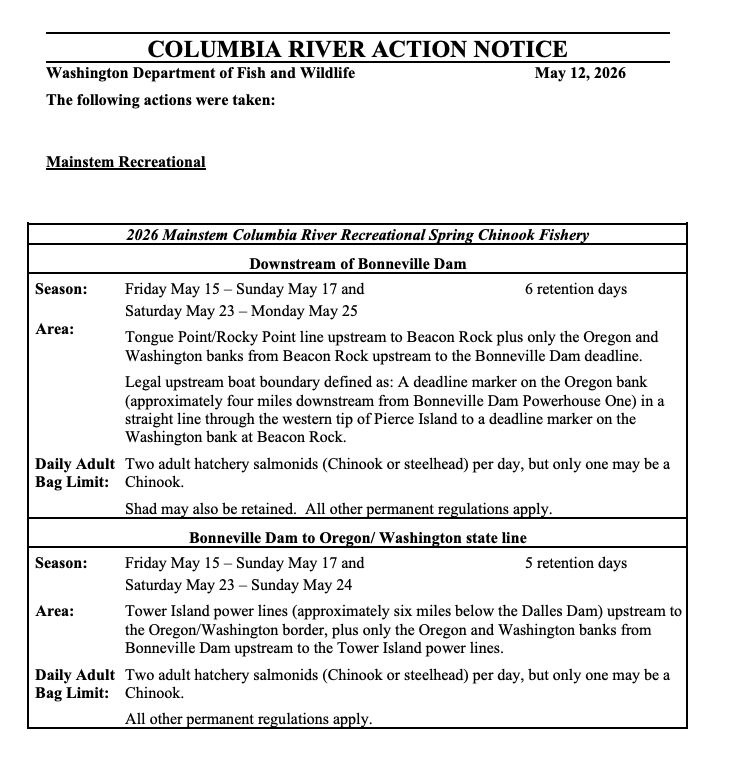
Fishing for spring Chinook will reopen on the Columbia River above and below Bonneville this weekend and next, state salmon managers decided on a conference call this afternoon.
Below the dam, springers will be open Friday, May 15 through Sunday, May 17, and Saturday, May 23 through Monday, May 25 from the Tongue Point-Rocky Point line east of Astoria upstream, while above Bonneville, fishing will be May 15-17 and 23-24 in the gorge pools to the state line east of McNary Dam..
The news comes even as the run of salmon headed back to tributaries above the dam was downgraded yesterday by the US v. Oregon Technical Advisory Committee yesterday to 126,200 from the preseason forecast of 147,300 fish.
But thanks to removal of the 30 percent runsize buffer that guards against an overforecast and overfishing, an uncaught available balance from the early-season fisheries, as well as an allocation tweak benefiting upstream anglers, there are still fair numbers of springers that can be caught within Endangered Species Act impacts and catch allocations.
Splitting the openers between weekends also allows managers to assess catches next week, and TAC will also take another look at the run next Monday.
According to today’s fact sheet, there is now 6,196 upriver springer mortalities available below Bonneville. A total of 5,521 springers were kept in February, March and April fisheries downstream of the dam, including 4,068 upriver mortalities, and with the runsize update and buffer lifted, that leaves a balance of 2,128 upriver fish available.
“Given the balances of upriver-origin spring Chinook available to mainstem Columbia River recreational fisheries downstream of the OR/WA border, staff modeled additional fishing opportunities that allows for in-season adjustments if needed to remain within the allowable ESA-impacts and catch-sharing guidelines. Modeling included recent-year observed May effort and catch rates. Chinook abundance, passage expectations, and current river conditions were also incorporated,” today’s fact sheet reads.
Mortality modeling suggests Lower Columbia anglers will catch 2,385 springers over the six days of fishing, including 1,991 upriver fish, and come within 137 fish, or 98 percent, of the updated allocation.
With the big river expected to come up and springers now heading upstream quickly, sportfishing advisors inquired about opening this Thursday instead of Friday, as well as moving the boat deadline up closer to the dam, a move that would spread out pressure on the Columbia – and maybe ease it at very busy Drano Lake and Wind River.
But Dr. Charlene Hurst, representing WDFW Director Kelly Susewind, and Tucker Jones, repping ODFW Director Debbie Colbert, weren’t interested in making any late tweaks to the recommendation that could exceed allocations that will come very close to 100 percent. They said that adding a day or area would ultimately lead to cuts elsewhere to make room for them.
Jones gave nodS to staffers for modeling a springer fishery over Memorial Day Weekend – “I really like what they’ve done,” he said – and working fast to take late yesterday’s runsize update from TAC to come up with today’s recommendations.
As for the above-Bonneville allocation, it is now 1,151 spring Chinook; mortalities so far have amounted to 546 fish, leaving a balance of 605 springers. If fishing goes according to modeling, 99 percent of the allocation will be used over the five days.

So far this season, anglers have taken 60,300 angler trips on the Lower Columbia, releasing 592 springers, while the gorge pools (which don’t include Drano and Wind) have seen 4,900 angler trips, 542 caught and 48 released.
This week’s runsize update also served to increase the Washington Snake River allocation, from 491 to 630 fish. Any expansion of that fishery will be determined solely by WDFW outside of the Columbia River Compact process.
Recently, the directors of ODFW and WDFW agreed to direct a previously unallocated 5 percent of impacts – a function of a disagreement between Washington and Oregon policies – to the gorge pools and the Snake, with essentially 60 percent of that 5 percent going to the former fishery and 40 percent to the latter, a win for upriver fishermen who often feel shortchanged as lower river seasons are extended and extended. Don McBride, a sportfishing advisor from the Tri-Cities, thanked the directors for addressing that one portion of nonconcurrence between the states.
Close watchers of the Bonneville count were giddy after early springer numbers ran well ahead of the 10-year average and even last year’s larger than expected run. But since peaking at 6,714 fish on April 30 daily tallies have been on the downslope, suggesting the 2026 return was just early, not early and big. So far, 70,958 have crossed the dam, which is higher than both the five- and 10-year averages of 58,899 and 69,655.
Currently, the Columbia is averaging 231,000 cubic feet per second at the lowest dam on the system, about 17,000 cfs below the five-year average, and running at 57 degrees, 4 degrees warmer than the five-year average, with 6.7 feet of visibility, 1.3 feet better than average.
“Staff will be monitoring fisheries and recommend additional hearings as needed,” Jones said.
In other springer news, a fact sheet for a Yakama Nation fishery expansion on Drano Lake, the Little White Salmon National Fish Hatchery has already reached its escapement goal of 1,000 adults and PIT tag readings at Bonneville suggest there are 10,503 springers headed for the facility this year. The 2026 forecast was for 11,300.