BY ANDY WALGAMOTT, NORTHWEST SPORTSMAN MAGAZINE
There again won’t be sturgeon retention on the Lower Columbia, and upstream it’s “likely” the Bonneville and The Dalles Pools keeper seasons won’t open until some time in February.
That’s according to the DFWs’ 2026 Sturgeon Joint Staff Report, posted today and which provides an annual overview of the status of the Northwest’s biggest fish, which have been struggling in the Columbia system due to predation and other issues.
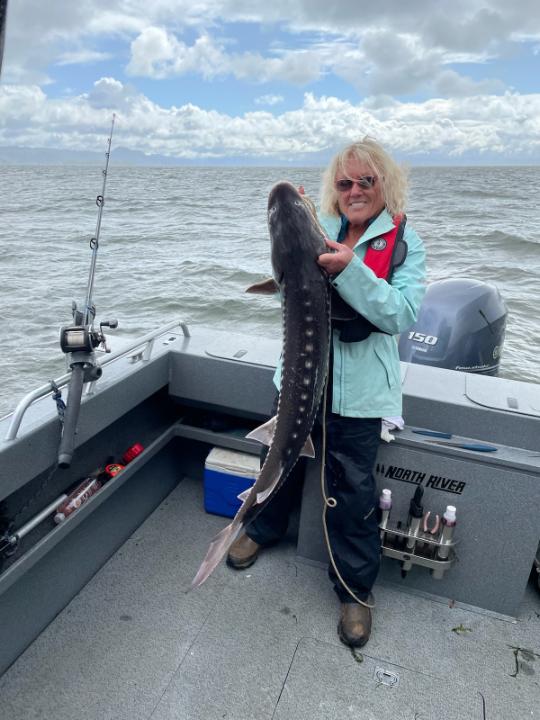
This will make for the fourth year in a row and eighth seventh of the last 13 that it will be catch-and-release only between Buoy 10 and Bonneville Dam, with managers pointing to a sturgeon population that’s essentially been turned on its head, with more adults and subadults than juveniles. For the first time in their reporting, they use the phrase “severe recruitment concern” to describe the situation.
From a fishery standpoint, legal-size sturgeon abundance remains depressed, with an estimated 90,100 38- to 54-inch fork-length fish in the lower river, a dip from 2024, and well below the 200,000-plus figures seen as recently as 2016 and 2020.
“The decline in legal-size abundance is primarily driven by reduced recruitment into the smaller portion of the legal-size range, with the lower sub-class (38–43 inches FL) now comprising only about one-third of legal-size fish. Juvenile sturgeon abundance reached its lowest level on record in 2025, representing less than 23 percent of the population and remaining well below conservation thresholds, indicating severe recruitment concern. Young-of-year monitoring in 2025 detected no recruitment in either the LCR or lower Willamette rivers (LWR), raising concerns about further declines in population productivity,” states the report.
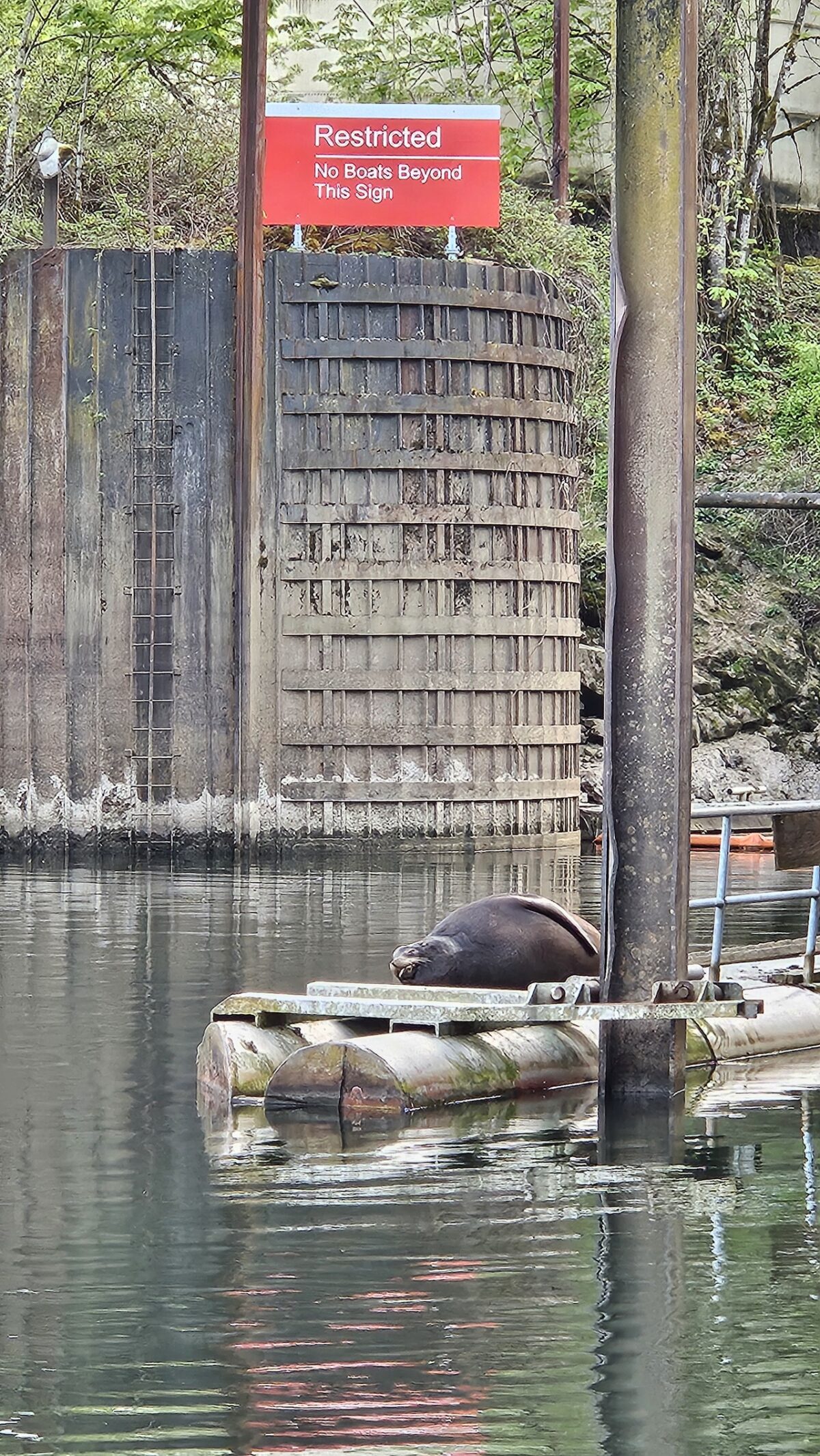
Pinnipeds – think sea lions, especially the larger Stellers – are “considered a substantial threat” to Lower Columbia sturgeon, according to the report. While Northwest states and tribes have continued authority to lethally remove a set number of individually identified sea lions, and fewer are preying on the long-lived fish at Bonneville, predation “appears to be increasing in other parts” of the Lower Columbia and lower Willamette.
Anglers and others are getting fed up with it, and a recent news story highlighted how Washington state lawmakers from both sides of the aisle and in both chambers of the legislature have cosponsored a pair of bills that would allow boaters to donate to a “Sea Lion Predation Control Account” when they register their jet sleds, drift boats and other watercraft.
And last month, Washington US Representative Marie Gluesenkamp Perez (D), who represents Lower Columbia and Columbia Gorge communities, jumped into a Congressional hearing to spotlight the relatively high cost of the lethal removals under the current onerous process – $38,000 per animal, she said – and to ask about “the viability of expanding direct-kill strategies and expanding take permit partnerships.”
According to the joint staff report, last year there were only 8,099 juvenile sturgeon, those from 21 to 27 inches long, down from as many as 406,920 in 2010, and 35,678 28- to 37-inchers, down from 503,066 in the same year.
On the flip side, the numbers of oversize, or over-legal, sturgeon – those above the maximum keeper size – have grown over the same time period. There were 10 times as many 55- to 65-inchers – 35,660 – and more than twice as many 66-plus-inchers – 23,673.
Theoretically, it’s a good sign that there are good numbers of spawners ready to get randy, but in practice it may not matter.
“… (Since) we have also observed a significant decline in juvenile sturgeon in the annual stock assessment, the lack of detectable recruitment in 2025 may indicate even more dramatic declines in population productivity than previously noted,” the report says as it also calls for more data.
Over the past three decades, state managers have created and expanded spawning sanctuaries where even catch-and-release fishing is banned from bank and boat during specific times of year, giving the fish temporary refuge from hooks.
Angler trips on the Lower Columbia system have also declined massively over the same period as seasons have been dialed back. Per the report, from 200,000 annually in the 1990s – a time of robust harvests and fisheries – to 33,000 in 2013 – the last year before a three-season keeper closure – to 4,100 in 2025, the third year in a row of catch-and-release-only fisheries.
Managers of course can’t really do that with sea lions except the immediate vicinity of Bonneville Dam and Willamette Falls.
In 2023, when this latest round of Lower Columbia keeper closures began, a WDFW sturgeon biologist postulated that not only were sea lions eating sturgeon, they were making their spawn less successful.
Marine mammals, of course, aren’t the only problem. The biologist also pointed to other population constraints such as hydropower operations affecting temperature and flow through spawning areas, prey availability, lag effect from past high commercial and sport harvest, and contaminants in the river system.
As for the 2026 Bonneville and The Dalles Pool keeper sturgeon fisheries, the traditional January 1 start of season was put on hold this year after high, fast catches last year. Managers have been advising to watch for an opener sometime later in winter, and the joint staff report pencils that timeframe in a little bit firmer.
“The expected opening of these fisheries is likely to be in February, when water temperatures are typically cooler and catch rates are expected to be slower,” it states.
The Dalles Pool – the only gorge reservoir to see an opener this month – closed after just nine days as its guideline of 105 fish was nearly full. Managers defended that move earlier in January.
Correction, 8:25 a.m., January 23, 2026: Because the wordmonger/editor can’t math straight, the number of years sturgeon retention will have been closed since 2014 in the Lower Columbia was initially miscalculated in this blog as eight. The correct number is seven. The river was closed in 2014, 2015, 2016, 2023, 2024 and 2025 and will remain closed in 2026. –Definitely Not Einstein