BY ANDY WALGAMOTT, NORTHWEST SPORTSMAN MAGAZINE
The invite to go spring Chinook fishing came at around 2 p.m. on Friday afternoon – the jinx about an hour and a half afterwards.
Bob Rees wanted to know if I could jump on his guide boat on the Lower Columbia on Saturday morning; my brother-in-law was looking for some salmon for Easter brunch.
The first was a no-brainer, and I hastily decided to do the vacuuming Friday evening to clear out a part of my weekend to-do list.
But knowing how iffy springer fishing can be even in this coveted first week of April and that Jeremy’s request had just made long odds even longer, I checked my remaining stash of last year’s fish, which otherwise was slated for the smoker, and wondered if I’d have to run to Safeway for some sockeye and hope nobody asked too many questions on Sunday.
Ahh, the angst … I have a little bit of PTSD about springers and family get-togethers.
Waaaaaaaaaay back when I first started chasing these fish, I brought a meaty filet from a Drano Lake or Wind River king to a May shindig at an aunt and uncle’s house. I can’t remember if it was Mother’s Day or Memorial Day, but I guess I assumed everybody would be dying to eat this delicious salmon I’d caught myself on a high-speed, 460-mile-roundtrip weekend dive bomb mission – on which I’d either thrown my shoulder out or trolled into mental oblivion, or both if I only had a boat ride lined up for one day – so I was mortified when my uncle threw a package of hot dogs on the grill alongside my springer.
I think this is where my disgust with hot dogs officially began.

The Friday afternoon report from Rees, who operates both a guide service and the weekly The Guide’s Forecast newsletter, as well as provides a monthly column in Northwest Sportsman, was that the day’s fishing was “not epic” and they had seen “just a few” others caught, but they’d also had two bites and there had been “some decent days down here.”
That was enough for me to, at the very least, want to battle my springer anxiety – for some reason with the Columbia spring Chinook fishery (and only this fishery), my body wants to puke the whole way on the drive to the ramp – and so I set the alarm for 3:50 a.m. Saturday morning.
AS THE SUN BEGAN TO RISE OVER Clatsop County’s very nice Westport launch, Rees pulled up to the transient dock, four of us stepped into his sled, and we headed downstream to anchor up in a little spot he’d found a while back.
It was – to my mind anyway – in surprisingly shallow water. With the tide still running out, the fishfinder read just 10 feet and would dip to as few as 6.9 feet over the ensuing hours. On the way to the spot we’d passed a couple hoglines as well as scattered other boats anchored up near shore, but it felt like we were set up inside of all of them.
The fishfinder also showed why Rees had chosen this location: Almost immediately we saw arches on the screen.
Initially, he rigged us up with plugs wrapped with tuna belly or sardine and what looked to be 6-ounce cannonballs on about 2- to 3-foot droppers, and which we ran out until the setups wouldn’t back any further downstream, about 26 to 32 feet or so on the linecounters.
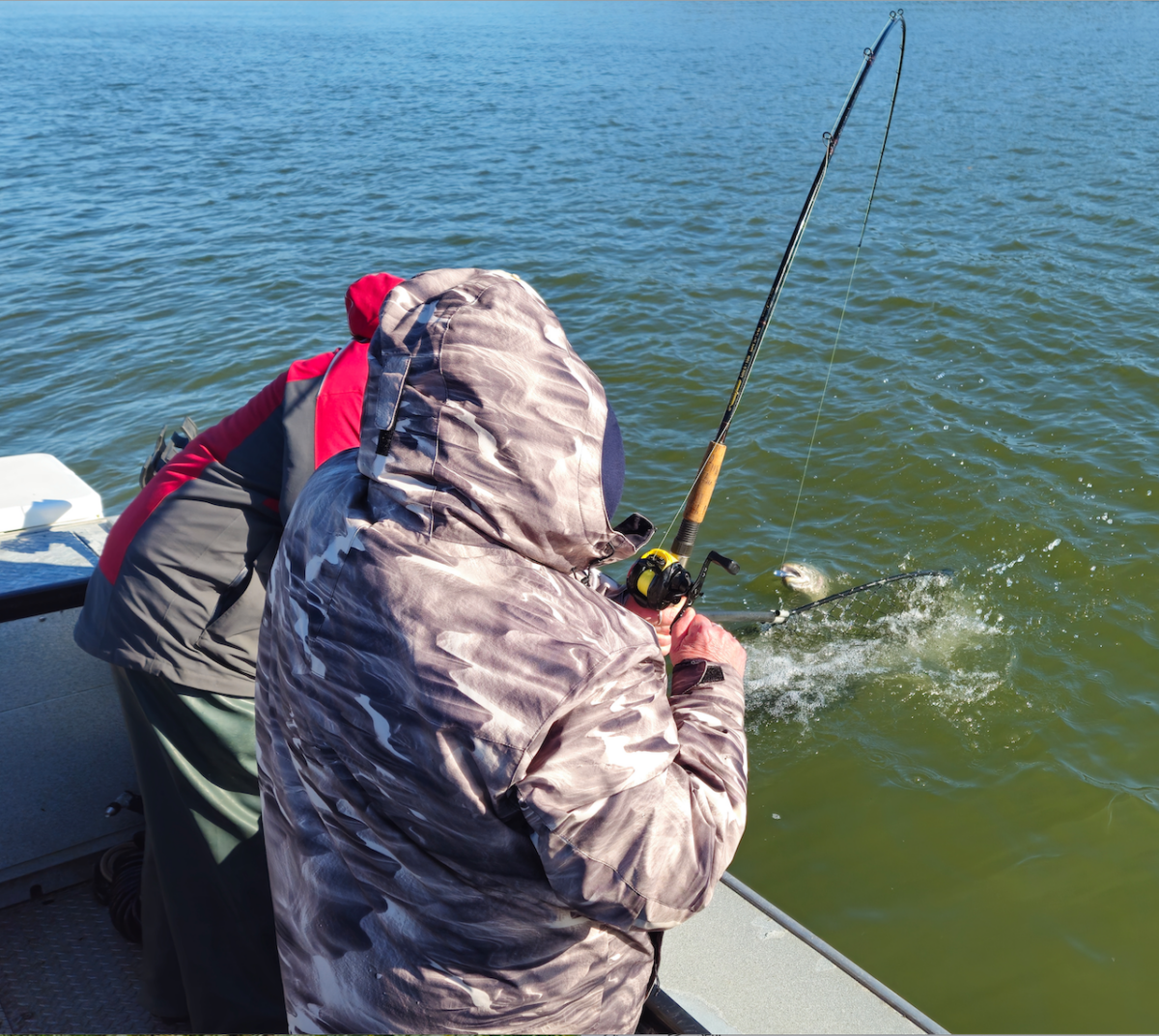
It wasn’t all that long before Dan’s Kwikfish got bit, and soon he was marking his paper tag with a nice hatchery springer. And not long after that, the super limber back rod set up with a flat-lined Mag Lip (if I recall correctly) went absolutely batsh*t crazy, and Dan’s wife Kelly recorded a fish of her own.
It was a great start to a gorgeous but very chilly morning in beautiful country.
THE FIRST WEEK OF APRIL IS PRIZED by anglers and guides alike because it’s usually when A) the fish start to arrive in force, and B) state managers begin getting fidgety about catch rates and the early season’s quota, and you never know if they’ll close it early or extend it, so you might as well go now.
This year, between the forecast, 30 percent runsize buffer and state-tribal allocations, there are 5,513 above-Bonneville-bound springers available in the March-April segment of the recreational fishery, which currently is scheduled to run through this Wednesday, April 8.
February’s preseason modeling suggested we would catch about 90 percent of that mark by midweek this week, but that seems less likely in the here and now.
This morning, Ryan Lothrop, the WDFW Columbia River manager, said that the last he’d heard last week was that there was “plenty of room” in the quota.
Part of that may be due to run timing – the fish just typically run in bulk over the dam in late April and May – and part of it may be due to river conditions this year.
In late March, fishermen began reporting increasingly turbid water on the mainstem Lower Columbia.
“Hurting the ability for fish to see our baits,” a Vancouver-based troller emailed me early last week after a third successive skunking.
Springer anglers watch what is known as the FNU, or formazin nephelometric units, count at the Vancouver USGS gauge. It had been in the 8 to 12 FNU range for much of last week, but then, right in time for the weekend, it spiked to 16 to 18 FNU – far higher than preferred.
“We really like fishing the Columbia when it’s 10 or less,” guide Brandon Glass told Outdoor GPS host Owin Hayes on Saturday morning from the Bachelor Island area. “So … we’re here because it’s a little shallower water and these fish might be pushing up closer to the shorelines, and … we got lucky and we got a nice fish in the box.”
Flooding such as last month’s high water on the Palouse, snowpack runoff from the Rocky Mountains and Cascades, and other factors drive visibility.
Meanwhile, the Willamette has been running a practically crystal clear 2 to 4 FNUs, which will serve to draw springer fishermen into the river and its slough and presumably dilute Lower Columbia catch and effort in these final days of the early season. The past three years have seen WDFW and ODFW carefully extend the mainstem season from two to four to six days, based on available quota, before closing it until the May runsize update.
But let’s switch from idle speculation back to actual fishing.

AS THE CURRENT GRADUALLY BECAME WEAKER and weaker, Rees went bigger with the Kwiks, which he continued to wrap with tuna bellies and sardines but ditched the droppers. These we ran out 60 feet. With the FNU readings, it made sense to be fishing so shallow; our gear wasn’t getting lost in the water column like it might if we were anchored out deeper.
Meanwhile, a guide friend of Rees’s pulled out of an upstream hogline, where he reported no action, and anchored up outside of us and ran out chartreuse plugs for his clients.
One of those plugs would make a surprise appearance at the surface in a fish’s face and on the opposite side of the boat from the rod it was deployed on. Did somebody way downstream lose a fish on a chartreuse plug? Wait, all of our plugs are chartreuse!
That was about the sum total of the excitement after our two early fish (there was another bite on the back rod, but it didn’t stick), so with the fishfinder showing the river was beginning to go back up with the start of the incoming around noon, Rees hauled out the trolling rods and set us up with whole herring behind triangles and those 6-ounce cannonballs.
As dark smoke from several local fire districts’ practice burn rose behind Skamokawa – my writer MD Johnson was among the volunteer firefighters on that drill – we put in a downstream pass, then picked up our gear and ran to the much shallower Clifton Channel.

There we essentially ran out twice as much line as depth, adjusting up if we ticked bottom.
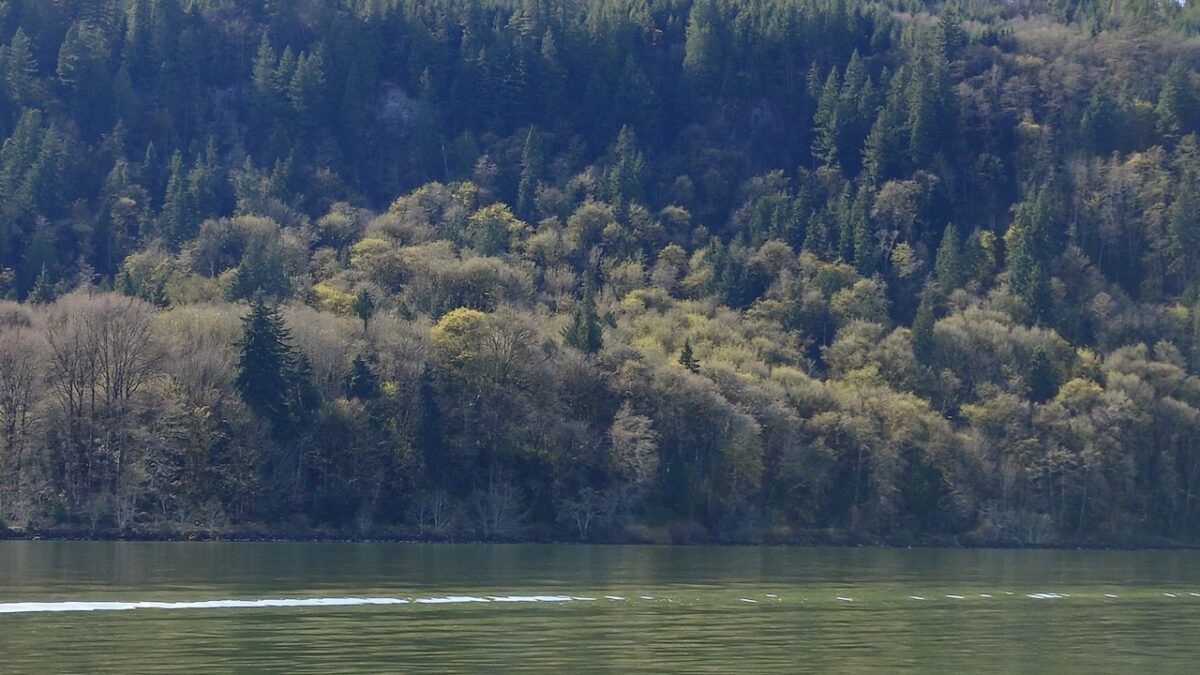
This was the first time I’d fished this particular stretch of the Lower Columbia, and I was stunned by the scenery (and geology). The first hints of green on the maples and alders above the former sawmill and cannery town of Clifton harkened me back to those days making the run to Drano and Wind. We would stop at the Cape Horn overlook on Highway 14 between Washougal and Skamania, and that’s where I first truly began to notice how the colors of the trees in spring are just as beautiful as they are in fall, but in a different way.
Ever since then I’ve tried to capture those soft greens in photos, and think I finally got a good one last year trolling on the Willamette above Sellwood Bridge.
Perhaps it was because I was reveling in this moment of the year over the decades, or perhaps because I was distracted by my phone and West Ham’s improbable two-goal comeback in second-half stoppage time against Leeds to level their FA Cup quarterfinal, or perhaps the faux pas/shame of grabbing a herring rod too early was on mind, or all three at once, but the springer that bit right then got away and I sat back down pretty sure I’d blown my one chance for the day.
Jeremy and his damn jinx!!

But on the next pass there was no question about the bite; the only questions were, would it be wild; would yours truly lose it and have to opt for last year’s fish for brunch; or would springer be on the menu after all?
You can guess how this story ends, and yes, the fish competed very well against Jeremy’s scrambled eggs, artisan bread and leberwurst, and waffles also on Easter offer. Mine was the only thing completely eaten at that outdoor table; the bald eagle that soon landed in a nearby treetop was out of luck.
(Eventually as a father, I realized that my uncle all those years ago had been very wise to put hot dogs as well as burgers on his grill, because not everybody likes or trusts fish, and that’s fine too; more for me.)
That springer also put some time back onto the clock of Rees’s previous 45-minute warning and we trolled some more in hopes of putting Aaron into one too.
Some gents at the top of the troll tied into one, for which a sea lion made a beeline; from the sound of it, I think they won the race, and that fish was one of three others I believe we saw nets for over the course of the day.
Afterwards, what might have been that same sea lion, or another marine mammal (or something else entirely) showed up on the fishfinder for a long stretch, presumably giving our gear a check before swimming off.
SOMEWHERE AROUND 3:30 P.M. REES called it a day, and so we stripped off the baits, ran the long herring leaders around the reels and slotted the hooks into the droppers’ duolocks, and lockered the rods.
Back at the Westport dock, the fish checker told me the score was seven fish for 27 boats as she headed toward Rees’s sled, which would raise those figures to 10 for 28. Overall, we went three for five.
As this workweek begins, tallies from other ramps and beaches up and down the 146 miles of the Lower Columbia are being put together. Managers will also receive effort count data from Saturday’s overflight of the fishery, which anecdotally will also tell them where anglers are congregating and what tributaries are muddying up the system, per ODFW’s Jeff Whisler.
“We won’t see the formal estimate until Tuesday to see how the weekend played out,” Lothrop, the WDFW manager, said this morning.
What I can tell you is how the rest of the weekend played out at the Walgamott house.
True, those tail and belly cuts went down well at my brother-in-law’s brunch, but he didn’t get all the good stuff. No sir. Last night’s grilled Chinook bites paired very nicely with another one of spring’s greens – fresh asparagus straight out of my garden.
Here’s hoping the Columbia, Willamette and my soil, produce a few more dinners like that this season.